Friday, April 08, 2022
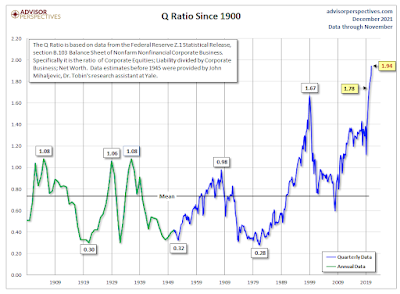
Tobin's Q: The q ratio
Friday, March 25, 2022
Thoughts #27: Scams and Counterparty Risks
Human civilization has progressed so far that we sometimes give a lot of the benefit of the doubt to be trusting. We buy bottled water, packaged food trusting it is all good. We buy things off the internet like nobody's business today, trusting that our purchased goods will arrive at our doorsteps tomorrow or at worst, in a few days.
It was not always like this. We have become too trusting and there are scammers out there who are getting really good at scamming in this unique era of ours. Scammers existed throughout history and we simply must always be vigilant. Our parents and older friends and relatives are also usually more vulnerable.
This post is a reminder that sometimes the most important risk is simply the other party or platform across the table. It could also be people we are supposedly working together with. If we have a counterparty who is helping to transact, can we trust him or her? Are we using a reputable broker? Is the Bitcoin exchange setup certified by the MAS? Can we trust the property agent, or the supposed seller/owner of the property? These are simple things that we should make sure that we do not overlook.
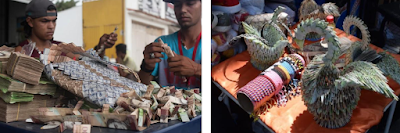
Scams are also everywhere. Some are easy to spot but others may not be so. Bernie Madoff structured his Ponzi Scheme for almost 40 years and no one found out because he was so good at covering his tracks. Jho Low pulled off the 1MDB by registering similar sounding company names. Internet scams are everywhere, so it's better to just buy from the big platforms rather than to try to save 20%.
Needless to say, when we are buying big ticket items, like a luxury watch, a car, or a house, then it makes even more sense to be beware of scams and counterparty risks. We need to double and triple check that everything is in order. A good friend shared this with me some time back:
"When you are about the part with your money, think again and double check. Pay half or 1/3 first if necessary. Things will change when money has been transferred"
Caveat Emptor!
Friday, March 11, 2022
Books #17: Value Investors by Ronald Chan
I read an interesting book in 2021 simply called, "The Value Investors" by Ronald Chan. Well the full title is apparently - The Value Investors: Lessons from the World's Top Fund Managers.
This book is unique as it introduced the many value investors that we may know but had never been featured prominently. People like Irving Kahn, Walter Schloss and a few Asian value investors including Singapore's own Teng Ngiek Leng, founder of Target Asset Management.
There were many snippets and many lessons. I find the Asian lessons particularly useful as I could relate better.
Teng shared the importance to be flexible and be contrarian. This was echoed by Howard Marks who famously coined Second Level Thinking, which needs to be different but better. But Teng was able to connect that with his Asian experience, which brings the point home in a unique perspective for me. Another Asian value shared about the importance of knowledge and focus. We can only capture opportunities with knowledge which we have gained with a lot of experience and focus which is required because the opportunity will pass quickly in the markets. Otherwise, opportunities are simply easily missed.
One of the best quotes was from another Asian investor:
I believe that every human being has an artistic gene and in his or her lifetime can create at least one masterpiece that is globally competitive. However, to become a professional, you need to replicate your talent again and again if you are to have more than one masterpiece. It is the same as investing. You can be passionate about it but if you want to become a professional investor, you need to develop a system and have the talent to find good investments repeatedly.
Overall, a great read, do pick it up in 2022!
Thursday, February 24, 2022
Ukrainian War and Peace
A few hours ago, Russia decided to do the unthinkable which is to invade Ukraine when the world is still nursing itself from the disruption caused by the pandemic. It was reported that Russian forces poured into Ukraine from multiple locations and lives had already been lost on the battlefields. Global markets collapsed with major European markets falling 5-6% as we speak. Russia's own stock market fell 30%!
Oil prices which went negative $40 last year at the height of the pandemic is now at a multi year high of $105. This is the crazy world that we now live in. Imagine if we had bought oil at -$40 last year and now we can sell at +$100! How does the return calculation even work?
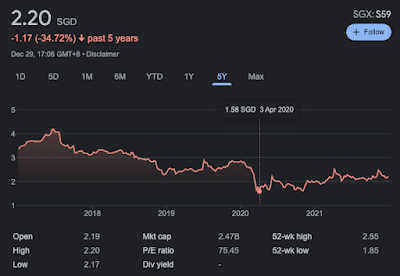
Meanwhile, individual stocks are badly hit. In Singapore, index names like banks fell as global investors take risks off their portfolios. Air travel related names got their second punch in the face (the first being the pandemic) and fell a good 4-5%. Food Empire, with its core business in Russia fell close to 6%. Only oil related names did well given the rally in crude.
It is unclear what is Putin's play here. Does he want to leave a legacy, be remembered as the Russian leader who united Ukraine and the ex-USSR nations? Or he simply wants to use this opportunity to stir shit, play geo-politics and stay in office for as long as possible? Or is it really pre-emptive because if Ukraine joins NATO, then Russia will see dark days with NATO at its doorstep and surely he doesn't want to be judge by history as doing nothing when that happened.
However, it is said that this war will cause at least 50,000 lives. Already, hundreds of soldiers and a few civilians have died. So what is the math here? 50,000 lives and thousands of Ukrainians and Russians suffering and all the sanctions that will come with the invasion (which will cause even more suffering for the rest of Russia) is worth Ukraine not joining NATO and Putin's legacy not getting tarnished?
Well, let's leave the moral questions aside for now. What can investors do about the current situation?
As with most crises, this would turn out to be a buying opportunity if we have the stomach for the volatility ahead. We have gone too far down the QE addiction that any decline will be supported by governments to devalue fiat currencies, thereby inflating the values of stocks, investments and other assets. However, if war breaks out in the same magnitude of WWI, then we are in a different regime. We shall revisit this doomsday scenario later.
It is worth noting that quality stocks are not falling as much as the high beta names. For example, amongst the European stocks that I track, weak names like Bayer and Rolls Royce are collapsing while stronger names like Diageo and Adidas are holding up much better. In Singapore, similarly stronger names like Singtel and SGX did not fall as much as Venture and the Jardine names (see table above). It also seemed that we are not seeing real capitulation yet, so the bottom may come only next week or the week after.
This is a good reminder that we should always stick with strength and quality. These stocks are boring but precisely in times like this that we don't lose sleep agonizing over why they are falling like rocks. Although I must emphasize that the heydays of Singtel could be over. It is on its way to become a dumbpipe. Also, I did recommend Jardine Cycle and Carriage as a holding but it's not in the same league as SGX and Diageo, for sure. So, sometimes we just have to stomach the volatility that comes with some of these higher beta plays.
Of course, if this escalates to full blown war, then no amount of buying on dips can help. I have held the view that we always face a remote possibility that all that we know about modern finance and money can be gone one day. During the GFC, we came close to that. I am talking about the breakdown of the global financial system, all our savings in the banks gone and fiat currencies no longer hold any meaning. If this war escalates to something like WWI, then that nightmare scenario comes back.
Therefore, I have always advocated that we should hold some tangible assets like gold, luxury watches, jewellery and things that are outside today's financial system that can retain value. Hence I also have changing thoughts on Bitcoin which I hope to blog about as well. However, Bitcoin bought at crypto exchanges are still part of the system so you do need to get the Bitcoin into a cold wallet and keep it safe. The other important asset is real estate. But you need to have at least two. One to stay in and the other to sell when savings run out in a protracted war.
Let's hope we don't get there and let's pray for the people in Ukraine now. I am sure Putin is not thinking of escalating the situation to a world war and let's hope the world can find some resolution and avert this nightmare and we can look back in a year's time and feel smart that we bought into the market courageously next week, or even this week.
Huat Ah!
Monday, February 14, 2022
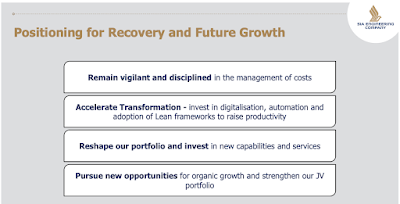
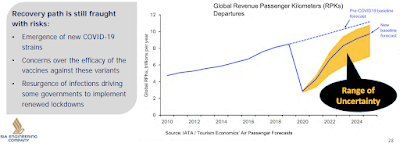
Revisiting SIA Engineering
Tuesday, February 01, 2022
Charts #43: The World
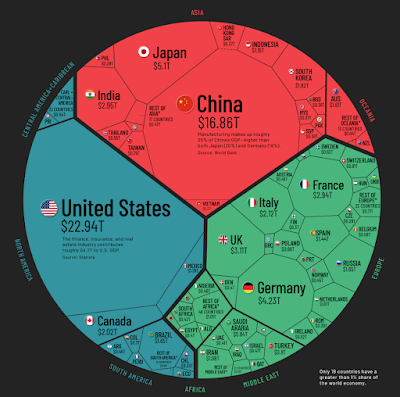
I check in with visual capitalist once in a while. I would recommend all investors do the same. This chart is worth scrutinizing and see how it will change 10 to 20 years from now.
Jim Rogers famously said the 21st Century belongs to Asia. Well, look like we still need to grow. We are counting on India now!
Do check out the visual capitalist, they are awesome!
Happy Chinese New Year, huat ah!
Saturday, January 15, 2022
Books #16: The Man Who Solved the Market
The Man Who Solved the Market is one of the best books I have read in 2021. This is the story of Jim Simons, founder of Renaissance Technologies, the world's most successful and most secretive quant fund. Even after the book is published, nobody knows exactly how Renaissance made so much money. The table below from the book says it all.
These no.s are net of fees and the annualized returns before fees are above 50%, which means doubling the capital every 18 months or so. When so much money is being made so fast, it is no wonder the whole Renaissance team doesn't want anyone else to know the secret sauce nor are they interested in sharing.
So we can only speculate how things actually work.
The details are scant. The book shared a couple of facts:
1. You need a lot of data for quant models to work and as such there are thousands of trades implemented at any point. Every trade is analyzed. It took decades before the team perfected their trading wins.
2. Trades at tested using mathematical / quantitative models, looking for correlations and robustness. Trades are based on math theories that may not have anything to do with economics or business fundamentals. Renaissance doesn't look for relevance or explanations.
It works because there are always anomalies that continue because humans are simply not rational. One of the most simple ones are traders and fund managers closing trades at the end of week or month, Renaissance takes advantage of that and reap the small returns by taking the other side. But most of time, according to people quoted in the book, they cannot explain fundamentally why some trades work, but that is okay.
The other revelation is that only slightly more than 50% of the trades are profitable. Although it is not stated in the book, it means that one the most important rule in trading - cutting losses, works. I learnt it while reading about the turtle traders. Their rule: as long as you cut loss at say 2% and let your profits run at double of that i.e. at 4% and above, you can win even if you only win 50% of the time.
Besides getting the taste of the secret sauce, or rather more of a whiff of smelling it, what is also interesting is how the book weaved the whole history of the financial markets for the general reader. It talked about the turtle traders, the 1987 Oct crash, George Soros vs the Bank of England, LTCM, a few flash crashes caused by quants over the last two decades, needless to mention - the GFC and all the other important financial moments over the last 60-70 years.
That was really just nostalgic for me and perhaps very educational for new students of finance.
It is worth noting that LTCM tried to do what Jim Simons did and blew up. So, in essence, Jim was the successful LTCM and when he succeeded, he stay hidden so that his team can continue to reap the profits from the anomalies. There is some value in maintain secrecy when you do have an edge as exemplified by Renaissance, KFC (Colonel Sanders' secret recipe), Coca Cola and famously in Japan: FANUC, the company that invented the numerical controllers for machine tools and robots.
The last bit of the book talks about how Renaissance employees managed to influence politics. Notably, one of the key staff allegedly supported Trump and got him into the Oval Office using his money and influence. It is a testament that big money is so powerful that it can decide politics and impact our lives.
Sunday, January 02, 2022
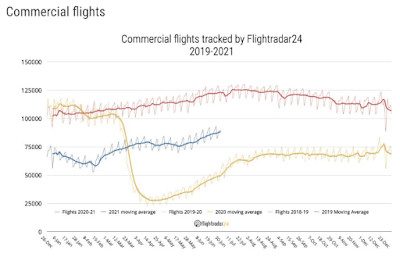
COVID-19 to Omicron: Three Years On
Saturday, December 25, 2021
Berkshire Hathaway in 2020-21
I have invested in Berkshire Hathaway for a decade or more based on the most simplistic investment thesis: this is Warren Buffett's company and he is the world's greatest investor. There was very little further due diligence after that. So is this investing or speculating?
Wednesday, December 15, 2021
Charts #42: Offshore Wind
This is an interesting chart from the Economist last month. Optimal offshore wind locations are at a certain latitude and we just need to build 500k offshore wind turbine to contribute to 7.5% of global energy output.
Well, we are not starting from zero, we have 7,000 today. And to power the whole world, we just need to 7 million wind turbines at these optimal locations.