Showing posts with label Books. Show all posts

Thursday, July 20, 2023

Books 20#: Play Nice But Win

Michael Dell depicted his life story in this riveting book starting from his high school days to his battles with Carl Icahn and finally the birth of Dell Technologies, a USD36bn market cap company today. It was an eye-opening journey into the world of private takeovers, corporate sabotage and how to play nice but win. This book really resonated with me and hence this post to detail my takeaways.

1. Form your team

This is a lesson that most leaders would know. You cannot do much alone. Even Superman needs the Justice League and we have to assemble our own Avengers team to take on the world. Not just any team, but the Avengers team, the best people you can find. Early on in Dell's journey, he sought out people who can help him and that was how he kept scaling and grew Dell Technologies to what it is today.

2. Persistence

In Michael Dell's words, this is the all-important quality and we must always persist and not be defeated by failures. He kept mementos to remind him in bad times how fortunate he was and that kept him going. We give up too early sometimes and that happens a lot with younger and younger generations. I think this is a good reminder for everyone to simply persist.

3. Dell Process

Somewhere in page 284, Dell talked about a proven Dell process, when faced with difficult decisions, lay down the Facts and Alternatives and then decide on the Choice and Commit to it. These are simple truths but in our busy lives today, we tend to just forget and decide base on emotions and other trivialities. 

In my own experience, it is very much about discussing with other smart thinkers. All my bad investment experiences were made alone. I thought it was a good idea myself and went ahead and bought and sold stuff. Only to suffer the consequences. Somehow, for me, talking to people clarifies most things and allow for better decision making. As such, it is important to cultivate a good decision making process, just as Dell did. He even said it is proven! Q.E.D.

4. Play Nice But Win

The most riveting parts of the book has to be his battles with corporate greenmailer Carl Icahn. When facing adversaries, all the above comes in. You need a team, you have to be persistent and you need a good process. Dell fought hard and finally triumph and he did play nice and win. It is not easy because most people don't play nice. If you do, you are playing with one arm tied behind your back. But it is possible. Michael Dell proved it. Just so hard that most people give up. 

That said, Play Nice But Win is a motto that really resonates. Difficult to achieve but the victory that comes afterwards makes it that much sweeter. 

Huat Ah!


Friday, March 17, 2023

Books #19 - Elon Musk

I just finished reading Elon Musk: Tesla, SpaceX and the Quest for a Fantastic Future which was first published in 2015 but updated recently to provide readers with the most up-to-date information. The author Ashlee Vance is an amazing writer. Even though the book was few hundred pages which usually takes me a few weeks to read. I devoured it in days. 

Much of Elon Musk is well known and I struggled to see how I can add new perspectives. As such, this is more of a reflection piece for myself. Hopefully, you can find some nuggets of insights here and there.

1. Elon Musk is a Genius and a Jerk

Intuitively, we probably know he is super smart but only after reading the book then it dawned upon me that this guy is probably at a different level compared to most other guys we tend to compare him with. For one, he is running two companies as the book was written and running three now as we speak.

Well, we know that smart people have big egos and are either born jerks or become jerks. Everyone of them is divorced. Jeff Bezos, Bill Gates, Steve Jobs, Warren Buffett, Robert Kwok, Sergey Brin. 

You name it. Every single one.

So Elon is probably the biggest jerk of them all. He had an affair with his best friend's wife and resulted in Sergey's name being on top. Goodness... (pic below). Of course, what Sergey did to piss his wife to sleep with others is not known. 

Sleeping with best's friend's wife...

But jerks do push humanity forward. This post cannot be written without my iMac and no additional research could be done without Google.

2. Space business may have some economics

I never understood the space business. To me, it was just concept. How can the ROIC be great for businesses that require so much capex, R&D with no demand? I am still skeptical but SpaceX shooting up hundreds of satellites and using space technology for commercial applications might become big. 

SpaceX satellites are being used in the Ukraine-Russian war. War generates business (bad business though) and brings in money. That said, there are all kinds of commercial applications, including internet, satellite imagery etc.

3. Life is about Luck

The statement above is universal. You don't have to read this 400 page book to know. Well, Elon is tremendously lucky. Tesla could have gone bust multiple times. The same could be said for SpaceX. But he was saved, so many times. It does not mean he does not have skill. Obviously he has, more than anyone today.

But for so many things to come together, you cannot deny luck.

There are people who have enough skill but never the luck to pull off anything. There are people who has not much of any skill but become big, maybe we can put Donald Trump, Jack Ma and Masayoshi Son in that category. Feel free to disagree, you are entitled to have your opinion and so am I.

But Elon Musk just has both. 

Huat Ah!

Thursday, January 05, 2023

Books #18: Security Analysis - Part 3

In this last post on Security Analysis, we would discuss some of the difficulties analyst faced when analysing stock then and now. The authors have put some thoughts out elegantly which is worth studying here. Here are a few lines from the book, including one of the most famous line in full and in bold:

The market and the future present the same kind of difficulties. Neither can be predicted or controlled by the analyst, yet his success is largely dependent upon them both. The major activities of the investment analyst may be thought to have little or no concern with market prices.

The market is not a weighing machine, on which the value of each issue is recorded by an exact and impersonal mechanism, in accordance with its specific qualities. Rather should we say that the market is a voting machine, whereon countless individuals register choices which are the product partly of reason and partly of emotion.


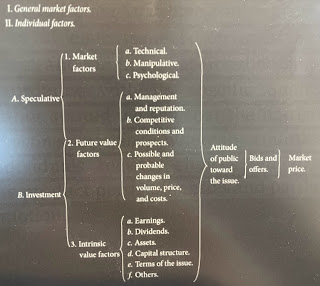
Alongside the famous line on the marketing being a voting machine, the authors also lay out this chart above to try to decipher what goes into determining market price. In short, there are so many things that make prices unpredictable in the short-term but yet it is the stock analyst's job to understand everything because in the long term, analysis of the business and its earnings power makes the difference.

Short term prices are also inexplicable but Wall Street wants actions and will explain for it, regardless whether the explanations are justified. This remains one of the hardest job of the day even for seasoned investors - to explain price action fo the day. Sometimes, stocks jump 5% for no reason and we only figure it out over the next few days.

Again, here are lines from the authors themselves:

The exaggerated response made by the stock market to developments that seem relatively unimportant in themselves is readily explained in terms of the psychology of the speculator. He wants action, first of all; and he is willing to contribute to this action if he can be given any pretext for bullish excitement (whether through hypocrisy or self-deception, brokerage-house customers generally refuse to admit they are merely gambling with ticker quotations and insist upon some ostensible reason for their purchases.) 

Stock dividends and other favorable developments of this character supply the desired pretexts, and they have been exploited by the professional market operators, sometimes with the connivance of the corporate officials. The whole thing would be childish if it were not so vicious. The securities analyst should understand how these absurdities of Wall Street come into being, but he would do well to avoid any form of contact with them.

As such, in order to profit from stock investment, we come back to valuation. We cannot win trying to profit from short term market movement. The only logical way to win is to determine the intrinsic value of the stock and buy with sufficient margin of safety. The following paragraph, the authors cautioned that general market conditions ie beta sometimes overwhelm everything so we need to be careful.

Investment in bargain issues needs to be carried out with some regard to general market conditions at the time. Strangely enough, this is a type of operation that fares best, relatively speaking, when price levels are neither extremely high nor extremely low. The purchase of "cheap stocks" when the market as a whole seems much higher than it should be will not work out well, because the ensuing decline is likely to bear almost as severely on these neglected or unappreciated issues as on the general list. 

On the other land, when all stocks are very cheap, there would seem to be fully as much reason to buy undervalued leading issues as to pick out less popular stocks, even though these may be selling at even lower prices by comparison.

On valuations, it was refreshing to see that the authors did lay out something concrete and also attributed the development to a certain Roger Babson (pic above), whom I didn't know who he was but apparently someone famous back then. The following is his rule of thumb:

The multipler might be equivalent to capitalizing the earnings at twice the current interest rate on the highest grade industrial bonds. The period for averaging earnings would ordinarily be seven to ten years.

In short, if the bond yields are at 3-4%, then earnings yield should be double of that at 6-8% and we should use the averaging earnings over 7-10 years. So we come back to why we should always buy stocks trading at teens price earnings, which can be difficult in today's context, so I would carefully stretch that to low twenties. 

Last but not least, here's their words on wisdom on trading. In trading, there is no margin of safety, you are either right or wrong and if you are wrong you lose money.

The cardinal rule of the trader that losses should be cut short and profit safeguarded (by selling when a decline commences) leads in the direction of active trading. This means in turn that the cost of buying and selling becomes a heavily adverse factor in aggregate results. 

Friday, October 21, 2022

Books #18: Security Analysis - Part 2

This is one of those long awaited sequel post as we took time to discuss T bills and dividend stocks given the interesting market movements in the recent months. As mentioned in the past post, Security Analysis is this seminal book which provides good lessons for any investors but it's a bit difficult to read. But we can still learn a few lessons from it.

As promised, let's discuss the financial shenanigans and bad management which happened then (i.e. c.1920s) and will still happen as long as humans are greedy. As the gurus put in, the financial statements that will uncover financial shenanigans are usually the balance sheet and the cashflow. The P&L statement is the most straightforward and since most laymen can read it, shrewd management will not screw that up. 

The balance sheet and the cashflow statements require more financial knowledge and it is the balance sheet that is used to hide the bad stuff. As such, the authors of Security Analysis warned against bloated balance sheets. By bloated, we are referring to account receivables, other assets, other liabilities and lines in the balance sheet that is used to hide the bad stuff. 

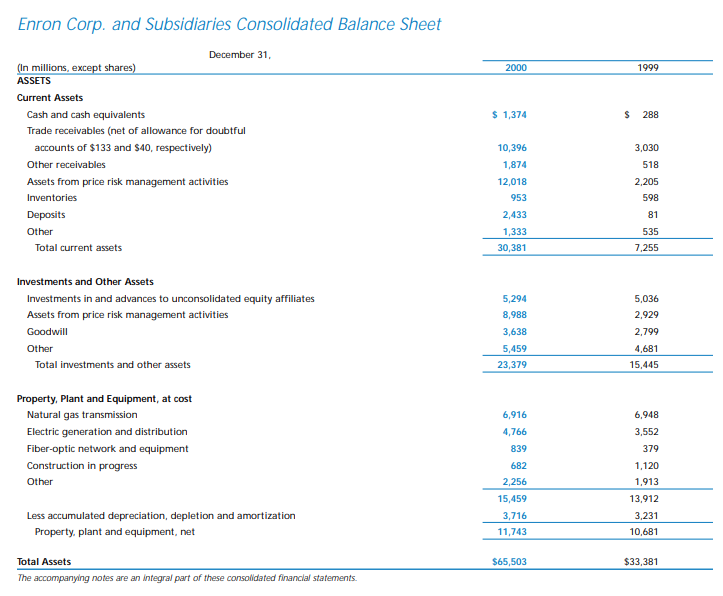
Most of the time, it is not easy to uncover because bad management has gone all out to hide stuff. I managed to find Enron's balance sheet in year 2000 online. Without hindsight, it is not easy to say things are wrong. The lines - "asset from price risk management activities" were where most of the bad was parked under, USD21bn worth of it, but management made so much effort to explain it so well that it's difficult to fault analysts for not being able to figure things out. 

Bad management will never admit that they are bad so sometimes, in the end, it really boils down to gut feel. I have written about this on various posts in the past: Billon Dollar Whale Fraud Detection Lessons and Theranos, the fraudulent startup. To jot down a few tell-tale signs:

1. Bloated balance sheet, what we have we talking about so far

2. Keep talking about importance of secrecy, trade secret and know-how, trademark protection to mask the lack of disclosure

3. Lack of governance

4. Past issues with the law, including ongoing litigation.

As a side note, companies with litigation risks should also be avoided because the cost is simply to hard to measure. We discussed BP and Bayer in the past on this infosite. Both names did not recover past their previous peaks after the litigation mess broke out. BP was the infamous Deepwater Horizon accident and Bayer was ensued in the supposedly cancer causing Roundup fertilizer class action lawsuits.

In the next and final post, we discus other lessons learnt from Security Analysis.

Huat Ah!

Thursday, June 02, 2022

Books #18: Security Analysis - Part 1

I finally finished this seminal book after reading for almost three years. It was simply too dry and too painful so I used it mostly as a sleep catalyst: i.e. I read it when I cannot sleep. Usually, I don't get pass a couple of pages which was why it took three years. 


To be honest the book was marginally helpful. It was written so many years ago that a lot of the case studies are now unrelatable and the whole section on fixed income was simply too technical. I can understand why Benjamin Graham wrote The Intelligent investor. So that his philosophy can be more easily understood by to the layperson. It was definitely a better read.

That said, the book was seminal because it introduced all the original value investing concepts. It described the original thinking about stocks, it popularized valuation methodologies, how we should look at financial records for at least 7-10 years and how we should think about management of companies. 

The biggest revelation was that most of the lessons learnt about financial shenanigans that were applicable then were applicable now. Human nature doesn't change and that is always at the crux of investing. In the end, investing is the ultimate battle of wits against a million other chess players. Here's a quote by Seth Klarman that just rings truth all over:

The real secret to investing is that there is no secret to investing. Every important aspect of value investing has been made available to the public many times over, beginning in 1934 with the first edition of Security Analysis. That so many people fail to follow this timeless and almost foolproof approach enables those who adopt it to remain successful. The foibles of human nature that result in the mass pursuit of instant wealth and effortless gain seem certain to be with us forever. So long as people succumb to this aspect of their natures, value investing will remain, as it has been for 75 years, a sound and low risk approach to successful long-term investing. 

Next up, we look at some of the original valuation methodologies and financial shenanigans!


Friday, March 11, 2022

Books #17: Value Investors by Ronald Chan

I read an interesting book in 2021 simply called, "The Value Investors" by Ronald Chan. Well the full title is apparently - The Value Investors: Lessons from the World's Top Fund Managers. 

This book is unique as it introduced the many value investors that we may know but had never been featured prominently. People like Irving Kahn, Walter Schloss and a few Asian value investors including Singapore's own Teng Ngiek Leng, founder of Target Asset Management. 

There were many snippets and many lessons. I find the Asian lessons particularly useful as I could relate better.

Teng shared the importance to be flexible and be contrarian. This was echoed by Howard Marks who famously coined Second Level Thinking, which needs to be different but better. But Teng was able to connect that with his Asian experience, which brings the point home in a unique perspective for me. Another Asian value shared about the importance of knowledge and focus. We can only capture opportunities with knowledge which we have gained with a lot of experience and focus which is required because the opportunity will pass quickly in the markets. Otherwise, opportunities are simply easily missed.

One of the best quotes was from another Asian investor:

I believe that every human being has an artistic gene and in his or her lifetime can create at least one masterpiece that is globally competitive. However, to become a professional, you need to replicate your talent again and again if you are to have more than one masterpiece. It is the same as investing. You can be passionate about it but if you want to become a professional investor, you need to develop a system and have the talent to find good investments repeatedly.

Overall, a great read, do pick it up in 2022!


Saturday, January 15, 2022

Books #16: The Man Who Solved the Market

The Man Who Solved the Market is one of the best books I have read in 2021. This is the story of Jim Simons, founder of Renaissance Technologies, the world's most successful and most secretive quant fund. Even after the book is published, nobody knows exactly how Renaissance made so much money. The table below from the book says it all.

Jim Simons vs all gurus

These no.s are net of fees and the annualized returns before fees are above 50%, which means doubling the capital every 18 months or so. When so much money is being made so fast, it is no wonder the whole Renaissance team doesn't want anyone else to know the secret sauce nor are they interested in sharing. 

So we can only speculate how things actually work.

The details are scant. The book shared a couple of facts:

1. You need a lot of data for quant models to work and as such there are thousands of trades implemented at any point. Every trade is analyzed. It took decades before the team perfected their trading wins.

2. Trades at tested using mathematical / quantitative models, looking for correlations and robustness. Trades are based on math theories that may not have anything to do with economics or business fundamentals. Renaissance doesn't look for relevance or explanations.

It works because there are always anomalies that continue because humans are simply not rational. One of the most simple ones are traders and fund managers closing trades at the end of week or month, Renaissance takes advantage of that and reap the small returns by taking the other side. But most of time, according to people quoted in the book, they cannot explain fundamentally why some trades work, but that is okay.

The other revelation is that only slightly more than 50% of the trades are profitable. Although it is not stated in the book, it means that one the most important rule in trading - cutting losses, works. I learnt it while reading about the turtle traders. Their rule: as long as you cut loss at say 2% and let your profits run at double of that i.e. at 4% and above, you can win even if you only win 50% of the time. 


Besides getting the taste of the secret sauce, or rather more of a whiff of smelling it, what is also interesting is how the book weaved the whole history of the financial markets for the general reader. It talked about the turtle traders, the 1987 Oct crash, George Soros vs the Bank of England, LTCM, a few flash crashes caused by quants over the last two decades, needless to mention - the GFC and all the other important financial moments over the last 60-70 years. 

That was really just nostalgic for me and perhaps very educational for new students of finance.

It is worth noting that LTCM tried to do what Jim Simons did and blew up. So, in essence, Jim was the successful LTCM and when he succeeded, he stay hidden so that his team can continue to reap the profits from the anomalies. There is some value in maintain secrecy when you do have an edge as exemplified by Renaissance, KFC (Colonel Sanders' secret recipe), Coca Cola and famously in Japan: FANUC, the company that invented the numerical controllers for machine tools and robots.

The last bit of the book talks about how Renaissance employees managed to influence politics. Notably, one of the key staff allegedly supported Trump and got him into the Oval Office using his money and influence. It is a testament that big money is so powerful that it can decide politics and impact our lives.

Tuesday, October 05, 2021

Books #15: Bill Gates' How to Avoid a Climate Disaster

I picked up this book without much expectations. After all, so much has been said about climate change, is there anything new? Bill Gates was the world's richest man, still a billionaire and recently more of a philanthropist, how much did he know about climate change? What's more, his womanizing history caught up with him and he got divorced! So, can we actually trust this guy?

Well, I have also learnt some time back to think about the message. Brilliant truths are not about the messengers. Of course, someone respected and credible saying something is always the gold standard. But there are intrinsic truths utter by liars that will nevertheless remain true. As a simple example, if Donald Trump says Ï€ equals to 3.14159265, it is still true. Despite the speaker having a track record as a recalcitrant liar.


Bill Gates is not a liar. He has no reason the write a book about some topic that already has so much publicity. At a time when he is having trouble with his wife! So, let's pay attention to his message. As such, I wanted to put this down for future readers and for myself to remember the important message.

I believe there are three key takeaways:

1. Big numbers to define the problems

2. We must do something now, if not the problem gets bigger.

3. The solution is to reduce the green premiums to zero.

Bill Gates, being a geek, likes to throw out a lot of numbers and as investors, we should take note. Numbers are important. So these are the important numbers:

51 billion tonnes of carbon. Humans produce this every year and we need to get this to zero. 

The world needs of the current electricity generation capacity of 5,000 GW to be from renewable and zero-carbon sources. If we want to achieve this, it will take a lot innovation and willpower. He also believes we need to use more nuclear power.

On the second point, it's really self explanatory. A stitch in time saves nine. If we don't do it now, the problem gets bigger and it may become intractable. I did not remember if the number came from the book. But roughly speaking, if we don't do anything now, the cost to do something 10 years later will be 10x higher and we are talking about trillions of dollars here!

The last point on green premium is really the core of the book. For almost all situations, the zero-carbon solution will cost more. The point is to reduce the green premium to zero. There are examples that this has been achieved. For example heat pumps to regulate temperature in buildings. If we innovate and use technology to reduce green premiums, we can incentivise the world to go green faster. 

This is definitely a book worth keeping. Hope to read again if there's time. 

Huat Ah!


Sunday, August 01, 2021

Books #14: Daniel Pink's When

I have read two books written by Daniel Pink. Both were simple and good. The recent book was simply title When. This is a book telling us to be mindful of time and think a bit more how we should use it when. There were many gold nuggets. I shall list a few that were quite meaningful to me.

1. Every day, every project and every venture has a peak, trough and a rebound. We should be mindful of our own cycles and try not to make important decisions during the trough.

2. In the context of a venture or a project, the middle is a crucial moment where teams break or breakthrough. It is important to know this and garner all resources to make sure we handle the middle trough well. Daniel has the following four strategies to help us move towards breakthrough:

i) Go for small wins - if the task is too big and overwhelming, break it down and go for small wins.

ii) Moving beats stationery - walk around, exercise, do something. Not doing anything will mean falling down the slippery slope.

iii) Social beats solo - as retail investors, we tend to think alone, it is important to ask friends, seek help and advice. The wisdom of crowds beat solo thinking. This works in life, not just for investing.

iv) Outside beats inside - Daniel advocates that we should always connect with nature. It could be as simple as having plants around us. But nothing beats going to the park for a stroll to clear the mind.

3.  Here's the last bit about timing. There are times when we should go first and times we should not. We should go first when there are few competitors and we can make strong impressions. We should not go first when we are the default choice, or when there are too many competitors and when we are in an unknown environment.

Overall, I really like his style of writing. Simple and clear and hence worth the effort to jot this down for future reference. 

Friday, June 04, 2021

Books #13: Chris Voss' Never Split the Difference

Chris Voss was a FBI hostage negotiator turned consultant and I chanced upon his book on Kindle. It took quite a while to finish as I was busy with other stuff. Overall, it was a somewhat satisfying read although I probably need a lot of practice to become a better negotiator. Here's his lessons for winning negotiations.

1. Listen, mirror and label. Chris first lesson was simply these three words. We should listen to what the other party wants. Then mirror and label their emotions. Once they feel that they are heard, we can then negotiate. He encouraged to use phrases like, "it seems like..." and "I hear that you are feeling...". These are labeling techniques to confirm what has been said. It validates the other party and allows for the conversation to progresss.

2. Accommodator, Assertive and Analyst. The next three words are as stated. They should all be read as nouns to describe people. Once we understand their style, it is easier to negotiate with them. Accommodators are people who likes to agree. They tend to be silent when they are actually angry. Assertive people needs to be heard before they can hear anything and analysts can be won by numbers and facts. Most people are multi-facet so it is important to know when they change from say assertive to analytical.

3. Ackerman model. The best part of the book is probably the introduction of the Ackerman model and other tactics to negotiate salaries or when buying cars. There are a few interesting rules like let others go first and then when you state your price, be prepared to raise it just a little each time. The final number should also be an odd number like $35,505 to give the impression you are being squeezed to the last dollar.

It was just a somewhat satisfying book because I felt that it did not capture everyday negotiations. We do not negotiate for the release of hostages in our daily lives. We are negotiating with family members, bosses, colleagues and it takes a slightly different attitude because in the end we want win-win solutions. That said, hopefully the three lessons above are useful enough and can be applied at work or at home successfully. 

Huat ah!


Saturday, May 01, 2021

Books #12: Daniel Pink's Drive

I read this book a while back and has forgotten the bulk of it. It's good that we are in the internet era. So many people wrote good summaries and made it easier to simply recall the main messages and even come out with new ones that are relevant to me now.

Autonomy and mastery: Daniel believes that people has the innate drive to achieve autonomy and mastery. Rewards and nagging rarely get us anyway. For those of us with parental experience, gosh, how true! Goals that we set for others seldom work if there is no buy in. 

Goals people set for themselves, when we get there, we enter a state of flow. This is very blissful and this is the state that helps musicians create music. This is the state Michael Jordan is constantly in when he is on the basketball court. We all have experienced flow. We should strive to achieve flow in our work and life. 

In office work, positive feedback, useful information and meaningful information can be more powerful that monetary reward. Positive feedback can be given and reminded. Useful information from bosses will be able to help subordinates complete their tasks. Meaningful information will propel innate drives!

Lastly, two quotable quotes from Drive:

“At the end of each day, ask yourself whether you were better today than you were yesterday.” 

“One of the best ways to know whether you’ve mastered something is to try to teach it.”

Sunday, December 27, 2020

Books #11: The Starbucks Experience

The Starbucks Experience is an interesting quick read that served to remind us what it takes to be the best. We have to think bigger and broader than our competitors and be the best that we can be. Here's two lessons:

1. Great companies (or great individuals for that matter) are always at 100%. Everything matters and no details can be overlooked. We all have our up and down days but to be truly great, we strive to be the best all the time. Great sportsmen, great companies are constantly doing that. That is what it takes to be at the top of the game.

2. Embrace resistance. Nothing in nature grows without facing limiting forces. To work with resistane effectively, one must distinguish between good and bad criticism. We take heed of good criticism while ignoring those that are not true. It is also essential to correct misinformation swiftly. By taking these steps well, we can then grow.

There are only very few retail food chains that has grown so big and sustained for so long. After reading the book, I gained a better understanding why Starbucks is one of them, always trading at very high PER and is currently a USD 120bn company despite its business being brick-and-mortar and being hit badly by the coronavirus.

This is a stock that I would love to own someday. Happy holidays and wising everyone a huat 2021 ahead!

Saturday, August 01, 2020

Books #10: Ray Dalio's Principles

I have not been able to put this book down for the last few weeks. Even though I read the very first version when it was published as a memo in pdf format many years ago. It was already very good then and I printed and kept a copy. But the book is 100x more awesome. If you have not read it, pls go pick it up today. This is one of the best books written ever.

For the un-initiated, Ray Dalio runs the world's largest macro hedge fund called Bridgewater. He is a multi-billionaire, made from investing and he attributes his success to his principles for work and life. Hence the eponymous book. He has never published his investment track record, but like Warren Buffett, he probably made most of his money in the earlier years. Bloomberg published a league table (below) a few years ago.

Bridgewater's returns

Well, track record aside. The book is a page turner because every sentence just made sense. At the core of it, as Ray puts it, life is about seeking the truth and embracing reality. More often than not, we do not want to face reality. We somehow believe that if we think hard enough, or want things bad enough, we can bend the truth. For instance, we want a nice body. No belly fat, good muscles, ideal BMI of 20. Yet, we do not schedule even an hour per week at the gym. We snack on potato chips, drink alcohol thrice a week and eat ice-cream all weekend. This is not understanding the truth nor reality. 

Yes, we can change reality by scheduling and actually going to the gym. Until then, we must look at the truth in the mirror. The verdict can always change, as Mariah Carey has shown us. The right pic below is unflattering but apparently she is now fit again (in 2020).

Mariah Carey: 90s vs 2018

Beating the markets is all about understanding reality. This reality takes the best minds to figure out. One head is not enough. Warren Buffett had Charlie Munger and George Soros had Stan Druckenmiller. So at Bridgewater, Ray Dalio made the best and the brightest put all their heads together and debate to seek the truth about markets. But it can be super tough. Smart people all have egos and all of them want to bend the truth to fit their own reality. So it takes time to figure out who's really interested to just seek out the truth.

To Ray, only 100% open minded and yet assertive people are able to achieve that. These people seek out others to disagree with them, in order to get to the truth. They will suppress their ego to do that. If they are wrong, they admit so, change their mind, reverse bets and make money. Closed minded, egoistic, smart people are the most dangerous. Naturally, nobody will volunteer to tell you they are closed minded and/or egoistic. So it took Ray 40 years to figure things out. Here's just a few best quotes:

1. Beware of assertive fast talkers, they use speed as a way to push their agenda past other's examinations. Slow them down, make sense of things before conceding.

2. Open minded people ask questions, closed minded people always tell you what they know, even if they hardly know anything. They are typically uncomfortable being around those who know a lot more than they do. Closed minded people will just waste your time.

3. Being open minded is more important than being smart. It is hard to be open minded and assertive. Some people are too willing to accept others' views at the expense of their own. One must be both open minded and assertive.

4. Watch out for people who think it is embarrassing not to know. They are likely to be more concerned with appearance than seeking the truth. These people go for style and form over substance.

5. Don't worry about looking good, worry about achieving your goals. Get over blame and credit and get on with accurate and inaccurate. The need for phoney praise needs to be unlearned.

6. Reflect on pain because pain leads to growth. Remember that the pain is all in your head. To evolve, we need to confront the pain and see clearly the paradoxes. Reflect, learn and resolve them. The past no longer matters except as a lesson for the future. 

7. Don't be naive, most people will pretend to operate in your interest while operating on their own.

8. Everyone has opinions and they are often bad, including your own. Only listen to the believable ones who are open minded. After making sure they have demonstrated believability, with track record, reason and logic.

There are way too many nuggets in this book. Hopefully I can find time to organize more of them. 

Hope this helps! Huat Ah!

Sunday, June 28, 2020

Book #9: Security Analysis - Chapter 2

Security Analysis is a seminal book written by the grandfather of value investing Benjamin Graham and David Dodd, a professor at the Columbia University. It was published in 1934. I started reading it about a couple of years ago but have yet to reach Chapter 3 (out of over 50 chapters). The book has over 700 pages.

The reason for such slowness is due to the way this book was written. First, it was written by two intellects espousing difficult concepts in investing. The language they used is not common day English and it does not help that it was written over 80 years ago when the usage of English wa probably different. Nevertheless, I believe there is value in finishing this book and as I complete these chapters, I hope to jot down my learnings here.

The first lesson learnt today is about trying to model earnings trend. As it is now vs 80 years ago, analysts like to model future earnings. They could create models for the next 5 years, or the next 10 and based on their model, they believed they can calculate the intrinsic value the stock. This is also what I have done for various stocks on this infosite.

To the grandfather of value investing, this is actually bullshit. The future earnings, in their minds, are not even quantitative numbers. They are merely qualitative assumptions of the future. The way they explained it, only past financial numbers are quantitative. They are track record achieved and they provide an idea how this business can perform and how cyclical or defensive the business can be.

They look for variance in earnings, look at long term (10 years) trends and is very discerning about what is truly quantitative i.e. not disputable. I guess this is simply another verification of how Ben Graham was always looking at hard numbers, net nets and balance sheets because everything else is just qualitative.

So this is it, first lesson from Security Analysis. Hope to come back with more in the future chapters!

Friday, May 29, 2020

Book #8: Billion Dollar Whale's Life Lessons

This is a continuation of the previous post.

In the last post discussing Billion Dollar Whale, the book depicting fully the 1MDB scandal and Jho Low's craziness, we learnt a few lessons on fraud detection. Today, we would discuss the last simple trick he used - putting in slight discrepancy in names of bank accounts and incorporated entities.

In order to fool people, Jho Low created shell companies which he controlled in Cayman Islands and other jurisdictions with very relaxed rules and regulations. These jurisdictions are happy to simply collect fees, without doing too many checks, including the previously discussed blatant oversight on lack of beneficiary name during bank transfer.

Jho used an ingenious trick which was to create shell companies with names that were very similar to the real beneficiaries. So it would be like 1MDB Investment Corp Ltd, which have nothing to do with the real 1MDB because the actual entity was 1Malaysia Development Berhad Ltd. Okay, I simply created these names without referring back to the book. But you get the idea.

The book introduced half a dozen of these examples used by Jho Low to wire money illegal to himself or his cronies. This allowed him to siphoned off a few billion dollars from Malaysia. He used the money to party, buy luxury yacht and financed his crazy lifestyle.

Google screenshot of Jho's various party photos

There are two lessons here: always double check when names are similar but not a 100% match and when there is something fishy, make sure we figure the whole damn thing out. The second lesson is that we cannot rely others to do the checks. The 1MDB saga showed that a lot of international wire transfers are simply done unchecked or even if checks were done and questions were asked, those not involved tend to let things slip through. So it ties back to the point made in the previous post. When there is no oversight, then chances are that things will go wrong.

Here's the summary of the three financial lessons:

1. Be careful when there is no transparency
2. Be very vigilant when there is a lack of independent oversight
3. Look out for the small discrepancies and figure things out when the parts doesn't gel

The life lessons from Billion Dollar Whale were more interesting, in my opinion. It is also related to what Warren Buffett referred to as people's inner scorecard as opposed to outer scorecards. According to the book, Jho Low lived by other people's scorecards of himself. It was this desire to prove himself that led him down the dark path. Well, that's Billion Dollar Whale's authors interpretation, we will never know for sure, but it's important to understand this scorecard concept.


People who live by how others score them will forever be chasing other people's dreams. Outer scorecard matters, if someone whom you trust and respect gives a realistic scorecard of you and would like you to improve. It then helps to compare our own inner scorecards to these important outer scorecards. So not all outer scorecards are bad, but when all outer scorecards matter more than inner scorecards, then the balance is upset and things can go wrong. 

In the book, Jho Low was being describe as an Asian boy who wasn't in this place during his school years in UK's top elite schools. This planted the seed of desire to prove himself and impress others. He wanted it so badly to the extent that he borrowed his friend's bungalow and put his own family photos to trick visitors that the big house was his. There were other episodes mentioned to put forth the story as well. If true, then Jho Low's story really is the cautionary tale to remind ourselves how living by outer scorecards can screw up everything.

His balance was totally upset. 

The other big life lesson was how Jho Low failed to get himself out of trouble when he had the chance. This was at the time of the so-called "third heist" of USD 3 billion dollars which Goldman Sachs helped 1MDB raised by selling bonds to gullible investors. After jumping several hoops and hurdles, this ridiculously went through all the checks and Jho Low got the money. All 3,000,000,000 US dollars! At that point, he could have used part of the 3 billion to plug his previous holes, which amounted to a billion or so (if I recall correctly). That way, he could have bought time to finally invest and claw back his losses. But he didn't and spent it on luxury yacht, pointless stuff and parties again. So here's the last lesson.

Once we do something wrong, it is very hard to turn back from black to white. It's a slippery slope down, like joining the dark side. Jho Low couldn't stop himself. It was akin to an addiction. Once you crossed the line, your mind tells you just keep going. It's been crossed, no point turning back. I stole a billion, why not steal three? Who's counting anyways? It takes a lot to redeem oneself. It is also very difficult for people from the other side to help. It is almost has to be one's own journey back. We have real life, fictional and historical examples of this: Benny Teo, founder of 18 Chef in Singapore, Darth Vader and St Paul from the Bible. Yes, only one real life example. Such redemptions are truly far and few in between.

So, don't cross the line. 

Circuit Breaker Ending! Huat Ah!

Monday, May 04, 2020

Book #8: Billion Dollar Whale's Fraud Detection Lessons

Billion Dollar Whale was published in 2018 and updated in 2019 tells the story of Jho Low and the 1MDB heist in full details. Jho Low was the mastermind (even though he denied it) behind stealing billions of dollars from Malaysians. When the scandal broke out, it brought down Najib in the 2018 elections, in effect, ending UMNO's 61 year rule in Malaysia, our truly Asian neighbour.


Alongside Bad Blood, these two books provided detail descriptions of the financial bag of tricks and things to watch out for in fraud cases. It is worth jotting them down for future references. For me, here's the three warning signs:

1. Lack of transparency and out-of the-norm obsession with secrecy
2. Lack of independent oversight
3. Slight discrepancy in names of bank accounts and incorporate entities

1. Lack of transparency

In both stories, the perpetrators used secrecy as the main reason to put people off track. Theranos constantly site its need for maintain top secrecy because the firm had to take precaution against competitors who might steal their technology. They refused visits to their labs and keep a tight check on its employees to make sure nothing was ever leaked. In reality, there was no proprietary technology, it was all about hiding the scam. In Jho Low's case, he used the authority of the Malaysia's Prime Minister (Najib) and his sovereign wealth fund to fend off the need for transparency.

Without transparency, it is easy to cook anything. As such, investors must always be extra vigilant when companies or organizations use all sorts of excuses to mask transparency. In today's connected world, it is no longer possible to hide anything. You can only go only as far as common sense allows. When a company sue ex-employees for divulging secrets (Theranos' case) or when bank transfer is asked for accounts with no beneficiary's names (Jho Low's case), warning signs are all over. 

2. Lack of independent oversight

Every company has a board of directors. The board has a say in many things including firing the CEO and is accountable to shareholders. Singapore companies like to publish the faces of board members as it is an accomplishment for someone to be a board member of a prominent company. DBS' board webpage is decorated as such (see below).


The board usually made up of both insiders and outsiders. Sometimes, the board has a non-executive Chairperson. This means that the Chairperson is not a complete insider. In other cases, the founder or the past CEOs become the Chairperson. The Chairperson is very important as he is ultimately responsible for the board and thus the company or entity in question.

So when 1MDB first Chairman resigned in 2009. It was a big warning sign. Unfortunately, in our busy, mobile phone addicted world today. Nobody would notice anything if it's not flagged out. It was the same situation with Theranos when multiple board directors resigned as they kept hearing uncomfortable news from outer sources. The bombshell was dropped on Theranos when Henry Kissinger resigned. As such, resignation of prominent external parties is something to look out for.

There are cases whereby the board was already stuffed with conspirators in the first place. This was what happened in 1MDB after the first Chairman resigned. In many small companies, nobody wants to be on the board in the first place. So, naturally, only friends or friendly acquaintances would join the board. This is one reason why mid and small caps are not comparable to large, blue chips companies. The board is the minority investors' last line of defense. If they are conspirators of fraudster CEOs and founders, then there is little hope to see our money.

The other big independent entity is the auditor. The auditor's report is an important piece of document to pick up nuances as highlighted in Billion Dollar Whale. 1MDB rotated through 3 of the big four auditors with most of them highlighting concerns that were crafted into the auditor's report. The thing to look out for would be a disclaimer of opinion or an adverse opinion. A disclaimer of opinion means that the auditor chose not to provide an opinion of the company. 

An adverse opinion means that the auditor found something wrong in the financials but does not have enough evidence to express that opinion. When this happens, regulators would have to step in. As such, both disclaimer of opinion and adverse opinion would usually not happen in writing so what happened at 1MDB was continuous delay in finalizing the accounts as well as change of auditors within a short period of time.

This would be another major warning sign. In the next instalment, we would discuss discrepancy in names as well as other lessons. Stay tuned!

Happy Star Wars Day! May the Force be with You!

Friday, November 29, 2019

Books #7: Bad Blood, Secrets and Lies in a Silicon Valley Startup

Bad Blood depicted the story of Theranos from its inception to its bankruptcy over the span of 15 years. At the heart of the story was Elizabeth Holmes, the blue eye blonde who dropped out of Stanford to start her healthtech company aimed on revolutionizing blood tests. Alas, it was all a big fairy tale as Theranos never had any breakthrough technology nor the culture to bring anything together. It was a slow motion corporate train wreck and a cautionary tale with many lessons for investors to learn from.


For those who aren't familiar, Theranos was another Silicon Valley startup trying to change the world. But it's not like the typical tech or internet startup with a new business model. Healthcare is not software or e-commerce. It directly affects people's lives and is tightly regulated. Elizabeth Holmes believed she was destined to change how blood tests were performed after she experienced SARS in Asia. She saw firsthand how people suffered during the early months of 2003 when SARS broke out. There weren't enough nurses to draw blood, nor blood analyzers that could process results faster enough. Nurses and doctors themselves succumbed to the deadly disease. Hell broke loose and a lot of people died. She happened to be an intern in the middle of all this, in Singapore! That's when she thought the world needed a blood analyzer that could give results with one drop of blood.

She truly believed the world needed better blood tests to save lives and she was the messiah.

But vision has to be grounded in reality. She, her partner, or rather partner-in-crime and her board did not have the experience nor the technical background to understand it would not be possible without years of R&D. For most of us going through routine health checks, the dreadful blood test required 3-4 vials of blood drawn from our forearm's veins. Just simply going by blood volume, to reduce vials to drops of blood required for the tests meant a 100x improvement, very roughly speaking. It's a moonshot, using Google's lingo. Yet, this is healthcare, not software. It would take years, or even decades to achieve these results.

It might still be possible if one had the amount of resources to throw at the problem. Silicon Valley had the money, the talent and the drive and grit to do all that. But Theranos was a different story. It was led by a 19 year old university dropout and a super villain. For reasons unclear, Holmes fell in love with this Sunny Balwani who would wreak havoc in her company, randomly firing people and threatening ex-employees with lawsuits. The culture became toxic, good people left. Bad people thrived. Evil deeds were condoned. It was just crazy.

Sunny and Holmes

As the author of the book put it though, ultimately it was Holmes. She had the last say in almost everything. She endorsed the tyrant and all his despicable actions. So, when a villain is protected by a queen (or a king), then it's game over. Reading the book provided the revelation how warped our society had become. It took so much for this incredible story to come out because powerful people with money and connections played with justice. Imagine all the other stories where the villains are still controlling peoples' lives. As individuals, we have to be able to recognize these situations fast and move on. Well, unless we have the means to bring them down, like having lawyers with bigger guns or strong connections to powerful media like the Wall Street Journal.

As investors, there were also important lessons. The first one relates to stories with all the rainbows and unicorns that had dulled our senses. In recent years, we heard so many rainbow stories and saw so many unicorns and wondered why hasn't one landed in our own portfolios. As such, we suffered from the fear of missing out (FOMO) and forgot to be vigilant. Last count, we have over 452 unicorns according to techcrunch.com. 

The Unicorn Leaderboard now lists 452 companies, which have collectively raised $345 billion and represent a cumulative valuation of $1.6 trillion. Go back to February 2018 and there were just 279 companies, with $206 billion raised and valued at $1 trillion. In just 15 months 170+ companies reached unicorn status, raised $140 billion more and added $600 billion in company valuations.

Rainbows and Unicorns back in 2017

Unicorns were supposed to be so rare that we don't get to see one in decades inside fairy tale stories. Yet today, it's everywhere, in our real world. How many have real gamechanging technology? How many doesn't really have anything, like Theranos? How do we tell which unicorns are real unicorns? Despite having luminaries such as George Shultz and Henry Kissinger on its board, Theranos was a fraud. If the board didn't know, how could investors have an edge?

So here's the last lesson from the book - nothing beats boring due diligence. We cannot trust the board in private companies. We cannot trust fellow investors to do their homework. In private equity investing, we like to look at what's call the cap table - who else has invested. We like to think these other smart investors would have done their homework. We like to think the board would have done their job. The Theranos story tells us otherwise. 

Nothing beats boring due diligence. We have dig through the dataroom ourselves. We have to go further still, tumbling down the rabbit hole. Talk to past employees, find the financial models that value stock options for rank and file employees, scrutinize management and be very careful of companies that keep talking about trade secrets and proprietary technologies. 

It's hard work. Blood and sweat. Still, there's not guarantee we can live happily ever after. Welcome to wonderland and happy unicorn hunting!

Friday, October 18, 2019

Books #6: Shoe Dog

This post contains spoilers for Shoe Dog, if you intend to read the book, click the "x" at the top left or right corner of the browser right now, thanks! Do come back next week!

Shoe Dog written by Nike's co-founder Phil Knight was published in April 2016. It was written in plain English and immediately shot up the bestseller list as one of the best business books ever. Phil described how he tried to build up Nike, the difficulties he faced, the juggles between work and family and the seemingly insurmountable task to beat Adidas, which in 1965 probably 100x bigger than Nike. It's really must-read for anyone who wants to startup a company.

We tend to see only the end result of spectacular startup successes and think we can do it. One tagline to encourage more startups in Singapore goes like this, "Tired of a 9-5 job? Start up your own company, be your own boss!" It is the same trick used to entice thousands to become Uber drivers. It's never that simple. The greater the success, the greater the effort put it to achieve it. Are we actually up to it? What is not said is that working at a startup is not 9-5 but 24x7x365x10. To be really successful, both the CEO and the new team have to work 24 hours a day, 7 days a week, 365 days for 10 years or even longer.


That is what it takes. It's a competitive world. It's the same story in all arenas of spectacular human achievement: gold medalist in the summer Olympics, Nobel Prize winners, Jeff Bezos at Amazon, Stan Drunkenmiller. You name it. Even in Singapore, past President scholars - how many hours did they put into their studies? Robert Kuok. His memoir was also published recently. Gosh, how hard he worked. That's the reality. The greater the success, the greater the effort put it to achieve it.

The story of Nike's employee #1 Jeff Johnson also came across memorably for me. He was Phil's good friend and a reliable worker. So Phil tasked him to do the most difficult stuff like firing people and then sending him across the country to restart the new office that was in a mess, with no advance notice, no resources and best still, no increase in salary. It's usually not a one man show. Great endeavours require great teams.

Nike was fortunate to have such a team. In my mind, Shoe Dog was, in essence, a remarkable story about teamwork. A good team rarely exists. Think of all the organization structures all over the world. People are simply put together based on their CVs. But a real team requires camaraderie, diversity, balance, trust in good leadership and also good advisors. Phil had his coach, Bill Bowerman, the other co-founder of Nike. He was a fatherly figure and the guy who originated the idea of Nike Air. We all need mentors in life to bounce ideas, to guide us towards better solutions. This is one of the most important takeaways for me after reading Shoe Dog.


The contrasting corollary to the above is soft partnerships. We must be mindful of people who were helpful when circumstances were good. In Nike's case, these were the Japanese partners that Phil worked with. It's nothing bad because it's business. These partners are not Nike's teammates. They had their own interest to look after. So, when the winds change, they have to part ways. Phil was good at reading this and moved quickly to secure Taiwanese and later Chinese partners. That's just business. I guess the lesson learnt here is to be able to read people well and where their ultimate loyalty lies. 

To sum up this post, I would like to circle back on hardwork, intelligence, luck and success. It takes a lot of hard work to start something. But hardwork itself is not enough. Bill Bowerman's quote above comes in right here. One needs to work hard and also work smart. Innovation brings about the step change to rise above the competition. But that's still not enough, Nike's story is full of lucky encounters of how one wrong step would have meant bankruptcy. Behind one successful Nike, there are hundreds of failures. Behind every successful startup, there are many more failed attempts. 

So, it's not just do it. In this internet age, think different, do no evil, move fast, break things on top of just doing it! 

Thursday, April 11, 2019

Books #5: Best Selling Books

Did a quick google check on most books ever sold. Interesting list - no non-fiction and the best selling book was not written in English. 


Fortunately for 2018, we do have some non-fiction. In fact mostly non-fiction. 2018 was definitely Year of #MeToo and Girl Power!


Haven't read Michelle Obama's autobiography, should be good! Meanwhile, just finished Shoe Dog by Phil Knights, founder of Nike. Amazing story, must read for investors!

Tuesday, December 04, 2018

Book Lessons #4: Best Books Ever

I went through my readings and decided to write down the list of best non-fiction books I had ever read. It spans across genre and is listed here in no particular order.

1. Guns Germs and Steel by Jared Diamonds
2. Sapiens by Yuval Harari
3. The Snowball by Alice Schroeder
4. The Selfish Gene by Richard Dawkins
5. Fortune's Formula by William Poundstone
6. Liar's Poker by Michael Lewis
7. When Genius Failed by Roger Lowenstein
8. The Most Important Thing by Howard Marks
9. Freakonomics by Steven Levitt and Stephen Dubner
10. The Enzyme Factor by Hiromi Shinya

Remember all the book reviews we had to write in school? After compiling the list, I cannot recall the main message in some of these books. I just remember they were good and after many years, I still remember their titles. Fortunately, I did write the reviews for some of them on this blog over the years. The following links would bring you to the relevant pages:

Second Level Thinking - Howard Mark
Gambler's Ruin - Fortune's Formula

An average American reads 10 books a year and CEOs even more. In investing, our job is reading. Do share your lists too and let's hope there would be more titles in the years to come.

Huat Ah!