Thursday, August 03, 2023

Vicom

I have written about this name in 2017 and not much has changed since then. The stock did well and the thesis played out and it seemed that it should continue to perform. The company entered a rough patch during COVID and I think this presents an opportunity for us to buy / add today. 

The following is what I wrote on Substack a few months ago and am reproducing here.

Vicom is Singapore's leading testing and inspection company with two core businesses. The first is the vehicle inspection business which it has 70% market share across 7 inspection locations in Singapore. The second business housed under the brand SETSCO does industrial testing and calibration. It also provides certification services to various industries. The important ones are construction, oil and gas, aviation amongst food, sanitation and other test-heavy industries.

1. Fundamentals

I believe little has changed since my last analysis a few years ago. Vicom enjoys very strong fundamentals with stable demand that comes from regulatory requirement for vehicle testing. It conducts tests for 500,000-700,000 vehicles annually across its 7 test centres in Singapore. There is room to increase pricing as with everything else in Singapore.

SETSCO which makes up its second business in industrial testing, benefits from the global ESG* global trend. There will be more requirements and demands for tests and certifications in various industries. Singapore, the South East Asia’s hub for many industries, can also attract companies to do tests from other countries and SETSCO stands to benefit from this.

The company stopped disclosing the business splits years ago. We can only speculate that revenue is split roughly half in each and margins also more or less similar at 20+ percent. Putting the two businesses together, Vicom comes out as a solid compounder. Its revenue has grown from c.SGD50m in 2003 to c.SGD100m today. Similarly, its operating profit expanded from c.SGD11m to SGD30m with margins maintaining at 20-30% throughout the last 20 years

The ompany has never had a single year of negative free cashflow (FCF). It averages c.SGD20m over the last 20 years and is poised to generate a higher average over the next 10 years. In some good years, it has achieved over SGD30m and as you can imagine, cash has piled up nicely, reaching SGD100m back in 2017 but is at SGD65m today after returning some to shareholders. Its ROE is a healthy 18-20%, mostly on the back on strong margin and high asset turnover

Risks

That said, Vicom is not without risks. Every investment idea will have downside and it is vital to get these out in the open. Nothing is worse than being blindsided by obvious risks that we should have considered. Even when we have identified the risks, we have to keep monitoring and make sure things are under control. It will take willpower and courage to cut loss when things go wrong. Case-in-point is Hyflux, Singapore’s poster child in water purification that went bankrupt. I lost 100% of my capital even though I identified the key risk!

For Vicom, the key risk pertains to its passenger vehicle business. While this business does not account for the majority of revenue (only c.30% or less of overall revenue by my estimate), it is very visible and top of mind. Analysts and market participants immediately think about the drop in the number of passenger vehicles in Singapore when stratospheric COE prices and vehicle quotas are announced. These announcements come regularly!

It may be true that the number of passenger vehicles in Singapore will not increase much. But the majority of inspections are actually made on commercial vehicles (trucks, lorries, buses and also taxis) and importantly, there is room to raise prices to offset any volume decline. As such, the bigger risk, in circumspect, is the cyclicality that comes into Singapore’s economy for both vehicle inspection and industry testing and certification businesses

Vicom's end customers are subjected to the whims and fancies of business cycles. This is more pronounced in Singapore because we are a small open economy in the global ocean with big fishes generating bigger waves. In 2016, Vicom suffered a small revenue decline in more than a decade as the global economy plunged into crisis with China slowing down and Europe imploding on Grexit and Brexit. Although the share price did not react much, it did stagnate until 2019 and only crossed $1.5 for the first time around June in the same year.

Then in Mar 2020, at the height of the pandemic, share price suffered a 20% drawdown and fell through $1.5 again. On hindsight, that was also a good opportunity to add to this rare Singapore compounder

2. Technicals

This is a good segue to talk about technicals. As mentioned, all stocks have risks and the even best compounders suffer from drawdowns. With Vicom, we face a similar situation as the share price dropped from $2.1 to $1.9, c.10% decline in the last few months of 2022. This was likely due to:

  • a slight decrease in dividend and special cash over the calendar year when comparing 2022 against 2021 (8.5c vs 9.2c). Singapore shareholders hate dividend cuts. So, they voted with their feet (or sell orders in this case).
  • the relentless increase in COE prices bringing the initial cost of owning a car to SGD150,000-200,000 which was enough to buy a small 3-room HDB flat just a decade ago. Market is postulating that the Singapore car population will decline, therefore the number of inspections will decline and hence the share price weakness
This presents the opportunity for buying as the risk reward is now favorable. We shall further illustrate below:


The pandemic low for Vicom was $1.75 in Mar 2020. We always refer back to this period because the market exhibited complete pandemonium as panic and uncertainty gripped the world back then. As such, share prices around this time should mark the low price where shellshocked shareholders cowering in fear will capitulate when everything is messed up.

This is not to say that prices will not fall below this level. We have seen a lot of stocks trade below their Mar 2020 lows, like Netflix (until recently) and Peloton, the Netflix + bicycle gym stock darling of 2020-21 (PTON US) and Zoom Video Communications (ZM US). But for Vicom, with its stable business profile, $1.75 should represent some sort of threshold and we are here today!

In terms of risk reward, downside is limited from here, but the upside could be $2.4, which was the recent high. This is c.26% upside. Since this is a compounder, assuming that it compounds at 7%, the stock should double in 10 years (the famous rule of 72). So we are talking about c.9% downside but c.40% upside over a few years. Meanwhile we are also getting c.4% dividend annually

To add a cherry on top of the icing, Vicom is 67% owned by Comfort Delgro, the transportation conglomerate in Singapore that operates taxis, buses and the North East Line. For historical reasons, and because its fleet of taxis represent one of Vicom’s largest source of business, it has held to this 67% stake and suffers a 33% leakage to minority shareholders.

If Vicom gets too cheap, Comfort Delgro (CD) can simply take the whole company private. This is how the math can work. To buy the remaining stake that CD does not own today, it will require approximately SGD260m. This is assuming we put a 20% premium to buy out Vicom at market cap of SGD800m. Vicom has SGD65m on its balance sheet and churns out, say, another SGD75m in 3 years. So, technically, CD only has to fork out SGD120m (SGD260m - SGD140m). At a certain lower share price, for CD, putting some cash upfront to take Vicom private pays for itself.

Therefore we always have this situation that some kind of floor will be put on the share price. Of course, this is a theoretical exercise. We do not know whether CD will ever take Vicom private. But history has also shown that past share price drawdowns rarely exceeds 30%.

3. Valuations

Intuitively, we know Vicom can be worth a lot. Let’s use the usual three valuation methodologies (FCF, EV and PE) to triangulate to some intrinsic value. On FCF, we have alluded to Vicom capable of generating c.SGD30m per year. It did c.SGD18m last year and to be conservative, let’s assume it would do SGD25m on average for the next few years. Assuming it should trade at 3.5% FCF yield given its strong fundamentals, we get to SGD714m and adding back its SGD65m cash, we get to SGD780m of market cap

Based on experience, companies with strong business moats seldom trade above 5% FCF yield (except during crisis) and it gets to expensive to buy them at 2+% FCF yield. As such, I believe 3.5% FCF yield is a good level to get in.

With Enterprise Value or EV, Vicom will likely achieve an EBITDA of c.SGD45m in Dec 23. Using 15x which is near its last 5 year historical average, we get to EV of SGD675m and again adding back cash of SGD65m, we get to market cap of SGD740m.

Lastly, using Price Earnings or PE, Vicom should be able to achieve Net Income of SGD30m in Dec 23 and using PER 25x on the basis of its inherently strong business, we get to SGD750m and adding back its SGD65m cash, we get to market cap of SGD815m

Intrinsic Value

Taking the average of the three market caps, we arrive at SGD780m and translating this into share price, we get to c.$2.2 in terms of intrinsic value per share. This is 28% upside from today’s price and not as mouth-watering but that’s simply a function of the market’s efficiency. As we hold out stock for a couple of years and wait for compounding to do its job, we should see the stock going back to the recent high of $2.4 and exceed that in time to come.

Huat Ah!

This post does not constitute investment advice and should not be deemed to be an offer to buy or sell or a solicitation of an offer to buy or sell any securities or other financial instruments.


Thursday, July 20, 2023

Books 20#: Play Nice But Win

Michael Dell depicted his life story in this riveting book starting from his high school days to his battles with Carl Icahn and finally the birth of Dell Technologies, a USD36bn market cap company today. It was an eye-opening journey into the world of private takeovers, corporate sabotage and how to play nice but win. This book really resonated with me and hence this post to detail my takeaways.

1. Form your team

This is a lesson that most leaders would know. You cannot do much alone. Even Superman needs the Justice League and we have to assemble our own Avengers team to take on the world. Not just any team, but the Avengers team, the best people you can find. Early on in Dell's journey, he sought out people who can help him and that was how he kept scaling and grew Dell Technologies to what it is today.

2. Persistence

In Michael Dell's words, this is the all-important quality and we must always persist and not be defeated by failures. He kept mementos to remind him in bad times how fortunate he was and that kept him going. We give up too early sometimes and that happens a lot with younger and younger generations. I think this is a good reminder for everyone to simply persist.

3. Dell Process

Somewhere in page 284, Dell talked about a proven Dell process, when faced with difficult decisions, lay down the Facts and Alternatives and then decide on the Choice and Commit to it. These are simple truths but in our busy lives today, we tend to just forget and decide base on emotions and other trivialities. 

In my own experience, it is very much about discussing with other smart thinkers. All my bad investment experiences were made alone. I thought it was a good idea myself and went ahead and bought and sold stuff. Only to suffer the consequences. Somehow, for me, talking to people clarifies most things and allow for better decision making. As such, it is important to cultivate a good decision making process, just as Dell did. He even said it is proven! Q.E.D.

4. Play Nice But Win

The most riveting parts of the book has to be his battles with corporate greenmailer Carl Icahn. When facing adversaries, all the above comes in. You need a team, you have to be persistent and you need a good process. Dell fought hard and finally triumph and he did play nice and win. It is not easy because most people don't play nice. If you do, you are playing with one arm tied behind your back. But it is possible. Michael Dell proved it. Just so hard that most people give up. 

That said, Play Nice But Win is a motto that really resonates. Difficult to achieve but the victory that comes afterwards makes it that much sweeter. 

Huat Ah!


Friday, July 07, 2023

Charts #49: HK property prices

I recall thinking HK was the ultimate litmus test on whether property in Asia always goes up. With all the issues, protests and 2047 - full return to China looming, can prices actually hold?

Over the last few years, data has shown that what goes up must come down. On the broad aggregate basis, prices have fallen 5-7%. Amongst the developed cities in Asia, it is by far the worst performing city on a 5 year basis. 

A closer look at the price index chart shows that the drop is worse. From the peak of the index at 400, it has dropped c.15%. That means that some properties could be deep in red, having fallen 30-40%. Those owners could be in a lot of financial trouble.

Our own little red dot has done well so far. But we never know. My advice would be, don't trade your only property. Don't be too greedy and over leverage on multiple properties and in today's interest rate environment, pay down that mortgage fast!


Thursday, June 15, 2023

Alphabet / Google

This post first appeared on 8percentpa.substack.com, as part of a new effort to share investment ideas. It is updated in Jun 2023.

Alphabet / Google (ticker: GOOG) needs no introduction. The company is the largest search engine in the world and the giant in the world of online advertising. It controls 40% of the online advertising market while Meta / Facebook has another 20%. Today, GOOG generates the bulk of its revenue from ads via search and its own services (such as Gmail) and Google Networks - websites that hosts its ads. GOOG also provides a slew of critical services that we all know well: Youtube, Google Maps, Android, Chrome and DeepMind amongst many others. In 2015, CEO Larry Page announced that a parent company Alphabet will be created to house Google and its sprawling empire of subsidiaries. 

Thanks to shrewd business strategies and acquisitions, GOOG has managed to grow phenomenally almost without interruption from the beginning. The world might not have seen such a growth juggernaut. It has one quarter (or maybe two) of revenue decline since IPO! The company grew well above 20%YoY for more than a decade and continues to grow into new verticals which it can. These include cybersecurity, cloud services and A.I. enabled voice search could become very big with proliferation of smart speakers in our homes. 

Despite recent noise about chatGPT and upcoming competitors, we believe the company will manage this transition better than it did during the PC-to-smartphone switch years ago. One test of a strong business moat is how our lives would be impact if hypothetically, the company cease to exist. For example, what if there had been no Pfizer, how would our lives have changed? Well, maybe a significant percentage of us wouldn’t be alive since there we won’t be vaccinated for COVID-19. Similarly if Alphabet / Google disappears today, a billion or more people including most of us here will not be able to function. So, the question is, what if chatGPT disappears today? 

Meh, let’s see what’s new on Google News.

1. Fundamentals

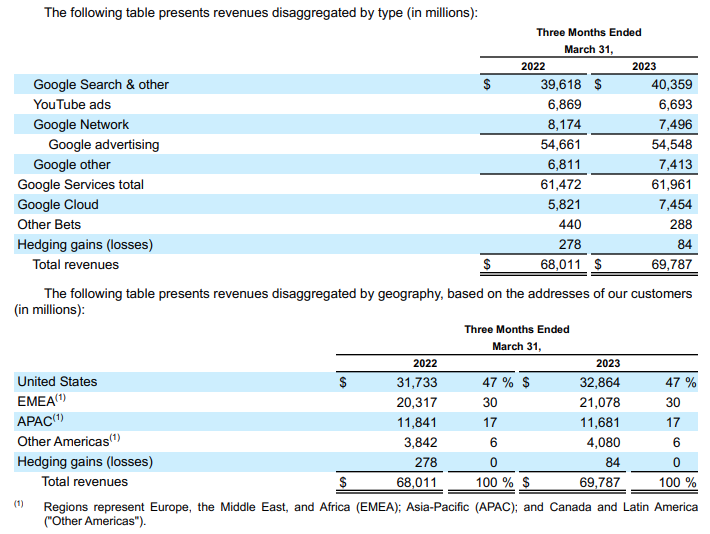
We showed a stylized version of Google's revenue breakdown, courtesy of FourWeekMBA a few weeks ago. Google's own disclosure has always been super high level. The following is from its recent quarterly earnings results.


Amazingly, GOOG generates more than the GDP of Singapore with c.70% of its revenue from search and Google Networks, platforms that uses Google to manage advertising. The other three buckets are important by themselves. Youtube, something most kids and teenagers cannot live without today, Android, something most phone users cannot live without today and last Google Cloud, an upcoming formidable competitor to Amazon's AWS and Microsoft's Azure. Perhaps, someday, most business cannot live without these cloud services.

Here's following snapshot of GOOG’s important financial numbers and ratios: 

  •  Revenue (2022): c.USD282bn 
  •  3 year revenue growth 23% 
  •  Gross margin 55% & Operating margin 26% 
  •  ROE 24% & ROIC 22%
  •  FCF USD67bn and FCF yield 4.3% (Jun 2023) 
  •  Net cash on balance sheet c.USD90bn

2. Risks

Every investment has risks and Google's biggest threat today is none other than ChatGPT. As a frequent user, I must say I see how ChatGPT can disrupt Google. It is simply a better way to get answers. That said, Google has launched its own A.I. called Bard. Given Google's early foray into A.I. with its c.$500m purchase of DeepMind in 2014, it should have a good headstart in this arms race. I would believe that the verdict is not out yet. Even if Google eventually loses, we will have time to get out.

The bigger risk today is anti-trust and lawsuits. Google has dominated the search world for more than two decades and governments around the world has tried to break this dominance. According to chatGPT, the following are the biggest fines against Google over the last 10 odd years.

  1. European Commission Fine (2018): In 2018, the European Commission imposed a record-breaking fine of €4.34 billion ($5.1 billion) on Google for violating antitrust laws. The Commission found that Google had abused its dominant position in the mobile market by imposing illegal restrictions on Android device manufacturers and mobile network operators.

  2. European Commission Fine (2017): In 2017, the European Commission fined Google €2.42 billion ($2.7 billion) for favoring its own shopping comparison service in search results and demoting rival services. The Commission considered this practice to be an abuse of Google's dominant position in the search engine market.

  3. European Commission Fine (2020): In 2020, the European Commission fined Google €1.49 billion ($1.7 billion) for abusive practices in the online advertising market. The Commission found that Google had imposed restrictive clauses on third-party websites, preventing them from displaying ads from Google's competitors.

  4. Federal Trade Commission (FTC) Fine (2012): In 2012, Google agreed to pay a $22.5 million fine to settle charges by the FTC. The charges were related to Google's tracking of users of Apple's Safari browser without their consent, in violation of an earlier privacy settlement between Google and the FTC.

As we know, ChatGPT is known to have accuracy issues. So we need to verify the details. A simple search showed that EU indeed fined Google c.USD5bn in 2018 and the litigation process is still underway today. Google's legal team has 400 lawyers and Google's court cases have its own wikipedia page with a long list of past lawsuits. 

https://en.wikipedia.org/wiki/Google_litigation

3. Technicals

GOOG peaked at c.$150 and was at c.$100 just a few months ago which was attractive. Share price has since rallied to $123 and I would argue that the margin of safety is no longer big enough. In market cap terms, it is USD1.6trn today and USD2trn at its peak. Share price bottomed at $84 in Nov 2022. At the height of covid in Mar 2020, it was c.$50. The stock went for a 20 for 1 split in July 2022 and these are no.s post split. 

If we use $50 as the low, $123 for current price at $150 for the upside. The risk reward is now skewed towards the downside. We have to make the assumption that share price can see $200 or more before the risk reward becomes palatable. As such, based on the above, Google is not too attractive for entry today, but since I am holding on to it, I will continue to do so unless there are more attractive similar opportunities out there.

4. Valuations

The chart below compares Google with its associated peers which may or may not be direct competitors. We can see that Google trades below this peer group average for all measures (PE, EV/EBITDA, Price-to-Sales or PS and FCF yield). It is worth noting that Free Cashflow (FCF) was USD11-13bn in 2012 and if we extrapolate its growth from then till now, it should be able to generate USD100bn in FCF in a few years alongside Apple. Although Apple would probably also grow its FCF bigger, maybe to USD150bn!

Triangulating the various valuation metrics below, we can see that Google's upside range from -9% to 17% which, as discussed above, does not warrant enough margin of safety.

If we bump up the multiples across (FCF to 30x, EV to 18x, PER to 25x and PS to 8x), we do get some upside but that's really stretching and not wise with the global recession looming and the disruption of chatGPT uncertain.

Previously at Substack, we had GOOG’s intrinsic value at $150 which was its peak in 2022. Perhaps things shouldn't be changing too much in just 6 months. Alphabet / Google is a HOLD now.  

Huat Ah!

Friday, June 02, 2023

Charts #48: SWF and PPF Returns

 This is a good chart on returns of SWF (Sovereign Wealth Funds) and PPF (Public Pension Funds)

Most large funds cannot beat the S&P500 return of c.10%pa.

Friday, May 19, 2023

2023 Dividend List

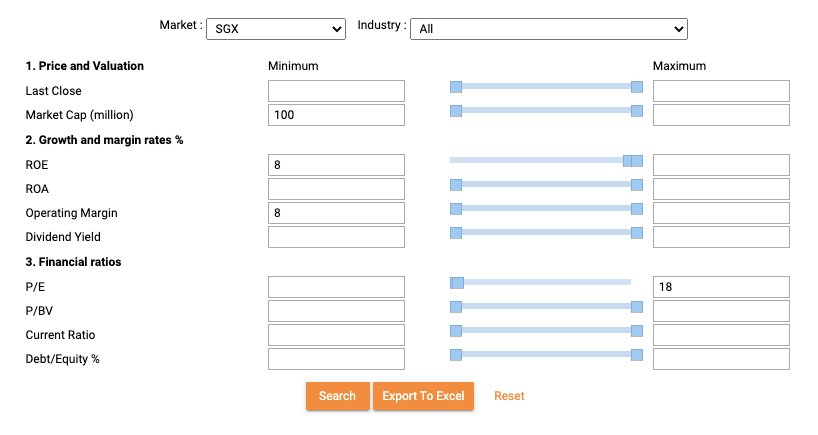
The wait is over. Today we will talk about *drumrolls* the 2023 Dividend List. This list has consistently generated the most popular posts on this infosite over the years. I started using Poems' simple dividend screen a few years ago. It allows adjustment for only 8 factors: ROE, ROA, Operating Margin, Dividend Yield, PE, PB, Current Ratio and Debt/Equity. While crude, it worked and we discussed good ideas in the years past (the full lists at the end of this post). This year, I came up with a 8818 4D winning formula to screen and would like to share the results. 

The above shows what 8818 is about. ROE > 8%, Operating Margin > 8% and PE < 18x. Dividend is no longer used as a criteria so it has become a misnomer to say this is a dividend list. But since Poems will always show the dividend yield, we can still see it as a reference and surprisingly, all the stocks featured today pays dividends. Although it doesn't really make any sense today to buy anything for 4% dividend since we get that risk-free buying Singapore T-bills. However, if it is a name with strong growth but still gives 4-5% dividend, then it's a steal. Buy, buy, buy!

For the Singapore market, I have cut off the market cap at SGD100m and we have 77 names. The last name cuts off at market cap of SGD1.5bn and honestly, I have also avoided small caps because the risk of seeing that investment going zero is way too high for me to stomach. I have discussed this point in Lessons Learnt from My 4 Biggest Losses. As such, the screenshot shows the top 30 names, the good blue chips on SGX sorted by market cap. We see the banks, REITs, Thai Beverage, Jardine Cycle and Carriage, Yangzijiang, Property names and Venture, Singapore's answer to Foxconn, albeit in a very small way, led by its founder Wong Ngit Liong. The following shows Venture's share price.


While it does not show the usual compounding graph, we can still see that Venture has created some value in the last 10 years after a long stagnation from the early 2000s to 2016-17. Contract manufacturing is a difficult business and hats off to Mr Wong and his team for being able to reinvent themselves, bringing the share price to $30 at one point. Venture went into niche contract manufacturing for MNCs by providing Singapore's branding for quality, process and timeliness and made a killing there.

But, let's move on from Singapore. In the next screen, I used the same 8818 (i.e. >8% ROE, >8% OPM and <18x PE) for NYSE, Nasdaq and Amex with the market cap cut off at USD100bn. Unfortunately, that is the quantum difference between our Little Red Dot and the World - USD100bn vs SGD100m as the cut-off in market cap. *Sigh* Anyways, the following shows some of the biggest names in the  world today:

I would note that TSMC is the most interesting name but it also comes with the most dangerous risk: China invading Taiwan. If that happens though, everything will be falling apart, so not sure which is worse, owning a diversified portfolio with TSMC or owning a lot of stocks in general that will see 20-30% drawdown if war breaks out. I don't have a good answer and that is why I have also advocated buying physical gold. In the middle of WWIII, all your stocks and money in the bank account may not be worth much, but physical gold will get you food and petrol in your $100k COE car.


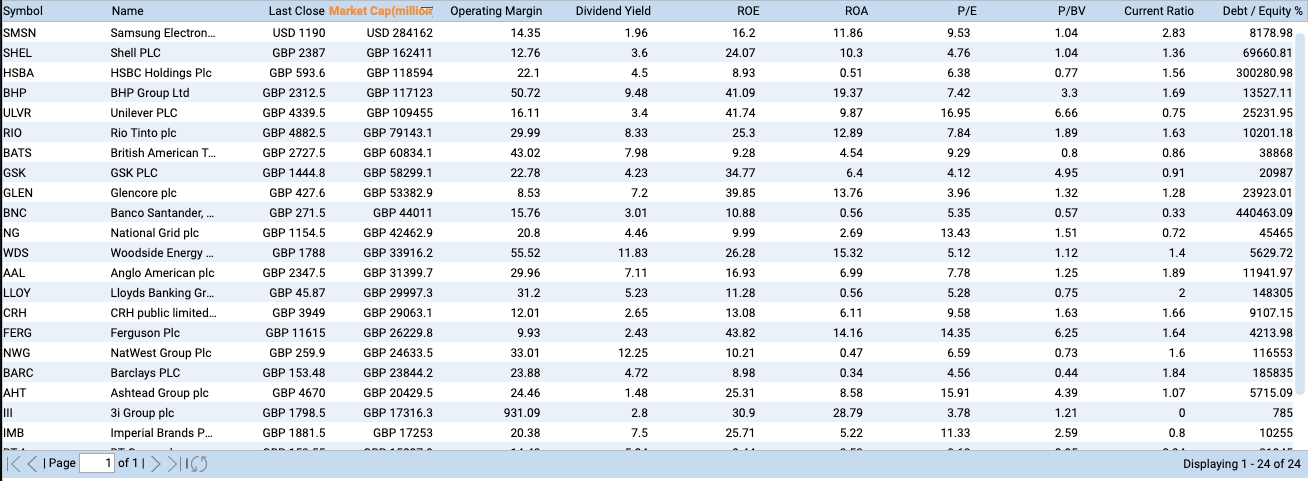
The last screen is the same 8818 criteria for LSE listed names. I would highlight that BHP and Unilever which appeared in both the London and US screens are good compounders. The chart for Unilever below shows the nice exponential curve as most compounders' long term share price chart shows. Different from the Venture one right?

Interestingly, we are also seeing many stocks trading below 1x PBR (e.g. HSBC and British American Tobacco) that has good ROEs and not necessarily basket cases. During the growth era from 2010 to 2022, this couldn't happen. Perhaps we are truly in a new value era. Long Live Value!

As usual, here's the past lists:

2020 Dividend List
2019 Dividend List
2018 Dividend List - Part 4
2018 Dividend List - Part 3
2018 Dividend List - Part 2
2018 Dividend List - Part 1
2017 Oct Dividend List - Part 2
2017 Oct Dividend List - Part 1

Huat Ah!


Friday, May 05, 2023

Thoughts #31: Investment Advice for Friends

As self-proclaimed investment gurus, friends tend to seek us out for investment advice and we tend to give freely, without contemplating the consequences. Most of the time, we share ideas that we are thinking of OR ideas that we already own and as conversations with friends go, there is no in-depth discussion and exact instructions are not provided. For example, a typical conversation will be:

Friend: "Hey, any stock lobang (good investment opportunity)"

Investor: "Yeah, check out Sembcorp Marine,  I bought already."

Friend: "Why is it good?"

Investor: "Energy is in demand, now oil price so high. Sembcorp will benefit."

Friend: "Oh yes, that is true, any risk?"

Investor: "They always need to put in a lot of capex, basically capital expenditure to build rigs and the industry is highly cyclical, so some competitors go bust. But no worries, Keppel will buy them if anything goes wrong."

Friend: "Ok, ok, I go buy tomorrow."

There are a few issues right here. There is no entry price, no target price and as such we do not know when to exit. Also, what is the size to commensurate the risk involved? These important points are all not spelt out. So when things go wrong, the investor sells at a loss and recommends that the friend do so, he or she may not follow because psychologically, loss-aversion is at work. Most people find it very hard to cut loss. Even when things go right, it is time to take profit, greed takes over and when the investor has sold, sometimes friends do not want to sell also. 

Such is the difficulty of providing investment advice on a casual basis.

Well, most friends are understanding and they know, it is always caveat emptor. You cannot fault your investor friend for providing advice just as you cannot fault your makan guru (foodie) friend for recommending you to his favorite restaurant which may not be to your liking. Of course, not all friends are like that.

To continue to hypothetical situation above:

Friend: "Hey Sembcorp died! What happened?"

Investor: "Well, it is highly cyclical, they did a lot of capex in the wrong regions, so when things go wrong, I sold and asked you to sell. Did you sell?"

Friend: "But you said Keppel will buy them."

Investor: "Well they did merge in the end. But did not go too well for Sembcorp shareholders. That is why I sold. Why didn't you sell?"

Friend: "I was hoping can rebound. But now lost so much money. Thanks bro... Guess your stock tips are not too reliable."

Investor: "Sorry... can we still be friends? Can I buy you dinner?"

Over the years, I have come to realize that the negatives of providing investment advice outweighs the positive. If he is serious, maybe he should consider subscribing to my Substack and we can have real in-depth and robust discussions on the Substack platform with other like minded subscribers.

Alas, most people just want stock tips. Not to read a 15 minute deep dive note on Substack or anywhere else. Just gimme the get-rich-quick tip bro!

Well, to each its own, we can still be friends.

Huat Ah!


Thursday, April 20, 2023

Warner Bros Discovery

This post first appeared on 8percentpa.substack.com, as part of a new effort to share investment ideas. 

Why do humans love stories?

Ever since our brains evolved to develop language, we have been telling stories to one another. Stories activate our cognitive brains and bring us into different realities which we believe can be perfect and we escape into them to forget about our not-so-perfect lives.

But stories can also inspire us to become better versions of ourselves. We worship both ancient Greek heroes and Marvel superheroes and aspire to be like them. We empathize with our heroes when they go through their challenges and rejoice with them when they finally overcome their nemeses and live happily ever after.

In recent years, storytelling has reached a whole new level with Hollywood and Netflix throwing billions of dollars into content creation. Disney up its game with the Avenger series and we see its peers following suit. On top of that, big budget television series, reality programs, anime and a slew of alternative content now proliferate our lives and our minds.

As such, our bet today is an overlooked content company created in the midst of the pandemic.

Investment Idea: Warner Bro Discovery

Warner Bros Discovery (WBD) was created with the merger of Warner Brothers Media and Discovery Inc in 2021-22. The stock price has corrected from $24 to $10 since its inception and looks amazingly cheap at teens free cashflow yield (FCF) today.

1. Fundamentals

The company now houses some of best brands and franchises outside of Disney under one roof (see slide from 2Q2022 investor presentation below). These include DC Comic, HBO, Harry Potter, CNN and Cartoon Network, amongst many other franchises. According to CEO David Zaslav, WBD probably has 35% market share of the best content on Earth, as much as Disney does. There is so much room to extract value but the market is not appreciating WBD’s value and not valuing the company as such.

As a result of the various past mergers, including the final mega combination between Discovery and Warner, one can also expect that a lot of duplicated costs can be reduced. Cost synergies is estimated to be USD3.5bn and while sales synergies are not factored in, it should also be significant. Just think about how Harry Potter and DC can now go on HBO and Cartoon Network or how they can further milk the Game of Thrones franchise as they already did with the House of Dragons.

The following is a set of simple financials projects WBD’s financial prowess in 2023. In the base case scenario, the company can create USD4bn on free cashflow (FCF) on its market cap of USD25bn:

Simple financials (estimated for Dec 2023, USD)

Sales: 48bn

EBITDA: 11bn

Net income: 500m

FCF: 4bn (current FCF in 2022 is 3bn)

Debt: 50bn, Mkt Cap: 25bn

Ratios

ROE 9% ROIC 6%

EV/EBITDA 7x

Past margins: OPM 20-30%

By comparison, Disney generated USD5-8bn of free cashflow pre-pandemic and achieved teens ROE which should be the levels that WBD can aspire to reach in the next 2-3 years. That said, the next few years does not bode well for Disney as it struggles with management succession and its streaming business. The same key risk can be said for WBD.

Risks

WBD faces the possibility of not being able to turnaround streaming losses (USD500m per quarter) and continued hiccups in execution, will mean that the abovementioned potential will continue to be unrealized. The mitigating factor is that with its lucrative content library, WBD might be taken over by another operator to achieve its potential. So by investing today, we should not lose money.

The second smaller risk is WBD’s balance sheet. With USD50bn of debt (against market cap of USD25bn) and rising interest rates, things could spiral out of hand if this debt and its interest expenses are not managed well. The mitigating factor is its strong FCF generation. At the current estimated range of USD3-6bn FCF annually, WBD could pay down its debt in c.8-16 years.

2. Technicals

WBD traded to $80 as a mime stock when it was still Discovery Inc (the deal was already announced). and it is not a stretch to imagine it can be valued as such given the strong FCF, franchise and leadership under David Zaslav, who was under the tutelage of John Malone, one of the best business leaders of our times.

David Zaslav alluded to this target in a recent podcast. He also shared that his stock options only make good money when the share price hit USD30 and beyond. We are also seeing insiders buying at current levels. These “technical” signals bodes well.

After it started trading as WBD in Apr 2022, the share price dropped from USD24 to its current USD10, a 60% drop reflecting the weakness in the markets. Its highest point was above USD30 shortly after the launch of its new ticker and it traded as low as USD8.8 recently. Thus, on many counts, the current share price presents a good risk reward profile.

3. Valuations

Warner Bros Discovery measures FCF and EBITDA closely and therefore we can use FCF yield and EV/EBITDA as the appropriate valuation metrics to triangulate its intrinsic value. Starting with FCF, WBD currently has a market cap of USD25bn and management expects free cashflow to hit USD3bn in 2022 and somewhere between USD4-6bn in the future, calculated from its EBITDA to FCF conversion ratio of 33-50%.

This implies its FCF yield is 12% using the USD3bn number and a whopping 24% if we believe WBD can make USD6bn in FCF. As a rule of thumb, an intact business (i.e. not declining business) with FCF 10% yield is what investors will kill for because we do not have to sell. We can technically hold it forever since this asset is going to give us 10% every year, perpetually.

WBD is trading way beyond this FCF 10% yield benchmark.

Similarly, we can use EV/EBITDA to value WBD. Management is guiding USD12bn in EBITDA next year but we have conservatively estimated that it will miss by a billion, achieving USD11bn. Using its current EV of USD75bn (market cap of 25bn + debt 50bn, WBD is trading at 6.8x EV/EBITDA, which is considerably cheaper than most of its peers (Disney at high teens and Netflix at over 20x).

4. Intrinsic Value

Assuming that WBD trades 8x EV/EBITDA on next year's USD11bn of EBITDA, WBD should have an EV of USD88bn and after deducting its USD50bn debt, its market cap should be closer to USD38bn (not the current USD25bn). If we use current EBITDA of USD9.5bn and similarly give it the 8x, then we get to a more conservative EV of USD76bn. After we deduct the USD50bn, we still get USD26bn of market cap, which is still 4% above today’s share price.

WBD is incredibly cheap!

Let's see how it looks like if we use FCF. Assuming FCF is at USD4bn and giving it 15x (or 6.7% FCF yield) which is again at a discount to its peers, WBD should trade at a market cap of USD60bn i.e. 140% above its current market cap. This translates WBD’s intrinsic value to USD24 per share.

If we look at its peers, Disney, Netflix, Comcast, they are trading at USD219bn, USD107bn and USD171bn respectively with EBITDA at USD12bn, USD19bn and USD36bn. The average market cap is USD166bn over an average EBITDA of 22bn. Without doing a full regression analysis, we can intrapolate the above numbers back to WBD's market cap using its current EBITDA of USD9.5bn, it implies that WBD should trade closer to USD72bn.

Taking the average of the four market caps, USD38bn, USD26bn, USD60bn and USD72bn, we get to an intrinsic value (IV) of USD49bn in market cap or USD20 per share. As such, we would put WBD's IV at 20 with over 90% upside from today’s price.

Huat Ah!

Read it at https://8percentpa.substack.com/p/investment-idea-2 and please support by subscribing at substack, thanks!

This post does not constitute investment advice and should not be deemed to be an offer to buy or sell or a solicitation of an offer to buy or sell any securities or other financial instruments.


Thursday, April 06, 2023

When Money in the Bank is Not Safe Anymore

This post first appeared on 8percentpa.substack.com. We also provide for monthly investment ideas for paid subscribers.

The last few months saw the spectacular collapses of financial institutions across different sectors and geographies starting with FTX, the crypto-exchange that was a fraud. Sooner than we know, Silicon Valley Bank went into trouble and Credit Suisse needed to be bailed out by its arch-rival UBS. These crises are still unfolding as the repercussions are being felt worldwide. In this post, we hope to highlight the dangers involved and hopefully provide some differentiated advice for investors at the end of the post as we walk through how global financial system came to the current dire situation today based my understanding.

1. In Government We Trust

The modern global financial system today is built on trust. Before that, we used gold. Trust is not easily earned. Bank runs used to be a thing even in Singapore and my grandparents and parents did not put monies in banks until recent times but kept them under their pillows and cookie tins in their homes. My mum still do this today.

From the end of WWII to the 1970s, the financial system was pegged to gold in what was called the Bretton Woods system. The system dictated that all currencies were pegged to the USD and the USD was pegged to gold at USD35 per ounce. This was supposedly sacrosanct and built on centuries of human’s adoration for gold but it came to an end when the US government overspent on the Vietnam War and governments around the world abandoned the pegs which subsequently cumulated in Bretton Woods’ collapse in 1976.

Since then, our currencies are backed by nothing except the promises from governments of the world that the currencies they issued are worth something. Technology then connected the global financial systems via computers and later the internet in the 1980s and the 1990s. This allowed for global transactions to take pace with major banks in their respective countries as the gatekeepers. To summarize, the global financial system today stands on:

i) the trust in our governments and financial institutions

ii) the global interconnected financial web with banks as key intermediaries

2. Financial Web & Contagion

The interconnectedness of this global financial web brings about problems because the whole network is only as strong as the weakest link. Trust is easily broken (which is usually the case) and banks as well as other financial institutions can fail. In the late 1990s, it was believed that a hedge fund called LTCM would cause the collapse of the global financial system if it went bust. The Fed engineered a rescue to prevent that doomsday scenario from playing out. Then in 2008-09, the Global Financial Crisis (GFC) saw how the fall of Lehman Brothers almost brought the whole system down.

Lehman's bankruptcy in September 2008 triggered the acceleration of the GFC which led to AIG, the insurer going under, forcing the Fed to take over the firm. A few days later, money markets and credit funds saw unprecedented withdrawals which again forced the Fed to underwrite everything that people wanted to sell. US Congress authorising a USD700bn fund to buy toxic assets finally stabilized the ship. It was believed that if the Fed and the US government did not use the fund to backstop, the global financial system would collapse. Thousands of banks would fail, just like they did during the Great Depression and unemployment could hit 30%. Millions could be homeless and starve.

It was Armageddon avoided.

But the negative impact still reverberated into Europe causing the economic crisis in Greece, Italy and Iceland. Icelandic banks did go down and required IMF’s intervention. China responded by creating a CNY4trn economic stimulus package which subsequently led to other issues. Lehman’s collapse also hit Asia with the now infamous Lehman mini-bonds hurting retail investors in Hong Kong and Singapore. Retirees invested their life savings with banks that they opened their first and lifetime accounts into these financial products thinking that their monies were safe!

Breaking the weakest link can create contagion across the global system that could bring about the end of modern finance as some believed. Today, we have different pockets of failure that is threatening the system yet again.

Armed with experiences above, powers at be today know that they have to stop contagion because the whole system is built on trust and the system can collapse when the weakest link breaks and brings everything down with it. This is why the US will insure all deposits in all banks big and small and why the Swiss National Bank forced UBS to buy Credit Suisse. There can be no contagion.

3. Unintended Consequences

Despite the best of intentions, we may not be able to prevent all unintended consequences. The Fed chose to save Merrill Lynch and not Lehman Brothers back in 2008 because they believed they could handle the aftermath of Lehman going down as it was smaller. Today, we face similar issues. Credit Suisse chose to gave up on AT1 bondholders which could be disastrous (we will come back to this). FTX’s debacle indirectly led to the issues at Silicon Valley Bank which then impacted Signature and First Republic Bank. Both are in trouble now.

Most of the time, danger lurks in places no one is looking at. No one heard about Silicon Valley Bank until a few weeks ago. Who knows what can go wrong next? Back to Credit Suisse’s AT1 bonds, this is a special type of bonds that is a hybrid between equity and debt. They came about after the GFC to allow banks to issue this special type of instrument to beef up their balance sheet. They were known as co-co bonds back then. Co-co comes from contingency convertible bonds. They provide investors with higher interest (at c.6-9%) but will convert to equity when things go rough.

AT1 or coco-bonds ranked higher than equity but ranked junior to all other debt (see above). But still, they are debt. All finance students know that equity goes to zero first before debt is impacted. But in Credit Suisse’s case, the Swiss decided to write down AT1 to zero but a lifeline is provide to equity holders, turning finance rules on their heads. As such, the USD260bn global AT1 market is going down globally. AT1 is mainly held by Asian investors and banks from Stanchart, HSBC to Japanese banks are seeing their share prices collapsing.

4. How to Navigate from here?

With market valuations still high (see previous post in Dec 2022) and the current woes still ongoing, we are definitely not out of the woods, in fact, we are deep in the forest with no exit path in sight. It is not the time to buy anything. I would sell before buying. Investment ideas should be very well studied which reminds me of my mother’s nagging during school days. The best ideas should then be bought with prudence at a 2-3% or max 5% position of the portfolio each, making sure everything is diversified. But the more important diversification is about putting investments with different intermediaries (or different cookie tins if you like) i.e. different brokers and banks because you do not know if they might go down some day. No one thought Credit Suisse would fail last year.

I think this could be the important takeaway for today. It is a simple rule that has been forgotten over time as the global financial system evolved and we put so much trust into old and new entities without doubt. Back in the days when money in the bank isn’t as safe, my mum (yup her again) would diversify and split her savings into various banks and simply hold fixed deposits and no other types of financial investments. As mentioned, she would also keep some cash at home and buy gold and tangible assets of value.

Today we mindlessly buy structured products thinking they are safe (like Lehman’s mini-bonds) and invest in Bitcoin via exchanges with no proven track record. Maybe moms do know best even in investing and finance!

To end this post, here’s mom’s list of advice: 

i) Study your ideas well 

ii) Diversify your funds across banks and brokers

iii) Don’t buy structured products, just go for the simplest stuff like T-bills, stocks and fixed deposits

iv) Buy gold and tangible assets of value 

v) Cash on hand is king!

Huat Ah!

Friday, March 17, 2023

Books #19 - Elon Musk

I just finished reading Elon Musk: Tesla, SpaceX and the Quest for a Fantastic Future which was first published in 2015 but updated recently to provide readers with the most up-to-date information. The author Ashlee Vance is an amazing writer. Even though the book was few hundred pages which usually takes me a few weeks to read. I devoured it in days. 

Much of Elon Musk is well known and I struggled to see how I can add new perspectives. As such, this is more of a reflection piece for myself. Hopefully, you can find some nuggets of insights here and there.

1. Elon Musk is a Genius and a Jerk

Intuitively, we probably know he is super smart but only after reading the book then it dawned upon me that this guy is probably at a different level compared to most other guys we tend to compare him with. For one, he is running two companies as the book was written and running three now as we speak.

Well, we know that smart people have big egos and are either born jerks or become jerks. Everyone of them is divorced. Jeff Bezos, Bill Gates, Steve Jobs, Warren Buffett, Robert Kwok, Sergey Brin. 

You name it. Every single one.

So Elon is probably the biggest jerk of them all. He had an affair with his best friend's wife and resulted in Sergey's name being on top. Goodness... (pic below). Of course, what Sergey did to piss his wife to sleep with others is not known. 

Sleeping with best's friend's wife...

But jerks do push humanity forward. This post cannot be written without my iMac and no additional research could be done without Google.

2. Space business may have some economics

I never understood the space business. To me, it was just concept. How can the ROIC be great for businesses that require so much capex, R&D with no demand? I am still skeptical but SpaceX shooting up hundreds of satellites and using space technology for commercial applications might become big. 

SpaceX satellites are being used in the Ukraine-Russian war. War generates business (bad business though) and brings in money. That said, there are all kinds of commercial applications, including internet, satellite imagery etc.

3. Life is about Luck

The statement above is universal. You don't have to read this 400 page book to know. Well, Elon is tremendously lucky. Tesla could have gone bust multiple times. The same could be said for SpaceX. But he was saved, so many times. It does not mean he does not have skill. Obviously he has, more than anyone today.

But for so many things to come together, you cannot deny luck.

There are people who have enough skill but never the luck to pull off anything. There are people who has not much of any skill but become big, maybe we can put Donald Trump, Jack Ma and Masayoshi Son in that category. Feel free to disagree, you are entitled to have your opinion and so am I.

But Elon Musk just has both. 

Huat Ah!