While researching for another earlier post, I found this - someone tried to calculate the price of a human being by amalgamating what each and every organ can fetch in the black market. It's USD45m according to the Medical Futurist.
Tuesday, July 19, 2022
Thoughts #28: Price of a Human Being
Thursday, July 07, 2022
2022 SG Dividend List
We are at a good time to look at the annual dividend list again and as market cycle goes, we are back in the doldrums and therefore see a lot more names just in our beloved little red dot. The criteria have to be added so that we can down to a manageable list.
At the top of the market cap range, we start with Thai Beverage at close to SGD18bn market cap. I have owned this name for a while and I believe this is perhaps one of the rare compounders we can find on SGX. The numbers speak for themselves, double digits margins and double digit ROEs. I would argue that at 16x price earnings, this name is not expensive. Top Glove of Malaysia is another superb company but the numbers do look strange with ROE over 100% and dividend over 20%. That said, we know its strengths and kudos to the managers who brought the company to such global success over time. Alas, both of these strong names are not home grown Singapore companies.
Next up, let's see if we can find more interesting names in the other markets!
2019 Dividend List
2018 Dividend List - Part 4
2018 Dividend List - Part 3
2018 Dividend List - Part 2
2018 Dividend List - Part 1
2017 Oct Dividend List - Part 2
2017 Oct Dividend List - Part 1
Huat Ah!
Wednesday, June 29, 2022
SPH and SPH Reit gone!
5 July 2022 Update: Apologies for the mis-information and the anxiety that this post might have caused. While SPH is not longer around, SPH Reit is not delisted and was last traded today at $0.90. Cuscaden's chain offer would only privatize the company if it managed to buy more than 90% of outstanding shares. Since the lowball offer ($0.9372) was unattractive, it only acquired c.62%.
I have kept this post for readers who may still be interested. Will be updating on this name in the weeks ahead now that we have an actual bid at $0.9372 (which means at 15-20% discount from this price, this name will have really good margin of safety and worth taking a very close look) and there should be further developments.
Today is the last day you can trade SPH Reit. This was a stock I owned since its IPO and it is sad that I have to sell it the way I did. It was definitely not trading at my intrinsic value but I have not choice, unfortunately. In Singapore, minority shareholders continue to suffer when stocks are taken private cheaply.
For the uninitiated, the saga began around March with SPH Reit's parentco SPH embroiled in a bidding war sparked between Keppel Corp and Cuscaden Peak. Cuscaden Peak is a vehicle owned by Singapore #1 shrewd businessman Ong Beng Seng who has strong connection with Temasek. The actual shareholding is a bit complicated and I have copied the description from Shentonwire (pic below): https://shentonwire.net/2022/06/02/cuscaden-peaks-chain-offer-for-sph-reit-turns-unconditional/
To cut the story short, Cuscaden won and SPH, Singapore Press Holdings, publisher of The Straits Times, was taken private last month, ending its life as a public blue chip company on the SGX. Some shareholders took umbrage that it was taken out at SGD2.40 while most long term investors would remember this stock should be valued closer to SGD4.00, which was where it traded for donkey years.
SPH Reit was then bidded to be taken private at $0.9372 as part of a chain offer. The latest NAV of the company was $0.92 so at face value, we cannot say it was taken out at a cheap price. But, considering that rent is skyrocketing in sunny Singapore as a result of global inflation and further considering the stock's IPO price was $1 back in 2013 and the current cap rate (4.5-6%) of its five properties are pretty, which means it is not expensive (see pic below), well, I guess we have to admit Ong Beng Seng got the better bargain.
It is very difficult to have win-win transactions in life. Some people live through their lives believing it doesn't exist. Someone has to win and the other party has to lose. While that is not true, it might be so in this case. We, as minority shareholders, did not get our fair exit, with the backdrop of the current worldly state of affairs. Firstly, inflation rate is spiking and we know that properties are one of the best asset classes to own during an inflationary environment. Secondly, we all know that rents in Singapore are going through the roof, so we should see property prices soaring.
Lastly, Paragon, the iconic Orchard property, valued at SGD2.6bn, cap rate of 4.5% seemed to be at a discount. Pre-covid, it was valued closer to SGD2.8bn. Coincidentally, the market cap of SPH Reit is also at the takeover market cap of SGD2.6bn, which means that the rest of the properties come free. Of course that is simplistic because we did not take into the account of the debt. If we do that, then we come back to the NAV of $0.92 which, gut-feel wise, also seemed cheap.
So, are minority shareholders being short-changed?
The short answer, I would say is yes. But as a long term shareholder though, I have also benefited from collecting the c.5% dividend over the last 9 years. So this meant that I have collected 45% of my capital or c.$0.40-$0.44 which meant that I still made a decent profit selling to Ong Beng Seng at $0.9372 considering the dividend gains. It is said that more than half of long term investing gains come from dividends and in this case, that is arguably true.
Unfortunately, for recent buyers, they might be taken out at a cheap price and there is really no good way to fight back. Perhaps Singapore needs to see its share of activist investors who can fight for minority rights and stop corporate raiders from taking listed companies out cheaply.
For interested readers, you can also read about CK Tang
Thursday, June 02, 2022
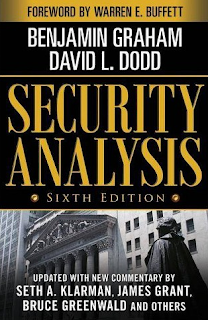
Books #18: Security Analysis - Part 1
I finally finished this seminal book after reading for almost three years. It was simply too dry and too painful so I used it mostly as a sleep catalyst: i.e. I read it when I cannot sleep. Usually, I don't get pass a couple of pages which was why it took three years.
To be honest the book was marginally helpful. It was written so many years ago that a lot of the case studies are now unrelatable and the whole section on fixed income was simply too technical. I can understand why Benjamin Graham wrote The Intelligent investor. So that his philosophy can be more easily understood by to the layperson. It was definitely a better read.
That said, the book was seminal because it introduced all the original value investing concepts. It described the original thinking about stocks, it popularized valuation methodologies, how we should look at financial records for at least 7-10 years and how we should think about management of companies.
The biggest revelation was that most of the lessons learnt about financial shenanigans that were applicable then were applicable now. Human nature doesn't change and that is always at the crux of investing. In the end, investing is the ultimate battle of wits against a million other chess players. Here's a quote by Seth Klarman that just rings truth all over:
The real secret to investing is that there is no secret to investing. Every important aspect of value investing has been made available to the public many times over, beginning in 1934 with the first edition of Security Analysis. That so many people fail to follow this timeless and almost foolproof approach enables those who adopt it to remain successful. The foibles of human nature that result in the mass pursuit of instant wealth and effortless gain seem certain to be with us forever. So long as people succumb to this aspect of their natures, value investing will remain, as it has been for 75 years, a sound and low risk approach to successful long-term investing.
Next up, we look at some of the original valuation methodologies and financial shenanigans!
Thursday, May 19, 2022
The Stock Market and the World in 2022-2023
2022 has become one of the most extraordinary year ever. The stock market reached all-time highs as we tallied 6m deaths (condolences to all the bereaved families) and Russia decided to start a war. A further 10m people were forced out of their homes as refugees, while people in sunny Singapore happily go for overseas tours. Some even decide to visit Ukraine to proselytize! (Dear Singaporeans, please don't do that...) It is a sad year and I am sorry to say, I actually only have more bad news.
There are three key topics in 2022-2023 which we will discuss today and they are all bad:
1. Inflation
2. Bear market and valuations
3. Regime change
We have seen inflation in recent months and we are going to see more inflation like we have never seen before. This is a new experience for most of us and it is not pleasant. Essentially, our money in the bank is losing value but it is not visible. $100,000 doesn't actually become $90,0000 but effectively, it does because prices of things we want to buy are going up. The geo-political landscape is making things worse.
Wars are inflationary because everything that is used in the war does not create value add but takes away useful resources that can propel the economy. The Russian-Ukraine war in particular is causing commodities prices to skyrocket and disrupting global manufacturing supply chain especially in autos and semiconductors. But the repercussions can go far and wide. For example, prices of eggs in Singapore also skyrocketed (for reasons unclear to me now). All this happened while the West was trying tame 7-8% inflation, which has not happened for a long time.
This is a big deal and this is bad. We have never experienced 7-8% inflation for more than 40 years. 2-3% inflation, yes and it is manageable. Our wage growth usually beats that and everyone is happy but when inflation is that high, lower income families may not see income growth covering cost inflation. For middle and upper income households, people are also seeing their luxury comfort slipping away. Some cannot change iPhone every year now because it's literally causing a kidney for a donor (see below).
Air ticket prices are rising, so that means less overseas travel even as we open up. Car and COE prices are also going up. In general, it will be just more expensive to live. Corporates are also not doing great. Wage inflation is all the rage now, banks and prominent startups in the US are forking out $100,000 to get fresh grads (It's also a talent war out there). Manufacturing companies see raw material cost increasing and those who can afford to pass it on do so, further exacerbating inflation, those who cannot take a hit to the margins. That is not good for share prices which brings us to the stock market discussion.
We are probably at the start of the bear market. The S&P500 peaked at 4,766 and has dropped 15% since then. The headwinds are so strong that it is hard to see how the market can still go up. We have valuations still at very high levels but topline growth is slowing. The biggest worry though, is not that. It is the US interest rate. For those who studied this either on this infosite or in school or in finance theory, you might remember that valuations are, by and large, determined by interest rates. In textbook language, this is the risk-free rate, which usually meant the 10 year government bond yield.
The reason why 50x PER was ok for a while was that risk free rate was below 1%. So when that happened, equity risk premium was also compressed and investors were ok with 50x PER which is roughly 2% earnings yield. The alternative was to buy US Treasury bonds at 1%, or some boring companies' bonds at 3%, which wasn't that palatable. The cherry on the cake was, of course, 50x internet companies always put in some spectacular growth story, so investors just piled up to buy.
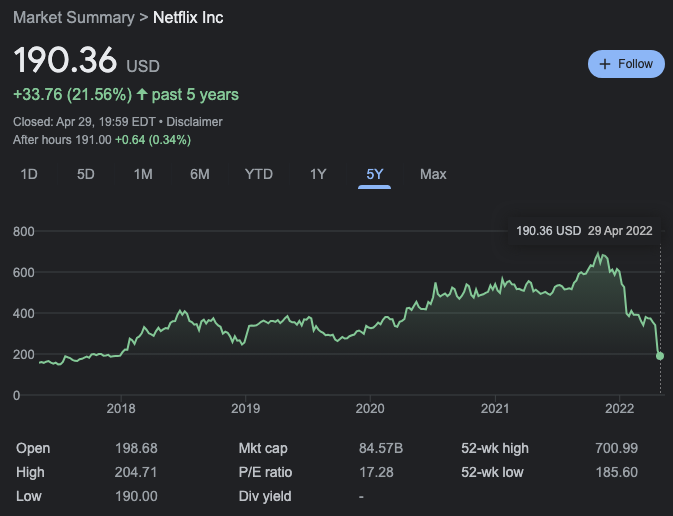
But now, the story has changed. If the 10 year US Treasury bond yield is going to 2.5%, you can no longer justify 50x PER, cherry or not. Calculating the earnings yield again, say the equity risk premium is also 2.5%, we are talking about 5% earnings yield for the market which translates to 20x PER. So in this new regime, a sexy growth stock could trade at 25-30x but 50x is definitely, a stretch. That is one key reason why Netflix and some of the hot stocks of past 5 years collapsed.
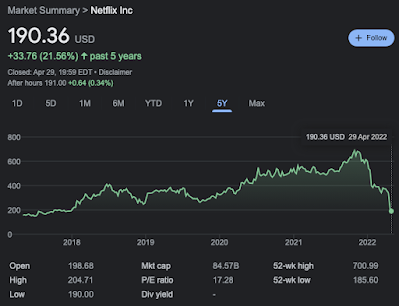
In the stock market, every 10-20 years, we see a regime change. We all heard about the Nifty Fifties and the bear market in the late 60s of the era past. In recent times, the late 1990s were led by the internet stocks. Then they collapsed and new leaders from Asia emerged. This was the boom of China that also drove the commodities supercycle. It collapsed with the GFC and we entered the current regime around 2011-2012. The first half was driven by recovery and false starts - remember Brexit and Grexit and the shadow banks in China? The second half was driven by the FANGs. We are now at the bloody ending in this horror movie (maybe The Shining and it's not going to end well). The FANGs have all declined and Netflix, the N here, fell 80% from its peak. This is a watershed moment.
Some of the other FANGs might do well, some might not, it is hard to say. It is probably prudent to trim some holdings if you have and wait for a better entry. In the broader sense, we are in another era now(改朝换代了), we are now in a bear market and cheap valuations, which has long been forgotten as the true compass for investors will now be ever more important. 2022-23 will be turbulent and we just have to wait and see how far this decline can take us before things get settled down.
So meanwhile, keep calm, keep liquidity, stay vigilant and stay safe!

Tuesday, May 03, 2022
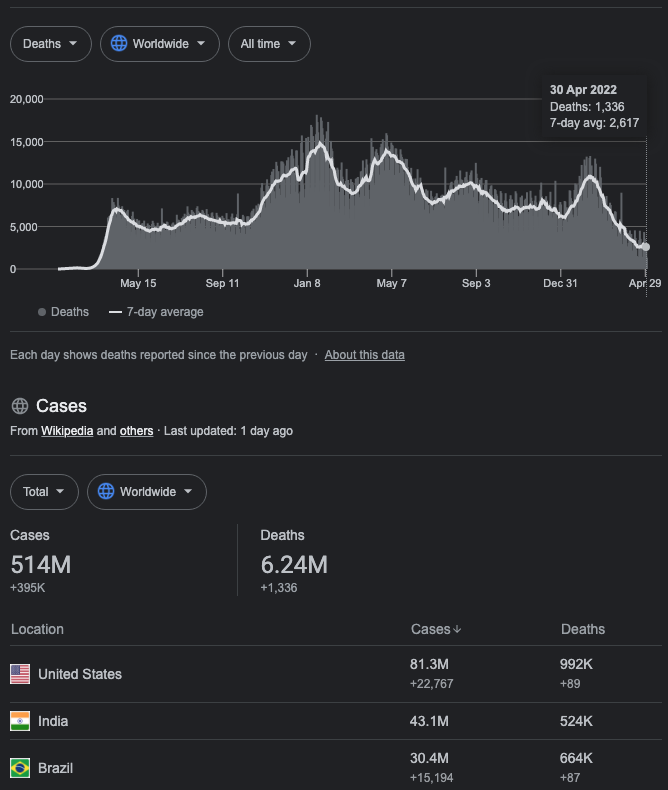
Chart #44: Taking stock of COVID-19
Two and half years ago, we could never have seen this coming. Over 500m infected and 6m deaths.
May the Force be with us all!
Friday, April 22, 2022
Ray Dalio's Power Principle
I have read many things written by Ray Dalio and his thought process simply never fails to amaze me. He has published a new book which I have not read but cannot wait to. He continues to think and write despite his age (72 and going strong). The following is something he wrote recently when commenting about the Russia-Ukraine conflict.
Having power is good because power will win over arguments, rules and laws all the time. When push comes to shove, those who have the power will either enforce their interpretation of the rules and laws or overturn them to get what they want. It is important to respect power because it is not smart to fight a war that will produce more pain than reward: it is preferable to negotiate the best settlement possible (that is unless one wants to be a martyr, which is usually for stupid ego reasons rather than for sensible strategic reasons). It is also important to use power wisely. Using power wisely does not mean forcing others to give you what you want ie bullying them. It is the recognition that generosity and compromise are powerful forces for producing win-win relationships, which are fabulously more rewarding that lose-lose relationships. In other words, it is often the case that using "hard power" is not ideal and that using "soft power" is preferable.
This paragraph is so powerful that I felt compelled to write it down here so that it will be part of my infosite and I hope to be able to practice what is written here as well as to be aware who in my circle is using hard power for stupid ego reasons.
We have all seen bosses enforcing their interpretation of the rules and we have all seen colleagues using power for stupid ego reasons. Most often, we are powerless to stop them at that moment. But we should learn from their mistakes and perhaps make records to note them down such that one day, we might be able to turn the tables against them.
For example:
1. Discretely deciding to use company's budget for meals by using power over secretaries to setup the meal with counterparty and colleagues, bypassing higher authorities.
2. Forcing the deal team to kill the deal by re-interpreting the criteria for new investment ideas which fit a pre-created framework. The deal would have passed the criteria but the re-interpretation meant that it now could not.
3. Using power to decide the fate of interns despite the verdict still being processed by the rest of the team and feeling happy about "playing god" over interns.
Yes, power abuses.
Back to Ray Dalio, I think the quote above list out all the important tenets about how we should use power. People who play with power are up to no good. They are political, egoistic and generally do not add value. So be careful with people who abuses power and also the companies that have these people.
Here's a few likeable timeless quotes about power:
Experience have shown that even under the best forms of government, those entrusted with power have, in time, and by slow operations, perverted it into tyranny - Thomas Jefferson
With power comes the abuse of power. And where there are bosses, there are crazy bosses. It's nothing new. - Judd Rose
Those who have true power share it, while those who hunger power abuse it - Royalton Ambrose
Friday, April 08, 2022
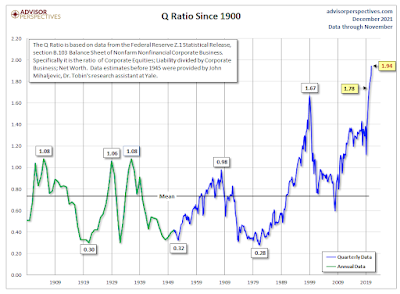
Tobin's Q: The q ratio
Friday, March 25, 2022
Thoughts #27: Scams and Counterparty Risks
Human civilization has progressed so far that we sometimes give a lot of the benefit of the doubt to be trusting. We buy bottled water, packaged food trusting it is all good. We buy things off the internet like nobody's business today, trusting that our purchased goods will arrive at our doorsteps tomorrow or at worst, in a few days.
It was not always like this. We have become too trusting and there are scammers out there who are getting really good at scamming in this unique era of ours. Scammers existed throughout history and we simply must always be vigilant. Our parents and older friends and relatives are also usually more vulnerable.
This post is a reminder that sometimes the most important risk is simply the other party or platform across the table. It could also be people we are supposedly working together with. If we have a counterparty who is helping to transact, can we trust him or her? Are we using a reputable broker? Is the Bitcoin exchange setup certified by the MAS? Can we trust the property agent, or the supposed seller/owner of the property? These are simple things that we should make sure that we do not overlook.
Scams are also everywhere. Some are easy to spot but others may not be so. Bernie Madoff structured his Ponzi Scheme for almost 40 years and no one found out because he was so good at covering his tracks. Jho Low pulled off the 1MDB by registering similar sounding company names. Internet scams are everywhere, so it's better to just buy from the big platforms rather than to try to save 20%.
Needless to say, when we are buying big ticket items, like a luxury watch, a car, or a house, then it makes even more sense to be beware of scams and counterparty risks. We need to double and triple check that everything is in order. A good friend shared this with me some time back:
"When you are about the part with your money, think again and double check. Pay half or 1/3 first if necessary. Things will change when money has been transferred"
Caveat Emptor!
Friday, March 11, 2022
Books #17: Value Investors by Ronald Chan
I read an interesting book in 2021 simply called, "The Value Investors" by Ronald Chan. Well the full title is apparently - The Value Investors: Lessons from the World's Top Fund Managers.
This book is unique as it introduced the many value investors that we may know but had never been featured prominently. People like Irving Kahn, Walter Schloss and a few Asian value investors including Singapore's own Teng Ngiek Leng, founder of Target Asset Management.
There were many snippets and many lessons. I find the Asian lessons particularly useful as I could relate better.
Teng shared the importance to be flexible and be contrarian. This was echoed by Howard Marks who famously coined Second Level Thinking, which needs to be different but better. But Teng was able to connect that with his Asian experience, which brings the point home in a unique perspective for me. Another Asian value shared about the importance of knowledge and focus. We can only capture opportunities with knowledge which we have gained with a lot of experience and focus which is required because the opportunity will pass quickly in the markets. Otherwise, opportunities are simply easily missed.
One of the best quotes was from another Asian investor:
I believe that every human being has an artistic gene and in his or her lifetime can create at least one masterpiece that is globally competitive. However, to become a professional, you need to replicate your talent again and again if you are to have more than one masterpiece. It is the same as investing. You can be passionate about it but if you want to become a professional investor, you need to develop a system and have the talent to find good investments repeatedly.
Overall, a great read, do pick it up in 2022!