Friday, March 17, 2023

Books #19 - Elon Musk

I just finished reading Elon Musk: Tesla, SpaceX and the Quest for a Fantastic Future which was first published in 2015 but updated recently to provide readers with the most up-to-date information. The author Ashlee Vance is an amazing writer. Even though the book was few hundred pages which usually takes me a few weeks to read. I devoured it in days. 

Much of Elon Musk is well known and I struggled to see how I can add new perspectives. As such, this is more of a reflection piece for myself. Hopefully, you can find some nuggets of insights here and there.

1. Elon Musk is a Genius and a Jerk

Intuitively, we probably know he is super smart but only after reading the book then it dawned upon me that this guy is probably at a different level compared to most other guys we tend to compare him with. For one, he is running two companies as the book was written and running three now as we speak.

Well, we know that smart people have big egos and are either born jerks or become jerks. Everyone of them is divorced. Jeff Bezos, Bill Gates, Steve Jobs, Warren Buffett, Robert Kwok, Sergey Brin. 

You name it. Every single one.

So Elon is probably the biggest jerk of them all. He had an affair with his best friend's wife and resulted in Sergey's name being on top. Goodness... (pic below). Of course, what Sergey did to piss his wife to sleep with others is not known. 

Sleeping with best's friend's wife...

But jerks do push humanity forward. This post cannot be written without my iMac and no additional research could be done without Google.

2. Space business may have some economics

I never understood the space business. To me, it was just concept. How can the ROIC be great for businesses that require so much capex, R&D with no demand? I am still skeptical but SpaceX shooting up hundreds of satellites and using space technology for commercial applications might become big. 

SpaceX satellites are being used in the Ukraine-Russian war. War generates business (bad business though) and brings in money. That said, there are all kinds of commercial applications, including internet, satellite imagery etc.

3. Life is about Luck

The statement above is universal. You don't have to read this 400 page book to know. Well, Elon is tremendously lucky. Tesla could have gone bust multiple times. The same could be said for SpaceX. But he was saved, so many times. It does not mean he does not have skill. Obviously he has, more than anyone today.

But for so many things to come together, you cannot deny luck.

There are people who have enough skill but never the luck to pull off anything. There are people who has not much of any skill but become big, maybe we can put Donald Trump, Jack Ma and Masayoshi Son in that category. Feel free to disagree, you are entitled to have your opinion and so am I.

But Elon Musk just has both. 

Huat Ah!

Thursday, March 02, 2023

T Bills - Fundamentals, Strategies and Risks

This post first appeared on my substack page - 8percentpa.substack.com and I have repackaged and reproduced it here as this idea remains very palatable and perhaps relevant for everyone since T-bills are risk free. Your grandmother should buy T-bills.

We have also discussed T bills below:

Singapore T-bills Full Analysis

Invest in Risk Free Singapore T-Bills!

Only Singaporeans and Singapore's Permanent Residents can invest in T bills. But I did some googling and surfed around at: 

https://www.treasurydirect.gov/

I believe the process is similar and most investors can similarly invest and earn c.4% annual return by buying US government T-bills. This post serves to illustrate the strategy and process to go about doing this investment optimally and how to think about your savings in a broader context. Ok, let's dive into it.

1. Fundamentals

The chart below shows the cut-off yield for Singapore Government T-bills with data going back to 1987, when Singapore was a developing country. In the past 20 years, Singapore established herself as one of the global financial hub and as such, we should pay more attention to data around the new millennium. 

We can see that the last era of high yield T-bills was around 2005-07 when yields hovered around c.3%. China was on the rise and together with her ascent, commodities boomed. At the same time, the housing bubble in the US which subsequently led to GFC started to take shape.

Thereafter, as we know all too well, the GFC broke out and brought our financial system to the brink of collapse. Global quantitative easing (QE) came to the rescue and interest rates stayed low since then. We have not seen SG T-bills anywhere near investable levels although 2018-19 saw it rising to c.2%. This was because the US Fed tried some quantitative tapering but stopped abruptly when the pandemic struck. 

In 2022, the global low yielding investment environment ended when the US Fed raised interest rates to 4% and vowed to bring it higher to tame inflation. We are still seeing higher interest rates as of this writing. We are now in a new regime. 

In the previous regime which started after the GFC, global interest rates were reduced to zero and liquidity flooded the global financial system to prevent it from collapsing. This led to cheap money chasing high returns, which exacerbated booms in private equity, startups and new speculative asset classes like crypto-currencies in the last few years. 

Those days are over. 

This is a new high interest rate regime, where the all important risk-free rate has now reverted back to the levels of 3-4% depicted in financial textbooks, where it should be. Since money is no longer cheap, it doesn’t make sense to chase high yielding dangerous instruments and growth companies with crazy valuations any more. 

This new regime will reset how markets think about yields and valuations. 5% is no longer high yield. We are seeing startups imploding, crypto has also collapsed and we have seen most high PER companies coming back down from the stratosphere. 

Pertaining to the topic today, the optionality of having cash sitting around back then was good and the negative impact was negligible. We can hold a lot of cash and do nothing without losing much. But now we are able to earn 4% on this cash. As such, cash savings with nowhere to invest needs to be put into T-bills to earn returns as much and as fast as possible. We need a good strategy and process to handle that.

2. Strategy and Process

The strategy is really simple. There is an auction every two weeks for the 6 Month T-bills in Singapore. Since the minimum size to invest is $1,000, we can technically split our full investment size into 12 tranches and bid for the T-bills every two weeks. After 6 months the money comes back and you can do everything all over again. The auction calendar is posted on the MAS website and it pays to note down all the dates so that we won’t miss them. 

There are different ways to split the tranches. You may choose to do 6 ie only do alternate auction. But you also stand the risk of not participating if the one you skipped happens to be a good tranche with a very high yield. Therefore, to me, the simplest way is to participate every round, especially since the yields are going up and should remain high in 2023. 

Competitive vs non-competitive bids 

When subscribing, we will be asked whether we want to do a competitive or a non-competitive bid. In a competitive bid, you put the yield you want (say 4%) and you will get full allocation but risk getting nothing if your bid is higher than the cut-off yield. While in a non-competitive bid, you will take what others have bidded as the final offer ie the cut-off yield. The caveat is that when the auction is hot, sometimes you do not get full allocation with a non-competitive bid. 

It is a small point and both ways work. So far, I have always chosen non-competitive. If I do not get full allocation, the money is recycled for the next tranche. This works well for my strategy for having 12 tranches. One last point to note is that the yield is annualized, but the T-bills is only for 6 months. So effectively, if the yield is 4%, you are only getting 2% of the money coming in. As such, it is important to keep the cycle going to earn the 4%. 

In the last few paragraphs below, we shall describe the risk and how this saving enhancement can work for us in the broader context.

3. Risks

We briefly talked about the risk free rate described in textbooks. By definition, T-bills are risk free. The Singapore government will not collapse in the foreseeable future. You will not lose money. So it makes sense to put as much as you can into it. Only when you find a better investment, generating twice or thrice the return you can get here, then deploy part of the money into such attractive alternatives. 

As you can see, how the world has changed since the days of zero interest rate. Unless some other investment can give 8% return or more, it doesn’t make sense to invest. All the REITs giving 5% dividend today are no longer attractive. Why should I risk losing money to get 5% when I can get T-bills for 4% with zero risk? 

But is it really risk free?

I would say that the risk lies with future optionality. You lose optionality for six months when you put money into T-bills. For example, if there is a freak auction, the cut-off yield dropped to 2% for some reason, then we are stuck at this low return for six months. Hence again, it is good to split out to small amounts such that the “damage” is not big every round. Even if we are stuck, it is a manageable quantity and only for 6 months.

More importantly, as the chart with cut-off yield from 1987 to 2023 showed (reproduced above), when we transition to a high yielding environment, it usually lasts for c.3 years. We are at the start of this cycle and this should be a good saving enhancement instrument for the next few years.

4. Savings Enhancement

This is an important point illustrated by Mr. Money Moustache years ago. The big idea was that if you have a retirement stash and your expenses are 4% of your stash / retirement portfolio, essentially you will never run out of money. This has been established in the landmark study called the Trinity Study. The full post below: 

https://www.mrmoneymustache.com/2012/05/29/how-much-do-i-need-for-retirement/ 

Amalgamating with our point today, if T-bills can earn us 4%, what if we deploy all our savings into this instrument? Forget about stock ideas, bonds, innovative trades, mutual funds. Just buy this lah! Isn’t that good enough? Our stash can then last forever as long as the return stays high at 3-4%. I believe that this could be the ultimate saving enhancement strategy. 

To be more conservative, say we are spending 6% of the retirement stash, this means that by investing all the savings in T-bills, we will be only expensing away 2-3% of the retirement stash. So, originally, if we spent 6% of our savings, our stash could only last 16-17 years, this is now enhanced to 33 or 50 years! 

For the older readers here, you will understand, this is way more than enough. We are definitely not around in 50 years. The goal is not to leave a huge stash of money when we pass, so this will help with our saving enhancement. For younger readers, work hard, save a lot more than you earn today and someday the math will work out also ;) 

Huat Ah!

Sunday, February 19, 2023

Charts #47: Alphabet / Google

 This is a good chart to understand Alphabet / Google at the big picture level. The bulk of earnings still come from basic search with Youtube and Google Cloud growing well. 

Courtesy of FourWeekMBA.

Google processes 8.5bn search every day, ie almost everyone on earth use Google at least once a day and it takes a cut. From the $162bn revenue, this cut is 5c (162 / 8.5 x 365). Just very rough math.

Friday, February 03, 2023

Thoughts #30: Bitcoin and the Metaverse

This post is inspired by Ray Dalio's book, Principles for Dealing with The Changing World Order.

In page 222 of his book, Ray shared the concept of financial wealth which is different from other types of wealth. To the un-initated, this is confusing, wealth is wealth right? What is non-financial wealth anyways? But there are differences. Importantly, Ray implored us to think about financial wealth, real wealth and in the digital world in the future, digital wealth.

Today, we are wealthy mostly just in terms of financial wealth, money in the bank, stocks, bonds, insurance, fixed deposits. This is actually different from real wealth - like owning a house, car, physical gold and silver, watches, jewellery etc. Financial wealth, including cash, are just "promises" created by human beings so that we can transact more efficiently. 

Financial wealth was created around 1350 in Italy (maybe earlier in China) and for most of human civilization, people value real wealth more than financial wealth. Imagine you are a wealthy merchant in the 1500s, if you have the equivalent of a billion dollars back then, did you put in all in the bank and wear T-shirts and jeans? No, you buy a castle, employ a million slaves to serve you, own horses and what not and flaunt. Well, we still flaunt. But real wealth exists in the physical world, they are mostly real assets.  

Financial wealth is not real wealth. When big regime changes (like during wars and/or revolutions), financial wealth may not mean much because it's usually destroyed. According to Ray, over the long history of human civilization, financial wealth is nullified, confiscated and essentially disappears and rich people either become poor after losing everything or are killed.

Well that's story for another day. Today, we also need to talk about digital wealth.  

18-24 months ago, huge bubbles were formed in the Metaverse. Virtual real estate are sold for millions of dollars or more and NFTs can be worth more than auction-able physical art. It all started with Bitcoin. Then came Ethereum, tokens and big companies like Coinbase and Gemini becoming the gatekeepers of digital wealth. While FTX debacle now calls to question is digital wealth real, the alternative is that we might look back and see this as the start of the age of digital wealth. If the era of financial wealth comes to an end, we either go back to real wealth or we might shift to digital wealth. 

Real estate has a mantra: location, location, location. But in the virtual realm, there is no location, no scarcity, so essential virtual land can be created at will. Will virtual Orchard Road, Ginza or Times Square be worth anything? Food for thought. NFT has its own story as well. If you own the original Mona Lisa in the era of real wealth, it is worth something. So how does that translate for Michael Jordan's MVP moment as NFT or the Nyan Cat? 

The Nyan Cat NFT was worth $600k at its peak

I have no answers, but it might be worthwhile to start to think about owning some digital wealth, which is different from financial or real wealth and might be a good diversifier. Albeit 99% may turn out to be worthless, as FTX has shown us. My original short thesis on Bitcoin in the early days was correct, it grew into a big bubble and popped. It sucked in so much financial institutional money because there is some truth in Bitcoin replacing gold. Then, everything crashed in 2022 but it is still $17,000 today! If enough people believe in it in the next 10, 20, 30 years, it will then become the source and the origin of digital wealth. It might just be a good bet to buy a little today.

Friday, January 20, 2023

On Timing, Sizing and Sell Discipline

Today, let’s spend some time to talk about some of the important nitty gritty of investing. This is not the usual fun and games - big ideas, cheap value names or best-in-class companies. Everyone loves ideas, what to buy, deep dives. But what actually brings the dough home is good money and portfolio management. As such, we need to talk about sizing and timing and how we should construct our investment portfolio.

There are three crucial aspects: sizing, timing, capacity and a fourth all-important factor: sell discipline. A lot has been said about how an investment will make money when we buy at the right valuation, but real money only comes into our pockets after we sell. So let’s talk practical about that too. First, it is about sizing the bet.

1. Sizing

Most people do not think too much about sizing and I seldom read literature about sizing which is unclear why given its importance. Perhaps sizing reveals too much financially or maybe we assume everyone knows how to size? But here is what I have figured out over the course of my investment career. Sizing wrongly hurts a lot. It is not easy, it requires practice, everyone has different thresholds and hence we should discuss seriously about sizing.

The first question to ask is how much can you lose and not be affected psychologically? Is it $10k or $100k? Or maybe it is lower or higher. There is no shame about it. If it is $1,000. Then that is your maximum bet size. Don’t mess with your mind. If losing $1,000 makes you unable to sleep, what is the point of playing this game with higher stakes and hurting yourself emotionally and psychologically?

So start with the size that makes you comfortable.

There is a related question which would be if we only bet $1,000, how can we get rich? Well, it will take more than a few ten-baggers and home-runs, but thankfully, low commissions today can make $1,000 bets go far. Back in the days when there is a minimum commission of $20 per trade, it was not feasible to bet $1,000 because you incur 4-6% of transaction cost just by buying and selling. But today, we can do it!

For more practical numbers, let’s use something with some macro-economic basis. I would start with $50,000. That is my maximum bet (not to be confused with initial bet) and a certain delta around that number might work better for you. Why $50,000? Well, it was slightly higher than my first annual paycheck and it is also in the same ballpark as the GDP per capita of OECD countries, which is $42,000 according to the link below.

https://data.worldbank.org/indicator/NY.GDP.PCAP.CD?locations=OE

But let’s talk about first paychecks. That’s more interesting. When I started work about two decades ago and took my first paycheck home. I was so happy, I gave money to my parents. I have enough money for the first time to afford stuff. It feels good. Everyone remembers their first paycheck.

So when I lost on an investment that was bigger than this first annual paycheck. Imagine the pain. Imagine I had to tell my better half I lost that much money. I couldn’t sleep just thinking about it. So that was how I figured out, my maximum loss is $50,000. It doesn’t matter if you think you have done your homework. You know the stock or investment and you are sure it will not drop beyond 50% or 80% therefore using this way to think about a maximum bet size is wrong. No it is not because if you have invested enough, one of those wrong bets will go to zero.

So when you have determined that number. Make sure you don’t ever buy more than that in one investment. Next, we need to build that up over tranches. You don’t put all $50,000 on Day 1 because you will never know if the stock will go down more and you lose the chance to buy at a lower price.

My rule of thumb is to think in baseball batting terms. You have three swings. After that, you are strikeout. Each swing you place 1/3 of the position. Some people like to do more, some less. It depends on how well you can do this, it is a subtle art.

Some people say it means a lack of conviction. If you are sure, just go all in. They have never invested. You go all in, you can get strikeout after the first swing. How does that feel? If you are really confident, maybe you can go 1/2 instead of 1/3 with your first swing. Going all in doesn’t end well most of the time. Trust me, been there, done that. Nope. Didn’t go well.

So if the first swing turns out well, the stock runs, then unfortunately, you cannot deploy the full amount. At least we have benefited. But if it didn’t, this is when the second and third swings will count. Here we will need time diversification.

2. Timing

Timing is about time diversification. You would have done a lot of homework before the first swing. So by and large, there will be enough upside. You know the margin of safety. But to make this work better, say the first swing didn’t go as planned and the stock corrected 10%. Then it pays to wait one month and take advantage of market movements later for the second swing. Of course, you also want to pay attention to the price. If it drops between 10-15% lower, then it is good to get in by averaging down.

There is another reason to think monthly or even longer. We are all busy with our lives, if this is not your day job, maybe spending a few hours once a month to focus and think and then execute is the best option. Don’t go buying today, buy more tomorrow if it drops or sell next week after you made 5%. It takes up too much energy. So set aside a time every month to think and trade. Then move on, come back and monitor monthly.

There are exceptional times when you need to do a lot in a few days. Think March 2020. Pandemonium struck but it was also the best time to buy. It takes guts. You have be able to recognize such times and deploy money well. Most investors will not be able to do so. They have either lost too much to think straight or just scared cold and unable to move. I would say you need to think in terms of your portfolio, not individual bets. Ideally, if you can deploy 50% of your portfolio in Mar 2020, you would have created a huge positive impact. There is no second chance next month. The window will be just days. But it is so scary that it is hard to move a lot. You are figuratively catching a falling knife with your bare hands, maybe even your kids’ hands. So try your best. Test your capacity.

3. Capacity

Besides the capacity of your gut i.e. ability to take losses, capacity is also about the number of bets, stocks, investments, ideas that you want to have. Most laypeople think that a portfolio, especially an individual or retail portfolio should have just a handful of bets. Depending on the individual it could be 10 or 15 bets at the maximum. For some people, it could be just 5 or 6 concentrated bets.

But it comes back to sizing. Unless you can stomach big losses, having say 5 bets, each bigger than GDP per capita of OCED countries is not something everyone can do. Hence a lot more bets at your maximum bet size makes sense. The upper bound could be your capacity to monitor. If you don’t want to monitor more than 10 bets. Then it is 10.

However to enjoy the benefits of diversification, one of the few free lunches in investing, maybe the number of bets should be big. The CFA textbook says it should be 30. But most people may think that is too much diversification. They cannot remember yesterday’s lunch, or 3 things the last writer asked them to remember, let alone 30.

In statistics, recall that we learnt about the Law of Large Numbers. So what is the smallest number that we can to be considered a Large Number? Remember N? Our teacher Mrs Shirley would say N >= 30. So maybe it should still be closer to 30.

Some astute investors don’t subscribe to this. Except for Peter Lynch, who managed Fidelity’s Magellan Fund, became one of the most celebrated successful portfolio manager and he held over 1,000 names. Today, most good investors think that an ideal portfolio should have 10 to 15 names. Warren Buffett said it was 20 for him. So, the idea is to pick your 10-20 best ideas and rake it in. You cannot have 30 best ideas, surely some of them are not best by the time you get #29 on that list.

I do not know which school is right? I do like to stick to the textbooks, maybe it is good to try to get 30. What worked for me is to have 8-10 top ideas and another 8-10 potential top ideas and the last few tail ideas that you want to have it in case they become so big for whatever reasons. This will be the goal for this newsletter. We will aim to get to 30 ideas!

4. Sell Discipline

When we have our best ideas, we were taught to buy and hold forever. “Our holding period is forever.” so says the Oracle of Omaha. No value investors talked about sell discipline. Naturally, I was brought up to think buy and hold.

It didn’t work for me.

Selling is so important. To sell well is perhaps the hardest part of the art. Well, to be fair, Warren Buffett did say never sell the best names and if you must, only sell when:

1. you have a better opportunity

2. you need the money for more urgent matters

3. when the investment thesis has gone wrong or has changed

I am not about to refute the Oracle so the above reasons are definitely the best reasons to sell. But as alluded throughout the article, investment is about timing, sizing and the many nitty gritty important details. So, the big idea is that we don’t have to sell everything all at once. We only sell 1/3 or 2/3 and we can hold the remaining 2/3 or 1/3 forever. We can use time diversification to sell over time when the right reasons present themselves to sell. With this in mind, I have added three more reasons when we should sell.

1. We should sell when valuation is rich → sell 1/3 or 1/2 depending on how expensive the stock has become. We can then recycle that capital to better names, which is #2 below.

2. We should sell to rebalance the portfolio (for me this means keeping bets at $50k if they have grown to $100k, ie lucky me! But we need to bring the notional sum down because losing all that gains back is very bad psychologically.

3. Lastly, we should sell when markets are overall expensive (e.g. Dec 2021). Although it is difficult to do so because at that point in time, we won’t know whether it is at the peak. As such, we diversify the selling, ie selling 1/3 or 1/4 or in different proportions. It is also good to accumulate dry powder during such periods so that we can deploy back when markets turn cheap.

It is important to understand your own style as well. If you tend to be too early when buying, then buy slower with the first bets being smaller accordingly. If you tend to overstay, then start doing bigger first sells. Understand your maximum loss and size according to your most comfortable level, diversify both the number of names and buys / sells over time, figure out your best ideas and structure the portfolio accordingly. When it is time to sell, look closely at valuations and the overall markets and document everything. With these steps hopefully we can get the portfolio to grow well. Target just 2-3% of value up every month, over time it will compound crazily.

Huat Ah!

Thursday, January 05, 2023

Books #18: Security Analysis - Part 3

In this last post on Security Analysis, we would discuss some of the difficulties analyst faced when analysing stock then and now. The authors have put some thoughts out elegantly which is worth studying here. Here are a few lines from the book, including one of the most famous line in full and in bold:

The market and the future present the same kind of difficulties. Neither can be predicted or controlled by the analyst, yet his success is largely dependent upon them both. The major activities of the investment analyst may be thought to have little or no concern with market prices.

The market is not a weighing machine, on which the value of each issue is recorded by an exact and impersonal mechanism, in accordance with its specific qualities. Rather should we say that the market is a voting machine, whereon countless individuals register choices which are the product partly of reason and partly of emotion.


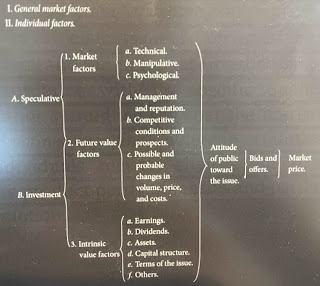
Alongside the famous line on the marketing being a voting machine, the authors also lay out this chart above to try to decipher what goes into determining market price. In short, there are so many things that make prices unpredictable in the short-term but yet it is the stock analyst's job to understand everything because in the long term, analysis of the business and its earnings power makes the difference.

Short term prices are also inexplicable but Wall Street wants actions and will explain for it, regardless whether the explanations are justified. This remains one of the hardest job of the day even for seasoned investors - to explain price action fo the day. Sometimes, stocks jump 5% for no reason and we only figure it out over the next few days.

Again, here are lines from the authors themselves:

The exaggerated response made by the stock market to developments that seem relatively unimportant in themselves is readily explained in terms of the psychology of the speculator. He wants action, first of all; and he is willing to contribute to this action if he can be given any pretext for bullish excitement (whether through hypocrisy or self-deception, brokerage-house customers generally refuse to admit they are merely gambling with ticker quotations and insist upon some ostensible reason for their purchases.) 

Stock dividends and other favorable developments of this character supply the desired pretexts, and they have been exploited by the professional market operators, sometimes with the connivance of the corporate officials. The whole thing would be childish if it were not so vicious. The securities analyst should understand how these absurdities of Wall Street come into being, but he would do well to avoid any form of contact with them.

As such, in order to profit from stock investment, we come back to valuation. We cannot win trying to profit from short term market movement. The only logical way to win is to determine the intrinsic value of the stock and buy with sufficient margin of safety. The following paragraph, the authors cautioned that general market conditions ie beta sometimes overwhelm everything so we need to be careful.

Investment in bargain issues needs to be carried out with some regard to general market conditions at the time. Strangely enough, this is a type of operation that fares best, relatively speaking, when price levels are neither extremely high nor extremely low. The purchase of "cheap stocks" when the market as a whole seems much higher than it should be will not work out well, because the ensuing decline is likely to bear almost as severely on these neglected or unappreciated issues as on the general list. 

On the other land, when all stocks are very cheap, there would seem to be fully as much reason to buy undervalued leading issues as to pick out less popular stocks, even though these may be selling at even lower prices by comparison.

On valuations, it was refreshing to see that the authors did lay out something concrete and also attributed the development to a certain Roger Babson (pic above), whom I didn't know who he was but apparently someone famous back then. The following is his rule of thumb:

The multipler might be equivalent to capitalizing the earnings at twice the current interest rate on the highest grade industrial bonds. The period for averaging earnings would ordinarily be seven to ten years.

In short, if the bond yields are at 3-4%, then earnings yield should be double of that at 6-8% and we should use the averaging earnings over 7-10 years. So we come back to why we should always buy stocks trading at teens price earnings, which can be difficult in today's context, so I would carefully stretch that to low twenties. 

Last but not least, here's their words on wisdom on trading. In trading, there is no margin of safety, you are either right or wrong and if you are wrong you lose money.

The cardinal rule of the trader that losses should be cut short and profit safeguarded (by selling when a decline commences) leads in the direction of active trading. This means in turn that the cost of buying and selling becomes a heavily adverse factor in aggregate results. 

Friday, December 30, 2022

Introducing Substack

I was introduced to Substack, a platform for writing and found it very complementary to the current blogspot space. Substack also has an app and allows for podcasts, chats and can help foster the discussion better. As such I have created 8percentpa.substack.com which will have posts from the current blogspot space (free) and also discuss investment ideas and strategies (paid subscription). Please sign up for the free subscription to give it a try!


Going forward, the blog will continue to discuss investment thoughts, charts, books, financial basics while the Substack will focus on value added posts. We will also track and publish the track record of the ideas, discuss lessons learnt and invite readers to contribute as well. This is the power of Substack, which allows for deeper interactions and collaborations.

I believe that a simple successful investment process depends on:

1. Good insights and initial due diligence

2. Discussing the idea with other like minded investors to uncover plotholes in the investment thesis.

3. Buying at the right valuation

4. Monitor and sell when valuation is rich

This blog and Substack will help with all the steps but step #2 is where everyone can chime in to discuss and help refine investment ideas which will create investment returns for everyone. We hope you can continue to support us in this effort and huat together!

Here's wishing all readers happy holidays and a good 2023 ahead!


Friday, December 16, 2022

Taking Stock of the Stock Market and the World

Time files. We are coming to the end of 2022 and it is always good to take stock at such timing. How was the year? Did we have anything to celebrate? What are the lessons learnt? As of this writing, there is nothing much to celebrate. We are still not out of the COVID-19 pandemic. We have a war in Ukraine and the global stock market has corrected on average 17% since the start of the year. Nasdaq is down almost 30%. 

NASDAQ -28% 
HKSE -25% 
DAX -21% 
SPX -17% 
Nikkei -10% 
STI -1%
Source: Tigerbrokers

Surprisingly, STI is flat while most markets are down double digits.

Valuations remain high despite interest rates going up. More importantly – the risk-free rates are going up! As you may recall from those textbook studying days, risk free rate forms the basis of all valuation. If I can earn 4% risk free, which is what the Singapore government Treasury bills give today, very broadly speaking, there is no reason to buy any stock with PER > 25x i.e. earnings yield < 4%. Why should I take risk to earn 4% or less when I can buy T-bills which are risk free and giving me 4%? 

But global stock markets have not caught up with this logic. The following are the PER and EV/EBITDA ratios for the same markets:

NASDAQ PE 26x EV 15x (vs low at PE 21 EV 10x in 2012) 
SPX PE 18x EV 12x (vs low at PE 13x EV 8x in 2011) 
Nikkei PE 15x EV 9x (vs low at PE 14x in 2018 and EV 7x in 2011) 
HKSE PE 11x EV 9x (vs low at PE 9x EV 7x in 2011) 
DAX PE 11x EV 7x (vs low at PE 11x EV 5x in 2011) -> DAX looks cheap! 
STI PE 11x EV 12x (vs low at PE 9x and EV 10x in 2011) 
Source: Bloomberg

Long term investors who had looked at a few cycles may recall that T-bills was not 4% when these valuations hit their lows in 2011-12. Japan has a different story back then and today and at PER 15x, it is not screamingly cheap, even though the yen is and everyone and his dog is in Tokyo buying luxury products. Germany, Hong Kong and Singapore look like of cheap, but clearly the US markets look expensive when compared against the current interest rate environment and with other markets. It is also expensive when compared against its own history. The SPX needs to be closer to Mar 2020 bottom of 2500 for valuation to make sense, assuming earnings hold up.

The old story goes as such, if US is not cheap and US falls, then the other markets will not be spared. Remember the old adage - when US market sneezes, the world catches a cold. Hence a lot of investors are bearish. Some are saying there will be a big, big crash e.g. GMO.


According to GMO, the markets should have collapsed pre-pandemic. We glimpsed that in Mar 2020 but then the huge rescue package from the various governments drove markets to new highs! At the end of 2021, the S&P hit its all-time high at c.4800 (see chart below).

Source: Google

This marked the backdrop of this crazy year. Since then, we had a war, inflation going through the roof, the shortest tenure UK prime minister and the meltdown of the GBP, the UK bond and stock markets, the assassination of a former Japanese prime minister and Donald Trump having a second go to be the world’s most powerful man after he messed it up big time last time!

Just when we think the world cannot be crazier, Koreans squeezed into a small alley to watch K-pop stars and got stuck, resulting in a stampede that killed more than 100 girls, an unthinkable accident in a developed country (my heart goes out to the families, pls pray for them). At the same time, we also realized China has become a prison and is forcing their rich and powerful (with the ways and means) to flee the country, pushing up home prices and rentals in Singapore!

So, how do you feel about 2023?

I would say this. We are not at the bottom. The war in Ukraine is escalating and inflation is here to stay. This means that global interest rates will stay high and the stock markets need to correct to lower valuations before we can say we are near the bottom.

Inflation will be a big topic in 2023. The following chart shows Singapore’s inflation for the past 25 years and we are at historical high. While the chart may seem to have peak out, anecdotal evidence tells us this is not the case. Rental cost in Singapore continues to rise, we are still seeing restaurant raising prices and importantly, as long as global issues causing inflation are not tamed, we will continue to import it due to the nature of our open economy.

Source: tradingeconomics.com

This brings us back to the STI. Recall that it corrected 1% while the rest of world has corrected double digits. Yes, we trade at lower PER (11x) but that is because of the constituents are mostly in the financial sectors which command lower multiples. Moreover, against our own history, we are not super cheap.

The only cheap market seems to be the DAX, but with the Russia-Ukraine war still looming large and the energy crisis unfolding, it is hard to bet on Europe. There might be individual stocks that might be interesting. Screening tools could come in handy. For the courageous, there is the option to buy some short ETFs but we need to be careful about the decay which can be 6-10% per year. Caveat: this is definitely not value investing and only seasoned investors should try this!

In conclusion, 2023 might be the year to just hold on tight. We shall wait for interesting names getting to interesting valuations as alluded in our first ever real investment idea on 8percentpa.substack.com. But mostly, stay vigilant and stay liquid.

Huat ah!


Thursday, December 01, 2022

Value Investing Algorithm: Can We Put Warren Buffett in a Box?

I talked to a friend some time back and he asked an interesting question - can Value Investing be automated? What is the Value Investing algorithm? I thought long and hard about this. It should be possible. In fact, everything can be automated. It is just a matter of inputs, processes and output. Some processes have a lot of complexity but in theory, it is always possible. As complex as life can be, our DNA is an algorithm, determining how we eat, love, sleep, reproduce, fall sick and die. So, the answer is yes, value investing can be automated. The question is how. How can we put Warren and Charlie's wisdom into a box?

World's greatest living investors: Warren Buffett, 91 and Charlie Munger, 97

Before we answer that though, let's think about why it hasn't been done yet. Well, maybe it is too hard. There are too many inputs. Market share, number of competitors, profit per employee (including part-timers), culture, CEO's ambition, regulator's scrutiny, branding, strength of eco-system etc. For most of these inputs, you cannot put them into numbers, like how do you transform Coca Cola's brand value into a quantifiable number? Or how can we quantify Costco's business model of using peoples' homes as inventory storage thereby reducing its own cost of business? So if there are ways to quantify these attributes and put them into an algorithm, then perhaps the true essence of Value Investing can someday be digital. We can then figuratively put the world's greatest living investors into an ultimate money-making box that anyone can use to make tonnes of money.

Until we can do that, human value investors will still have the advantage.

The other problem with the markets and not just value investing is that everything affects everything else. The algorithm is not run independently and is affected by "other inputs" which we have no control over. This could be interest rates, wars, pandemics, politicians, terrorist attacks, new discoveries, blockbuster games or movies that no one expected etc. How will our algorithm be affected by these and how can we model them in? It is not easy. To add to that complexity, stock prices and stock markets are also affected by what other people do. It is a psychological game.

The case studies that come to mind are Netflix and Peleton. Peleton is Netflix combining a gym class while cycling at home. It became the ultimate pandemic start-up play. But its share price is affected by how people buy it up and down depending on the mood of the day. I couldn't say it has a solid business model but the market believed it did one day, then not so the next day. So the stock did just that. However, Netflix does have a solid business, it has hundreds of millions of subscribers paying $10-20 a month. Most readers on this blog cannot cancel Netflix even if we want to because our kids will scream at us. I am sure some hard-core value investors out there have figured out the intrinsic value of Netflix and will be looking to buy at a certain price. But can we create an algorithm so strong that we can also churn out the right intrinsic value, for Netflix, Peleton and all the 10,000 listed companies in the world?

Courtesy of Google images: Netflix's CEO Reed Hastings and Netflix's recent sub numbers

Ultimately, it comes back to valuations. If we buy something expensive, then it is inevitable that when the market mood swings towards negativity, the stock trades below our buying price, which hopefully is below its intrinsic value. Then there is still hope it will go back up someday. Recall that intrinsic value is always a range, it is not an exact number. As such, investing is not a science, which implies that creating an algorithm is inherently difficult.

In its most basic form, the intrinsic value depends on the company's earnings or income and a multiplier. The multiplier is based on the industry dynamics, the companies' earnings power which is exemplified as margins and ROEs, interest rates and investors' sentiment, amongst other things. The right multiplier gets redefined depending on the times. When I started this blog around 15 years ago, something trading above 25x price earnings is considered so expensive that I would not touch with a ten foot pole. Then I found that there is nothing to buy. I started buying stocks above 25x price earnings. Now, it looks like my original rule based on prudence may come back in vogue again.

However it is possible to use screens and quant trading based on valuations to make money. There are many quant shops that have done it. They made good money. Renaissance Technologies have gone a few steps further to perfect the quant-based money making machine. It delivered annualized c.40% returns over 40 years! Even putting Warren Buffett in a box could not have generated those kinds of returns.

What's most important for me though is that Value Investing is a journey. As we read about interesting companies and learn about their businesses, we understand the world that we live in. I become a better person as I become a better investor. If I created an algorithm just to find value stocks and buy blindly, then where is the fun in all this? 

That said, investing is not for everyone. If you do not have the time, passion and gut to stomach painful losses, it is best just to buy the index. That is the next best thing to putting Buffett in a box.

Huat Ah!

Saturday, November 19, 2022

Thoughts #29: Little Men Doing Big Things

Warning: this post contains spoilers for "The Crown", please do not read on if you are keen to watch without knowing story plots.

In Season Three of "The Crown", one of the episodes featured one of humankind's greatest achievement - the moon landing and how Prince Philip asked for a session with the astronauts. He wanted to know how they felt achieving what they had achieved only to find out that the astronauts just did what they were told, ticking off checklists, following procedures and just mundanely went and came back. He was very disappointed and then decided to renew his faith in religion.

But I think this episode taught us more about life than Prince Philip's read. The great achievements are sometimes, simply doing mundane things. The success of the moon landing mission was about:

1. Following procedures and checklists

2. Teamwork

3. Safety and contingencies on top of contingencies

4. Keep practicing until everything is prefect and there is no room for mistakes

In many ways, it is very similar to investing. Warren Buffett did all the mundane things for 30 years until people found out how tough it actually was. Then lo-and-behold, he achieved 20% return over that time frame and he just kept going and is still doing it today. That's the path to greatness.

"One small step for a man, but giant leap for mankind."

To me, greatness is about taking the small step every day, being disciplined, being consistent and being kind. In investing, it is about:

1. Reading

2. Debating with friends

3. Being patient and demanding the all-important margin of safety

4. Repeat the steps above

Once in a while, you will get the homerun stock and that's the alpha. Of course, sometimes, we can innovate our way to greatness (like Renaissance Technologies) and then we have to incorporate ways to put innovation into our processes.

Keep walking!