Saturday, January 15, 2022

Books #16: The Man Who Solved the Market

The Man Who Solved the Market is one of the best books I have read in 2021. This is the story of Jim Simons, founder of Renaissance Technologies, the world's most successful and most secretive quant fund. Even after the book is published, nobody knows exactly how Renaissance made so much money. The table below from the book says it all.

Jim Simons vs all gurus

These no.s are net of fees and the annualized returns before fees are above 50%, which means doubling the capital every 18 months or so. When so much money is being made so fast, it is no wonder the whole Renaissance team doesn't want anyone else to know the secret sauce nor are they interested in sharing. 

So we can only speculate how things actually work.

The details are scant. The book shared a couple of facts:

1. You need a lot of data for quant models to work and as such there are thousands of trades implemented at any point. Every trade is analyzed. It took decades before the team perfected their trading wins.

2. Trades at tested using mathematical / quantitative models, looking for correlations and robustness. Trades are based on math theories that may not have anything to do with economics or business fundamentals. Renaissance doesn't look for relevance or explanations.

It works because there are always anomalies that continue because humans are simply not rational. One of the most simple ones are traders and fund managers closing trades at the end of week or month, Renaissance takes advantage of that and reap the small returns by taking the other side. But most of time, according to people quoted in the book, they cannot explain fundamentally why some trades work, but that is okay.

The other revelation is that only slightly more than 50% of the trades are profitable. Although it is not stated in the book, it means that one the most important rule in trading - cutting losses, works. I learnt it while reading about the turtle traders. Their rule: as long as you cut loss at say 2% and let your profits run at double of that i.e. at 4% and above, you can win even if you only win 50% of the time. 


Besides getting the taste of the secret sauce, or rather more of a whiff of smelling it, what is also interesting is how the book weaved the whole history of the financial markets for the general reader. It talked about the turtle traders, the 1987 Oct crash, George Soros vs the Bank of England, LTCM, a few flash crashes caused by quants over the last two decades, needless to mention - the GFC and all the other important financial moments over the last 60-70 years. 

That was really just nostalgic for me and perhaps very educational for new students of finance.

It is worth noting that LTCM tried to do what Jim Simons did and blew up. So, in essence, Jim was the successful LTCM and when he succeeded, he stay hidden so that his team can continue to reap the profits from the anomalies. There is some value in maintain secrecy when you do have an edge as exemplified by Renaissance, KFC (Colonel Sanders' secret recipe), Coca Cola and famously in Japan: FANUC, the company that invented the numerical controllers for machine tools and robots.

The last bit of the book talks about how Renaissance employees managed to influence politics. Notably, one of the key staff allegedly supported Trump and got him into the Oval Office using his money and influence. It is a testament that big money is so powerful that it can decide politics and impact our lives.

Sunday, January 02, 2022

COVID-19 to Omicron: Three Years On

When the pandemic broke out in 2019, we had no idea how crazy this could get. I have always been a fairly optimistic person and I thought we should be done in 12 months, if not 18 months. The world will quickly revert to normal because humans are creatures of habit and we like to go back to our old ways of lives as soon as we can. This is why losing weight is so difficult and why we cannot really change and become something we are not. 

We are entering the third year into the pandemic now and things are not looking optimistic. New habits are now being formed which may replace old ones permanently. For instance, we may not need to meet everyone face-to-face going forward. Zoom or virtual meetings can easily become say 60% of all our meetings and old style phonecalls may still make up 20%. So the last 20% of face-to-face meetings will be saved for the most important, most precious counterparties.

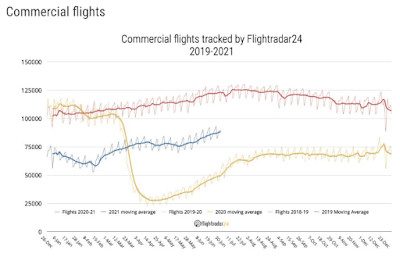
The big question is whether we will still fly as we used to. When the pandemic first broke, the airline industry quickly made a prediction: we will only get back to 2019's level of passenger volume by 2025. This was based on the experience from the 9-11 attack back in 2001. At first, I didn't want to believe that. We are so used to flying, how can that be true? Three years on, it now seemed likely, or perhaps, it could take even longer, since we are still only at 40-50% of 2019's levels.

Flight traffic comparison - courtesy of Flightrader24


This does not mean we will not travel anymore. It's the same as zoom or webex. We will save up for the best. We will still travel for leisure for sure. That's the first thing Singaporeans did! We are all not in Singapore now having not being able to travel for the last two years. Business travel should revert to some kind of new normal. For some, it could one less trip per year i.e. dropping for 4 to 3. For frequent flyers, it could be 10 to 8. But I believe, over time, we will surpass the previous peak. It is just whether it's 2025 or 2030. 

It may be just numbers (of years) to most of us, but to the airline industry, it's big difference. Our beloved carrier SQ or Singapore Airlines (SIA), continues to burn around S$300m every quarter and if it is going to drag on, they will need money again (it raised S$8 billion last year). Similarly, aviation related plays will continue to be affected. It is amazing how SIA is now S$5 after a massive 50% dilution. At one point it was even close to S$6 which was just a tad away from the share price (S$6.4) before the dilution! How can the stock be diluted half revert to its old price in a matter of months, when the pandemic that caused the whole situation is still with us? Sometimes the market just doesn't make sense.

SQ continues to burn money
 
As such, my belief is that SQ is overvalued now, even if we actually start to recover now from COVID-19, we may not have enough margin of safety for this name. But for other SG stocks, there could be. One name that comes to mind is Jardine Cycle and Carriage, which I have also discussed previously. It has been badly hit by the pandemic and has not rebounded. Partially because it is operating in Indonesia, an emerging country will limited bargaining power for vaccines, medicines and with its domestic consumption still weak, with no recovery in sight.

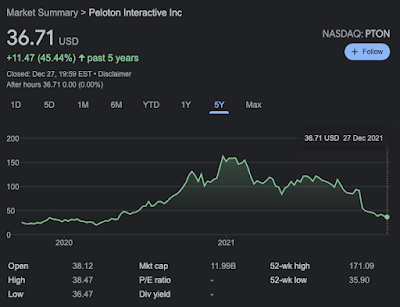
Similarly, there are many recovery plays that could be interesting: restaurants, cinemas, domestic tourism names in other countries (not so much Singapore) and we should think hard to find these names. On the flipside of the coin, we should be worried about pandemic positive stocks, like zoom and other SAAS names, that had done really well. Some of them have already collapsed, but we may not see it bottoming yet because valuations are still sky high. Just look at Peleton (below), the Netflix + stationary bike manufacturer.

Peleton's share price

At the height of the pandemic, everyone wanted a Peleton bike. The market cap was a crazy US$50 billion. It has fallen 80% but still it's US$12 billion market cap, which is bigger than SQ! This is a company with no earnings, no track record, no cashflow. Just the idea that you can watch motivation exercise videos and cycle to lose weight, which was the best thing ever when everyone was stuck at home. But what happens when we can go out again?

We live in the most unusual times. The GFC created the new paradigm shift to zero interest rates which caused asset prices to inflate through the roof. Some of this huge monetary expansion finds its way to fund startups and created giants (Gojek, Tiktok etc) in the span of a few years. Then the pandemic hit and we saw how it accelerated the growth of some of these co.s but decimated segments of the old economy.

In the midst of all this, we now have real world inflation, a possible bubble of everything and potential recovery in some covid-hit names. But we have to exercise caution because all this is not going to end well. We can only diversify (not so much into cash but different holdings, perhaps even crypto - topic for another day) and hope for the best!

Happy 2022, huat ah!


Saturday, December 25, 2021

Berkshire Hathaway in 2020-21

I have invested in Berkshire Hathaway for a decade or more based on the most simplistic investment thesis: this is Warren Buffett's company and he is the world's greatest investor. There was very little further due diligence after that. So is this investing or speculating?

"An investment operation is one which, upon thorough analysis, promises safety of principal and an adequate return. Operations not meeting these requirements are speculative." - Ben Graham

To satisfy Ben Graham, Warren Buffett's teacher, this post is a quick dive into of Berkshire Hathaway.

Here's a few numbers which should be read as average over the past few years:

Revenue c.USD250bn
Cashflow from operations c.USD40bn
Capex c.USD15bn
Free Cashflow c.USD25bn
Total assets c.USD870bn
Total equity c.USD440bn

Based on news report, Berkshire has rebounded with a 7% increase in overall profits with some of its businesses exceeding pre-pandemic levels. Cashpile is close to USD150bn and total equity portfolio has also rose to USD308bn and its market cap is now USD650bn.


Berkshire is the lifework of the world's greatest investor. It has compounded its value over the last 50 odd years, and should continue to grow its intrinsic value beyond Warren Buffett and Charlie Munger.

Merry Christmas and Huat Ah!


Wednesday, December 15, 2021

Charts #42: Offshore Wind

 This is an interesting chart from the Economist last month. Optimal offshore wind locations are at a certain latitude and we just need to build 500k offshore wind turbine to contribute to 7.5% of global energy output.

Offshore wind

Well, we are not starting from zero, we have 7,000 today. And to power the whole world, we just need to 7 million wind turbines at these optimal locations.

Wednesday, December 01, 2021

Economics: Factors of Production

I have never studied Economics academically and always felt it was my impediment as an investor. Now that my kids are taking the subject in school, I got hold of their textbooks and took this opportunity to learn with them. Yes, learning never stops.

In the first lesson in Economics, we are taught that there are four factors of production that is needed to produce finished goods and services. These are the building blocks that form the basis of any economy. Originally, there was only three, but over time, as knowledge increases, the fourth factor was added.

1. Labour: this refers to people, workers and manpower that make things and create services. People are also consumers and as such the largest economies tend to also have the largest populations.

2. Capital: this actually refers to financial and working capital (ie money in layman's term), fixed capital (equipment, servers, buildings) and also other forms of capital such as R&D and intellectual property.

3. Land: this is raw land and also the resources like copper, oil and gold under the land. This also includes forests for timber and water reservoirs. 

4. Entrepreneurship: this is human innovation and the ability to harness the top three factors and ingenuity to generate economic growth.

In the early days leading to the independence of Singapore, economic theory postulated that we could never have created any kind of economy since we have limited capital, labour and entrepreneurship. The biggest problem was that we didn't have land. We didn't even have enough water. Our forefathers really reinvented themselves to lay the foundations of the country and the abundance we have today. 

But it's fortunate we started in the 20th century and it became possible to create an economy and relying a lot on entrepreneurship and innovation.

Huat Ah!

Monday, November 15, 2021

NeverGrande: Is this China's Lehman Moment?

Last month, we witnessed the fall for Evergrande, the world's most indebted real estate developer, and the subsequent semi-bailout in stealth. While we do not know for sure if the Chinese government did step in, we have to assume so at the moment. Without the government's olive branch, Evergrande could  plunge China into pandemonium as the 80,000 retail investors who had invested in Evergrande rebelled, and the millions of Evergrande's homeowners could cause further unrest, threatening "common prosperity". Evergrande's share price has collapsed 90% since Jul 2020.


To recap, Evergrande owed USD300bn of debt which was accumulated to fund its crazy built-up of over 1.000 projects across 200 Chinese cities. It was reported that the company pre-sold 1.5m homes to Chinese citizens. Evergrande had always had issues. It just side-stepped them by launching new ventures and borrowing more money. But triggered by the pandemic which has caused disruption in the global supply chain, business workflow and money flow, rumor was that Evergrande would miss its bond payments and this would be the last straw that was going to take everything down.

This was really the last straw.

In summer, the cement, dynamite and sh*t hit the fan (figuratively, of course) and everything blew up. The courts took control of the firm's finances and the Central Bank even issued a rare warning. Losing confidence in Evergrande, workers, home-owners retail investors marched in the company's HQ claiming they were tricked and demanding to have their money back. Employees of the firm were similarly tricked alongside overseas investors and probably stand to lose the most. 

Evergrande's fallout then spread to the other developers. Smaller peers have defaulted and impacted bond and stock prices. While not picked up by the media, I am sure many homeowners are affected, losing their life savings. Tragedies abound. The old adage comes to mind: caveat emptor, buyers beware.

The worst is not over. The following table below from FT details the upcoming bond payments. In March and April 2022, there will be USD3.6bn or principal repayment due. If Evergrande or the Chinese government cannot raise the money, we are looking at the next rollercoaster plunge and perhaps China's Lehman Moment (which arguably, started in September when the problem was picked up by global media).

Courtesy of FT

Analysts have long warned about Evergrande. Amongst the big developers, it always stood out with more debt, more aggressive accounting and more issues. As early as 2012, short seller Andrew Left raised issues with Evergrande but was silenced by the Hong Kong authorities at that time. He was charged with market disconduct and banned from trading for five years. His ban is still on today despite his thesis being vindicated! 

This is another example of how the global system is pretty broken at times. It reminds me of the how Jho Low got to defraud Malaysia and got away with wiring billions across the world via major US and European global banks, making a fool of the SWIFT system and nobody caught him. He is still at large today. Well, that's the truth, nobody knows sh*t. People who run systems sometimes really have no idea.

So, what can we learn from Evergrande?

I think there are two important lessons, one for investors and one for understanding powers at play. As investors, we have to bolt when we smell trouble. This is a lesson that took me a while to learn because psychology is at work. We hate losing money and loss aversion clouds our minds. I made the same mistakes with Hyflux, Bayer, Sembmarine and so many other stocks which is in the portfolio.

When trouble brews and you have a position, the first thing to do is not wait-and-see. It is to cut loss. There is always a "canary in the coal mine" that died to warn us of danger. We must be vigilant to understand the tell-tale signs and more importantly take action by selling! 

The following timeline (courtesy of Reuters) shows how Evergrande's problems were well known. On hindsight, there was an optimal point to sell around Jul 2020 when the stock rebounded with the markets with the pandemic recovery rally. But one would have save some money by selling at any point.

August 2017 

Evergrande vows to cut debt for the first time, aiming to slash net gearing ratio to 70% by June 2020 from 240% in June 2017. 

November 2018 

Central bank names Evergrande as one of few financial holding conglomerates on its watch that it said could cause systemic risk. 

March 2020 

Evergrande targets cutting its debt by 150 billion yuan ($23.3 billion) annually for three years. 

August 2020 

Regulators meet with 12 major property developers, including Evergrande, to introduce caps for three different debt ratios in a pilot scheme dubbed “the three red lines”. Evergrande sells 28% of its property management unit for $3 billion ahead of the unit’s initial public offering (IPO) in Shenzhen.

September 2020 

Company offers 30% discount on properties for a month to push sales. 

October 2020 

Evergrande raises $555 million in a slimmed-down secondary share sale in Hong Kong. 

November 2020 

It terminates the Shenzhen backdoor listing plan. Some strategic investors agree not to demand repayment. Evergrande Property Services Group Ltd’s Hong Kong IPO raises $1.8 billion. 

January 2021 

China Evergrande New Energy Vehicle Group Ltd raises $3.4 billion by bringing in six new investors. 

March 2021 

Evergrande sells 10% of online real estate and automobile marketplace Fangchebao to 17 investors for $2.10 billion in a pre-IPO deal. It aims to meet all three caps on debt ratios by 2022-end. It plans to list Fangchebao by early next year, and spin off its water and tourism units among others. 

June 2021 

Evergrande says it will sell over half of its 58% stake in peer China Calxon Group Co Ltd, worth $386 million. Fitch downgrades Evergrande to ‘B’ from ‘B+’ with a negative outlook. The developer arranges HK$13.6 billion ($1.75 billion) to repay a maturing bond and interest on all other dollar bonds.

July 2021 

A court orders a freeze on a 132 million yuan bank deposit held by Evergrande at the request of China Guangfa Bank Co Ltd. Evergrande says the loan is not due until March and it plans to take legal action. 

 Some banks in Hong Kong decline to extend new loans to buyers of two of Evergrande’s uncompleted residential projects. Evergrande scraps a special dividend proposal. S&P cuts its credit rating on the company by two notches to B- from B+ with a negative outlook. Fitch downgrades Evergrande to “CCC+” from “B”. 

August 2021 

Moody’s downgrades Evergrande’s corporate family rating (CFR) by two notches to “Caa1” from “B2”. Legal sources say lawsuits against Evergrande across the country will be centrally handled by the Guangzhou Intermediate People’s Court. 

Hui Ka Yan steps down as chairman of flagship unit Hengda Real Estate Group which Evergrande says is due to the termination of its backdoor listing plan. 

China’s central bank and banking watchdog summon senior executives and issues a rare warning that Evergrande needs to reduce its debt risk and prioritise stability. Evergrande warns of liquidity and default risks.

September 2021 

Chairman Hui Ka Yan leads a pledge-signing ceremony to promise buyers it will complete construction of their homes.

Hui Ka Yan - Evergrande's founder

The second lesson is to understand people and powers at play. Undoubtedly, Hui Ka Yan, the still billionaire founder of Evergrande (after losing USD25 billion of his wealth) was a shrewd businessman and wasted no time to curry favor the new Xi's government and disassociate past links as early as 2012 when he dabbled into soccer to help bring China to the world's stage. In 2018, he was on the official list of 100 outstanding entrepreneurs, a recognition of his efforts by the Chinese government. He is also still a member of the Political Consultative Committee that advises the government on policy. 

But he was never in the inner circle and could never be in. So when Xi's anti-corruption campaign started and even Jack Ma was brought down, we must understand that a government bailout will always be difficult. This is now made even more difficult with the focus on "common prosperity". With USD11bn in his pocket, he probably has to dough out more to help the 80,000 retail investors and 1.5m homeowners first before his own prosperity becomes common.

A change in dynasty and/or paradigm is always big. It means that what we know hitherto no longer counts. Xi's rising in 2012 was big but it took the world a few years to realize that. The Lehman Moment defined global financial markets for more than a decade. We are still not out of the GFC's shadows. In China today, this focus on "common prosperity" is one huge paradigm shift. As for the next disruption in the financial world, crypto could be one.

So, stay tuned! Huat Ah!

Monday, November 01, 2021

Thoughts #26: Tesla at USD 1 trillion

Tesla became a trillion dollar market cap company last week (end Oct 2021). This is a company that has not made positive cashflow since its inception. Yet, the market is saying this company should be in the exclusive club of trillion dollar companies, of which there are only six members today.

Trillion dollar club

In my view, Tesla meteoric rise is a testament of two factors:

1. QE Infinity

2. We are in the biggest bubble of all times

It is a true irony that I am half-way through reading Ben Graham's Security Analysis and yet living in this moment when fundamentals do not seemed to matter anymore. In Ben Graham's days, he did not even bother to look at earnings because it was not possible to project companies' earnings with confidence. So he only looked at the balance sheet and only with co.s that has more current assets vs its market cap (a.k.a. net-nets).

Value investing then evolved to look at earnings of stable companies. Then we look at good businesses with strong moats. These are companies that can generate stable, growing cashflows. Today, I am not sure what we are looking at. Tesla has very little equity, no earnings, no cashflow and no moat. Yet, the market is saying it is worth a trillion dollars.

Tesla's $1.1trn market cap

 However, stocks will always revert to their intrinsic values. That is the truth like how gravity pulls objects down or how the sun rises from the east. It could be the case that QE Infinity will cause intrinsic values to be recalculated off different risk-free rates and different risk premium (ie like 50x PE for good stocks can be the norm in the future because investors simply cannot get better returns anyways) but stocks will revert to their intrinsic values.

Let's see if Tesla's intrinsic value is truly 1,000,000,000,000 dollars.


Friday, October 22, 2021

Charts #41: Breakthrough Energy

Breakthrough Energy is one of Bill Gates' company that is big on sustainability. The following chart and link provides good info for future reference.


https://www.breakthroughenergy.org/our-challenge/the-green-premium

The sustainability problem will become one of the biggest topic for us and our children. Let's hope we can solve it!

Tuesday, October 05, 2021

Books #15: Bill Gates' How to Avoid a Climate Disaster

I picked up this book without much expectations. After all, so much has been said about climate change, is there anything new? Bill Gates was the world's richest man, still a billionaire and recently more of a philanthropist, how much did he know about climate change? What's more, his womanizing history caught up with him and he got divorced! So, can we actually trust this guy?

Well, I have also learnt some time back to think about the message. Brilliant truths are not about the messengers. Of course, someone respected and credible saying something is always the gold standard. But there are intrinsic truths utter by liars that will nevertheless remain true. As a simple example, if Donald Trump says Ï€ equals to 3.14159265, it is still true. Despite the speaker having a track record as a recalcitrant liar.


Bill Gates is not a liar. He has no reason the write a book about some topic that already has so much publicity. At a time when he is having trouble with his wife! So, let's pay attention to his message. As such, I wanted to put this down for future readers and for myself to remember the important message.

I believe there are three key takeaways:

1. Big numbers to define the problems

2. We must do something now, if not the problem gets bigger.

3. The solution is to reduce the green premiums to zero.

Bill Gates, being a geek, likes to throw out a lot of numbers and as investors, we should take note. Numbers are important. So these are the important numbers:

51 billion tonnes of carbon. Humans produce this every year and we need to get this to zero. 

The world needs of the current electricity generation capacity of 5,000 GW to be from renewable and zero-carbon sources. If we want to achieve this, it will take a lot innovation and willpower. He also believes we need to use more nuclear power.

On the second point, it's really self explanatory. A stitch in time saves nine. If we don't do it now, the problem gets bigger and it may become intractable. I did not remember if the number came from the book. But roughly speaking, if we don't do anything now, the cost to do something 10 years later will be 10x higher and we are talking about trillions of dollars here!

The last point on green premium is really the core of the book. For almost all situations, the zero-carbon solution will cost more. The point is to reduce the green premium to zero. There are examples that this has been achieved. For example heat pumps to regulate temperature in buildings. If we innovate and use technology to reduce green premiums, we can incentivise the world to go green faster. 

This is definitely a book worth keeping. Hope to read again if there's time. 

Huat Ah!


Monday, September 20, 2021

2021 HK Dividend List - Bonus!

Hong Kong and China has matured as stock markets over the last 20 years. In 2005, Jim Rogers famously said that the 21st Century belongs to Asia and China, especially, which was awakening to capitalism after years of structural reform. The big beneficiary was the Hong Kong's capital markets. Shortly after, China went ahead to drive the commodities supercycle, became the world's largest exporter and now on its way to become the world's largest consumer market. Yes, we will continue to see the growth of China. 

2021 HK dividend list

This is the first list of interesting HK and China names and we see the corollary from the preamble above. Anhui Couch, China's second largest cement company and China Resources Cement were the Chinese companies that drove the commodities boom. Alongside was Zoomlion, the excavator manufacturer, helping to build up China's infrastructure over the last decade. Qingdao Port, an execution arm of China's export capabilities and Haitian, one of the plastic injection mold companies benefiting from the export trend. Then we have a bunch of consumer companies like Want Want and Uni-President which will be compounding growth in the years ahead. 

ROE and ROA driven screen

The criteria are similar to the Singapore list generated a few weeks ago whereby ROA and ROE drives the screener. The first part of the list shown here cuts off at market cap of HKD 35 billion (c.USD 5 billion) which is good. We do not like companies with small market caps as it's just risky. Remember Singapore only has less than 30 companies with more than USD 5 billion in market cap. That said, if we have done good analysis and are confident that they won't go belly up, it is okay to buy small caps. Those are the names that can give 10x returns (except Hyflux, which was USD 1 billion when it went belly-up).

If I were to pick one name from this list, it would be Want Want. We know that snacks are irresistible, the market will grow at high single digit and Want Want has the track record to keep growing. The metrics look pretty good too. ROE at 24% and ROA at 12% and operating margins are over 20%. Most importantly, the stock is not expensive at teens PE. However, the screen is always just the starting point. We must do more work. The stock price has collapsed from its peak and not moved for a couple of years. We need to find out why. 

That's what screens are about. We use screens for a first cut and then do the deep dive. It is hard work!

As usual, here's the past lists:

2020 Dividend List
2019 Dividend List
2018 Dividend List - Part 4
2018 Dividend List - Part 3
2018 Dividend List - Part 2
2018 Dividend List - Part 1
2017 Oct Dividend List - Part 2
2017 Oct Dividend List - Part 1

Huat Ah!