Friday, December 30, 2022

Introducing Substack

I was introduced to Substack, a platform for writing and found it very complementary to the current blogspot space. Substack also has an app and allows for podcasts, chats and can help foster the discussion better. As such I have created 8percentpa.substack.com which will have posts from the current blogspot space (free) and also discuss investment ideas and strategies (paid subscription). Please sign up for the free subscription to give it a try!


Going forward, the blog will continue to discuss investment thoughts, charts, books, financial basics while the Substack will focus on value added posts. We will also track and publish the track record of the ideas, discuss lessons learnt and invite readers to contribute as well. This is the power of Substack, which allows for deeper interactions and collaborations.

I believe that a simple successful investment process depends on:

1. Good insights and initial due diligence

2. Discussing the idea with other like minded investors to uncover plotholes in the investment thesis.

3. Buying at the right valuation

4. Monitor and sell when valuation is rich

This blog and Substack will help with all the steps but step #2 is where everyone can chime in to discuss and help refine investment ideas which will create investment returns for everyone. We hope you can continue to support us in this effort and huat together!

Here's wishing all readers happy holidays and a good 2023 ahead!


Friday, December 16, 2022

Taking Stock of the Stock Market and the World

Time files. We are coming to the end of 2022 and it is always good to take stock at such timing. How was the year? Did we have anything to celebrate? What are the lessons learnt? As of this writing, there is nothing much to celebrate. We are still not out of the COVID-19 pandemic. We have a war in Ukraine and the global stock market has corrected on average 17% since the start of the year. Nasdaq is down almost 30%. 

NASDAQ -28% 
HKSE -25% 
DAX -21% 
SPX -17% 
Nikkei -10% 
STI -1%
Source: Tigerbrokers

Surprisingly, STI is flat while most markets are down double digits.

Valuations remain high despite interest rates going up. More importantly – the risk-free rates are going up! As you may recall from those textbook studying days, risk free rate forms the basis of all valuation. If I can earn 4% risk free, which is what the Singapore government Treasury bills give today, very broadly speaking, there is no reason to buy any stock with PER > 25x i.e. earnings yield < 4%. Why should I take risk to earn 4% or less when I can buy T-bills which are risk free and giving me 4%? 

But global stock markets have not caught up with this logic. The following are the PER and EV/EBITDA ratios for the same markets:

NASDAQ PE 26x EV 15x (vs low at PE 21 EV 10x in 2012) 
SPX PE 18x EV 12x (vs low at PE 13x EV 8x in 2011) 
Nikkei PE 15x EV 9x (vs low at PE 14x in 2018 and EV 7x in 2011) 
HKSE PE 11x EV 9x (vs low at PE 9x EV 7x in 2011) 
DAX PE 11x EV 7x (vs low at PE 11x EV 5x in 2011) -> DAX looks cheap! 
STI PE 11x EV 12x (vs low at PE 9x and EV 10x in 2011) 
Source: Bloomberg

Long term investors who had looked at a few cycles may recall that T-bills was not 4% when these valuations hit their lows in 2011-12. Japan has a different story back then and today and at PER 15x, it is not screamingly cheap, even though the yen is and everyone and his dog is in Tokyo buying luxury products. Germany, Hong Kong and Singapore look like of cheap, but clearly the US markets look expensive when compared against the current interest rate environment and with other markets. It is also expensive when compared against its own history. The SPX needs to be closer to Mar 2020 bottom of 2500 for valuation to make sense, assuming earnings hold up.

The old story goes as such, if US is not cheap and US falls, then the other markets will not be spared. Remember the old adage - when US market sneezes, the world catches a cold. Hence a lot of investors are bearish. Some are saying there will be a big, big crash e.g. GMO.


According to GMO, the markets should have collapsed pre-pandemic. We glimpsed that in Mar 2020 but then the huge rescue package from the various governments drove markets to new highs! At the end of 2021, the S&P hit its all-time high at c.4800 (see chart below).

Source: Google

This marked the backdrop of this crazy year. Since then, we had a war, inflation going through the roof, the shortest tenure UK prime minister and the meltdown of the GBP, the UK bond and stock markets, the assassination of a former Japanese prime minister and Donald Trump having a second go to be the world’s most powerful man after he messed it up big time last time!

Just when we think the world cannot be crazier, Koreans squeezed into a small alley to watch K-pop stars and got stuck, resulting in a stampede that killed more than 100 girls, an unthinkable accident in a developed country (my heart goes out to the families, pls pray for them). At the same time, we also realized China has become a prison and is forcing their rich and powerful (with the ways and means) to flee the country, pushing up home prices and rentals in Singapore!

So, how do you feel about 2023?

I would say this. We are not at the bottom. The war in Ukraine is escalating and inflation is here to stay. This means that global interest rates will stay high and the stock markets need to correct to lower valuations before we can say we are near the bottom.

Inflation will be a big topic in 2023. The following chart shows Singapore’s inflation for the past 25 years and we are at historical high. While the chart may seem to have peak out, anecdotal evidence tells us this is not the case. Rental cost in Singapore continues to rise, we are still seeing restaurant raising prices and importantly, as long as global issues causing inflation are not tamed, we will continue to import it due to the nature of our open economy.

Source: tradingeconomics.com

This brings us back to the STI. Recall that it corrected 1% while the rest of world has corrected double digits. Yes, we trade at lower PER (11x) but that is because of the constituents are mostly in the financial sectors which command lower multiples. Moreover, against our own history, we are not super cheap.

The only cheap market seems to be the DAX, but with the Russia-Ukraine war still looming large and the energy crisis unfolding, it is hard to bet on Europe. There might be individual stocks that might be interesting. Screening tools could come in handy. For the courageous, there is the option to buy some short ETFs but we need to be careful about the decay which can be 6-10% per year. Caveat: this is definitely not value investing and only seasoned investors should try this!

In conclusion, 2023 might be the year to just hold on tight. We shall wait for interesting names getting to interesting valuations as alluded in our first ever real investment idea on 8percentpa.substack.com. But mostly, stay vigilant and stay liquid.

Huat ah!


Thursday, December 01, 2022

Value Investing Algorithm: Can We Put Warren Buffett in a Box?

I talked to a friend some time back and he asked an interesting question - can Value Investing be automated? What is the Value Investing algorithm? I thought long and hard about this. It should be possible. In fact, everything can be automated. It is just a matter of inputs, processes and output. Some processes have a lot of complexity but in theory, it is always possible. As complex as life can be, our DNA is an algorithm, determining how we eat, love, sleep, reproduce, fall sick and die. So, the answer is yes, value investing can be automated. The question is how. How can we put Warren and Charlie's wisdom into a box?

World's greatest living investors: Warren Buffett, 91 and Charlie Munger, 97

Before we answer that though, let's think about why it hasn't been done yet. Well, maybe it is too hard. There are too many inputs. Market share, number of competitors, profit per employee (including part-timers), culture, CEO's ambition, regulator's scrutiny, branding, strength of eco-system etc. For most of these inputs, you cannot put them into numbers, like how do you transform Coca Cola's brand value into a quantifiable number? Or how can we quantify Costco's business model of using peoples' homes as inventory storage thereby reducing its own cost of business? So if there are ways to quantify these attributes and put them into an algorithm, then perhaps the true essence of Value Investing can someday be digital. We can then figuratively put the world's greatest living investors into an ultimate money-making box that anyone can use to make tonnes of money.

Until we can do that, human value investors will still have the advantage.

The other problem with the markets and not just value investing is that everything affects everything else. The algorithm is not run independently and is affected by "other inputs" which we have no control over. This could be interest rates, wars, pandemics, politicians, terrorist attacks, new discoveries, blockbuster games or movies that no one expected etc. How will our algorithm be affected by these and how can we model them in? It is not easy. To add to that complexity, stock prices and stock markets are also affected by what other people do. It is a psychological game.

The case studies that come to mind are Netflix and Peleton. Peleton is Netflix combining a gym class while cycling at home. It became the ultimate pandemic start-up play. But its share price is affected by how people buy it up and down depending on the mood of the day. I couldn't say it has a solid business model but the market believed it did one day, then not so the next day. So the stock did just that. However, Netflix does have a solid business, it has hundreds of millions of subscribers paying $10-20 a month. Most readers on this blog cannot cancel Netflix even if we want to because our kids will scream at us. I am sure some hard-core value investors out there have figured out the intrinsic value of Netflix and will be looking to buy at a certain price. But can we create an algorithm so strong that we can also churn out the right intrinsic value, for Netflix, Peleton and all the 10,000 listed companies in the world?

Courtesy of Google images: Netflix's CEO Reed Hastings and Netflix's recent sub numbers

Ultimately, it comes back to valuations. If we buy something expensive, then it is inevitable that when the market mood swings towards negativity, the stock trades below our buying price, which hopefully is below its intrinsic value. Then there is still hope it will go back up someday. Recall that intrinsic value is always a range, it is not an exact number. As such, investing is not a science, which implies that creating an algorithm is inherently difficult.

In its most basic form, the intrinsic value depends on the company's earnings or income and a multiplier. The multiplier is based on the industry dynamics, the companies' earnings power which is exemplified as margins and ROEs, interest rates and investors' sentiment, amongst other things. The right multiplier gets redefined depending on the times. When I started this blog around 15 years ago, something trading above 25x price earnings is considered so expensive that I would not touch with a ten foot pole. Then I found that there is nothing to buy. I started buying stocks above 25x price earnings. Now, it looks like my original rule based on prudence may come back in vogue again.

However it is possible to use screens and quant trading based on valuations to make money. There are many quant shops that have done it. They made good money. Renaissance Technologies have gone a few steps further to perfect the quant-based money making machine. It delivered annualized c.40% returns over 40 years! Even putting Warren Buffett in a box could not have generated those kinds of returns.

What's most important for me though is that Value Investing is a journey. As we read about interesting companies and learn about their businesses, we understand the world that we live in. I become a better person as I become a better investor. If I created an algorithm just to find value stocks and buy blindly, then where is the fun in all this? 

That said, investing is not for everyone. If you do not have the time, passion and gut to stomach painful losses, it is best just to buy the index. That is the next best thing to putting Buffett in a box.

Huat Ah!

Saturday, November 19, 2022

Thoughts #29: Little Men Doing Big Things

Warning: this post contains spoilers for "The Crown", please do not read on if you are keen to watch without knowing story plots.

In Season Three of "The Crown", one of the episodes featured one of humankind's greatest achievement - the moon landing and how Prince Philip asked for a session with the astronauts. He wanted to know how they felt achieving what they had achieved only to find out that the astronauts just did what they were told, ticking off checklists, following procedures and just mundanely went and came back. He was very disappointed and then decided to renew his faith in religion.

But I think this episode taught us more about life than Prince Philip's read. The great achievements are sometimes, simply doing mundane things. The success of the moon landing mission was about:

1. Following procedures and checklists

2. Teamwork

3. Safety and contingencies on top of contingencies

4. Keep practicing until everything is prefect and there is no room for mistakes

In many ways, it is very similar to investing. Warren Buffett did all the mundane things for 30 years until people found out how tough it actually was. Then lo-and-behold, he achieved 20% return over that time frame and he just kept going and is still doing it today. That's the path to greatness.

"One small step for a man, but giant leap for mankind."

To me, greatness is about taking the small step every day, being disciplined, being consistent and being kind. In investing, it is about:

1. Reading

2. Debating with friends

3. Being patient and demanding the all-important margin of safety

4. Repeat the steps above

Once in a while, you will get the homerun stock and that's the alpha. Of course, sometimes, we can innovate our way to greatness (like Renaissance Technologies) and then we have to incorporate ways to put innovation into our processes.

Keep walking!

Friday, November 04, 2022

Lessons Learnt from 4 Biggest Losses - Part 2

This is a continuation of the previous post lessons learnt from my 4 Biggest Losses. To recap they are: 

1. Overseas Education, negative c.30%, operator of one of the largest international schools in Singapore. Student enrollment and revenue fell continuously for almost 10 years. It was exacerbated by the pandemic but even if the world normalizes, it is unclear if the stock will rebound. Management are owners and exemplified small cap risks.

2. SIA Engineering, negative c.20%, aircraft maintenance arm of our national carrier. I overpaid for this and am now suffering. It is unclear if I can breakeven. Oversizing the position also caused outsized absolute losses. This is the ultimate reminder for me not to overpay and to size my bets well.

3. Under Armor, negative c.70%, this was a stock that got into the portfolio because of a structured product went wrong. I sold puts and it got exercised. After holding the stock, it continued to drop and was hit by the pandemic. While there is a chance it can go up 100% or more from here (the 40x gap between Under Armor's and Nike's market cap seemed too big), I am not betting on it. This is another lesson about valuation - never overpay!

4. Cinema related small cap name, negative c.80%, this is a Chinese cinema technology provider that was badly hit by the pandemic. It is also another small cap name which comes with it small cap risks, like Overseas Education. The lesson is therefore not to invest in too many small caps and/or if we must, demand a much higher valuation discount.

In a nutshell, the lessons learnt here are: sizing, small cap risk, understanding unknown risks and over-valuation. I have discussed about sizing and hence we shall touch upon the rest today.

Small cap: I would refer to stocks trading at lower than USD2bn market cap and this was the case with #1 and #4 above. Small caps are usually run by owners, less experienced management teams and the business revenue also tend to be more volatile and as such deserves lower valuations. But we tend to forget that and ascribe just a 10-20% valuation discount to a similar business which is much bigger. 

Courtesy of CME Group

Looking at the four names, we can also argue whether Under Armor (market cap USD3.9bn) truly has an investment case. It is small cap looking through the eyes of Nike (market cap USD147bn) and Adidas (market cap USD28bn). One is much better off buying Nike or Adidas. Why bother with the third smallish player? The chart above says it all - it shows returns between large cap and small cap are not really different yet small cap investors take on a lot more risks. As such, the lesson here is that perhaps we should just avoid small caps. 

Understanding the risks: This brings us to the second lesson. We think we have uncovered everything. We have done our homework well. But it is actually very difficult, especially with small caps and inherently volatile industries. I think there are no good advice (to myself and readers) here, it takes years of experience to understand some of these industries and I urge everyone to always have robust discussions with other smart thinkers. 

The case-in-point here is the cinema technology provider that I bought which has gone down 80%. We all go to cinemas and we think we know the industry well. But with Netflix and streaming disrupting the industry, let alone all the faster changes in China, the writings were on the wall that risks are mounting. When the pandemic hits such small cap names, it was game over. 

It was a similar story with SIA Engineering. I thought I got the investment thesis right. There will be a lot more middle income tourists in the world, Changi will build T4 and T5 and SIA Engineering will benefit. I discussed with smart friends and even though they said it is not water-tight, I refused to listen. Lo-and-behold the pandemic came and turned everything upside down. Looking back, the airline industry is just inherently volatile and it doesn't pay to put too much money into one name and let alone related names (yes, I have other related names!).

Over-paying: There are multiple mistakes with SIA Engineering. Not only did I read the industry wrongly, I overpaid for it at more than 20x PER at the time of buying. I did the same with the cinema name (25-30x PER), believing in the growth story. I also overpaid for Under Armor at more than 30x PER. So much so for proclaiming to be a value investor. But this is also portfolio-manager-wanting-action error. 

Swing you bum! - Courtesy of MyTrade PH

Sometimes, we are compelled do to things even when there is nothing that we should do. From 2016-2020, the market was overvalued and as such most stocks are over-valued. I thought I was getting bargains for getting these high growth names at 25-30x PER. After all, Amazon and Tesla did so well trading at even higher valuations right? Well, unfortunately, I didn't have those but had these! The related lesson is that not all sexy stocks are the same. So perhaps it was best to avoid high valuations, esp after triangulation, they are still high. Again it's easier said than done. The inner voice is constantly shouting "Swing you bum!"

To sum up this last lesson:

1. When everything is expensive, it pays to do nothing.

2. Don't think your growth stock is Tesla.

3. Do not overpay. 

Huat ah!


Friday, October 21, 2022

Books #18: Security Analysis - Part 2

This is one of those long awaited sequel post as we took time to discuss T bills and dividend stocks given the interesting market movements in the recent months. As mentioned in the past post, Security Analysis is this seminal book which provides good lessons for any investors but it's a bit difficult to read. But we can still learn a few lessons from it.

As promised, let's discuss the financial shenanigans and bad management which happened then (i.e. c.1920s) and will still happen as long as humans are greedy. As the gurus put in, the financial statements that will uncover financial shenanigans are usually the balance sheet and the cashflow. The P&L statement is the most straightforward and since most laymen can read it, shrewd management will not screw that up. 

The balance sheet and the cashflow statements require more financial knowledge and it is the balance sheet that is used to hide the bad stuff. As such, the authors of Security Analysis warned against bloated balance sheets. By bloated, we are referring to account receivables, other assets, other liabilities and lines in the balance sheet that is used to hide the bad stuff. 

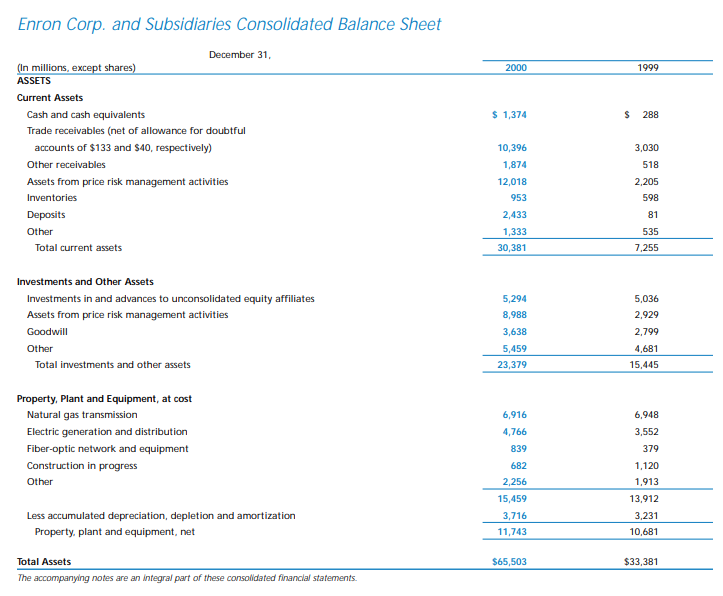
Most of the time, it is not easy to uncover because bad management has gone all out to hide stuff. I managed to find Enron's balance sheet in year 2000 online. Without hindsight, it is not easy to say things are wrong. The lines - "asset from price risk management activities" were where most of the bad was parked under, USD21bn worth of it, but management made so much effort to explain it so well that it's difficult to fault analysts for not being able to figure things out. 

Bad management will never admit that they are bad so sometimes, in the end, it really boils down to gut feel. I have written about this on various posts in the past: Billon Dollar Whale Fraud Detection Lessons and Theranos, the fraudulent startup. To jot down a few tell-tale signs:

1. Bloated balance sheet, what we have we talking about so far

2. Keep talking about importance of secrecy, trade secret and know-how, trademark protection to mask the lack of disclosure

3. Lack of governance

4. Past issues with the law, including ongoing litigation.

As a side note, companies with litigation risks should also be avoided because the cost is simply to hard to measure. We discussed BP and Bayer in the past on this infosite. Both names did not recover past their previous peaks after the litigation mess broke out. BP was the infamous Deepwater Horizon accident and Bayer was ensued in the supposedly cancer causing Roundup fertilizer class action lawsuits.

In the next and final post, we discus other lessons learnt from Security Analysis.

Huat Ah!

Friday, October 07, 2022

Lessons Learnt from 4 Biggest Losses - Part I

Most people brag about their investment wins. It is just human nature. We need to show we are better, so we get status, pride and get to lead and enjoy the benefits that get accrued to leadership in tribes. In prehistoric times, alpha males who can hunt, have muscles, can fight well tend to get the best food, the best shelter and the women and produce more offsprings and win the natural selection competition. 

As such, bragging is biological.

Alpha male primate can even get cookies!

Today, it is about money. You can be bald and fat but if you are a billionaire, then prestige and goodies and some women will come your way. So we brag about investment wins to showcase that. We buy cars, watches, houses and NFTs to display wealth. It is imperative, biologically and socially.  But what is truly and fundamentally beneficial is to learn from our losses. That is how we get better as investors. That is what this post and the next is about. 

As I look at my portfolio, there are now four big loss-making positions which I felt compelled to write about. The losses amount almost to six digits and you can imagine how it pains to write about them. But I believe there are many lessons learnt and I hope readers can really takeaway some of these so as not to repeat them. But trust me, it will be easier said than done! Here are the losers in no particular order:

1. Overseas Education, negative c.30%, I have blogged about this stock.

2. SIA Engineering, negative c.20%, pandemic victim, I have also briefly blogged about this.

3. Under Armor, negative c.70%, hit by overvaluation and the pandemic.

4. Cinema related small cap name, negative c.80%, looks like I will never recover my capital.

As I looked at the four painful names, I see similar mistakes and recurring lessons. While all four names were somewhat impacted by Covid-19, it was not just the pandemic. It was overpaying i.e. valuations, it was ignoring small cap risks and not understanding all the issues and most importantly, it was not getting the sizing right. Actually, sizing is so crucial so let's talk about that in more detail. 

What I got from Google wrt to sizing

For me, the sizing mistake relates to all four names but it had the biggest absolute damage in the first two. As such, despite the percentage loss was only 20-30%, the outsized impact on the absolute damage was big and this is the nutshell lesson about sizing:

We must size the bet such that we can still sleep if we lose 80% of the amount invested. We must also think in terms of percentage of the portfolio. In most professionally run portfolios, there are hard limits like 10% for one position but for personal accounts, we may want to size it lower depending on our own psychological construct and the amount of absolute loss we can bear.

Let's use so numbers to illustrate the above. First we must determine how much we can afford to lose in one position. I will arbitrary put that as S$40,000 which is close to half of Singapore's median household income. (Imagine when you need to tell your better half that you lost half a year's income on one stock. This should be good pyschological threshold ;) Looking at my actual losses, since a position can go down 80%, that means the maximum bet on one stock should be c.S$50,000. Of course that also depends on your portfolio. If this is more than 10% of your portfolio, then perhaps it should be smaller. 

There is also a minimum size for a position which relates to transaction costs. When I first started, round trip (buying and selling) transaction cost can cost minimally $100 which means that any position should be c.S$10,000 otherwise it doesn't make sense as it costs 1-2% every time you do some buying and selling. Well, the world has changed and transaction costs can go to zero with some brokers, but still, sometimes it's not and it pays to know what is the optimal minimal size for you.

Going back to my mistakes, if I sized the bets correctly, I could have reduce my absolute losses by half and the pain will also be halved and I would not have to endure the wrath of my better half! When you can size correctly, losses cannot hurt your portfolio and your family peace and you can sleep better at night. There is a lot more to talk about sizing which perhaps deserve its own post but let's stop here for today and we shall discuss in the next post:

1. Valuations 

2. Small cap issues

3. Unknown risks

There are two rules in investing. First rule: don't lose money. Second rule: don't forget the first rule.

Huat Ah!


Friday, September 30, 2022

2022 Australia Dividend Post - First ever!

As mentioned previously, Poems offer a good screener that is pretty sufficient for our purposes as value investors looking for good stock ideas. Today, we look at Australia, one of the most attractive and yet under-rated markets globally. Australia is the world's 18th largest economy by PPP at c.USD1.8trn which is roughly 6x larger than Singapore's. It took the record for the longest stretch of uninterrupted GDP growth in the developed world (26 years from 1991 to 2017) driven by good policies, growth of its natural resource producers and its strong financial sector. It is also a fertile hunting ground for good value and growth compounders even if we just look at large caps above USD10bn.

Criteria used for ASX's screening

I have almost always used the same criteria for screening (partly due to the limitation of the screen) and the above shows what is being used for today's Australia screen. The criteria are simply ROE at 10%, ROA at 5% and operating margins (OPM) at 10% and we generated a pretty interesting screen. I have not used traditional valuations such as PER and PBR because it will cut out interesting names such as CSL, Cochlear and Resmed etc. 

First section of 2022 ASX's screen

Valuation has evolved over the last 20 years and the way to value growth stocks might be to use Price to sales or PEG because traditional metric like PER and PBR does not work for the super growth companies we have seen like Tesla, Amazon. We also have a few of those in Australia shown on this first section. Aristocrat is one of the largest gaming machines maker and has compounded well over the last 20 years. Australia also has some of the most interesting healthcare names in the world. Cochlear is the company that invented ear implants and cure deafness. If Helen Keller was born in this era in Australia, she would be able to listen and speak. Then she may not become Helen Keller, but that's besides the point. Cochlear has the ability to ensure that no babies will be deaf since its founding, unfortunately government policies and restriction continue to inhibit this reality even though we already have the technology.

Second section of 2022 ASX's screen

The second section has James Hardie, a homebuilder that has compounded double digits for decades and Resmed, another world class healthcare company that cures sleep apnea. But what is worth highlighting today would be Woodside Petroleum. This is one of the pure LNG listed companies that has gone from strength to strength. With today's energy prices soaring, Woodside will continue to benefit. It should have been bought out by big majors but somehow it never happened. Now that is has grown to become a USD 60bn company, it might be too big to swallow, but we never know. Energy security will be ever more important. So glad I kept my global energy names all these years. 

As usual, here's the past lists:

2020 Dividend List
2019 Dividend List
2018 Dividend List - Part 4
2018 Dividend List - Part 3
2018 Dividend List - Part 2
2018 Dividend List - Part 1
2017 Oct Dividend List - Part 2
2017 Oct Dividend List - Part 1

Huat Ah!

Thursday, September 15, 2022

Charts #46: Fed's tightening

We are finally getting back to textbook's environment of risk free rate at 3% after years of QE although it remains to be seen if this can last.


Since Singapore's monetary policy imports rate from the US, do keep buying Singapore T-bills while the interest is still good!

Thursday, September 01, 2022

Singapore Treasury Bills from 1987-2022: Full Analysis

Singapore Treasury bills and bonds (T bills and bonds in short) continue to intrigue me as I studied the recent movements. Things started to get interesting around March 2022 when the US Fed started talking about hiking interest rates. The following table depicts our six month T bill movement - issue date and cut off yield, which is the yield we get when we subscribe, fortnite by fortnite (no gaming pun intended).

  • 20 Jan 0.48%
  • 3 Feb 0.69%
  • 17 Feb 0.76%
  • 3 Mar 0.78%
  • 17 Mar 0.95%
  • 31 Mar 1.22%
  • 13 Apr 1.32%
  • 27 Apr 1.56%
  • 11 May 1.69%
  • 26 May 1.8%
  • 9 Jun 2.04%
  • 23 Jun 2.36%
  • 7 Jul 2.66%
  • 21 Jul 2.93%
  • 4 Aug 2.87%
  • 18 Aug 2.98%
  • 1 Sep 2.99%
As of this writing, 6 month T bill pays 2.99%pa (1.49% over six months). This is risk free. Well, as long as Singapore stands, which I think she should for the next six months. I hope some of you subscribed as previewed in this post c.1 month ago! MAS also issues 1 year T bills but only on a quarterly basis and the latest cut off yields are as follow:
  • 13 Apr 2%
  • 21 Jul 3.1%

Singapore has one the highest home ownership in the world and as such I believe most of us reading this should have a mortgage. Given that mortgage rate is lower 2.99% (about 1.6-2.1% today), we should all draw out maximum mortgage and put into T bills, effective making free money! To illustrate this, if you can borrow at 2% and invest in this, using the 21 Jul 1 year T bill rate of 3.1%, you make 1.1% risk free with no equity. Let's use concrete no.s, say we can borrow $1m from the bank, which is not your capital since you borrowed it, then you buy the 1 year T bill and make 3.1%. After one year, you get back $1.031m, pay the bank $1.02m and voila you just made $11,000 with no capital outlay! 

Okay, you say there is duration mismatch. The mortgage can last 10, 20, 30 years, we cannot guarantee T bills will be at 3.1% for 10, 20, 30 years. The latest issue of our 10 year Gahmen bond has a cut off yield at 2.71% (see below). So technically, it is still doable. In fact, this also works if you can borrow at any kind of facility at 1-2%pa (ie lower than the cut off yield).


Now that we know this wonderful trick, the next relevant question would naturally be - so how much did our Singapore T bills yield over time? Here's the shocking conclusion. Read on. 

The MAS publishes all the data on T bills and bonds since 1987. Anyone can download all the data via the link below. The average 6 month T bill cut off yield has been 2.07% since 1987. While it has been mostly uninteresting at below 1% over the last decade or so, no thanks to QE, it did hit 3.05% in 2015 (and now 2.99%). In Jun 2000, right after the dot-com crash, it was 4.74%!  

https://eservices.mas.gov.sg/statistics/fdanet/BondTreasuryBillsCMTBsAuctions.aspx

We spent 16 years discussing on this infosite about investing, taking risk and trying to make 8%pa. We all know someone, aunties or uncles, or even our own parents rushing to banks every few months to hunt for the highest fixed deposit rate and park money there to earn 1.x%pa. But since 1987, the Singapore government provided this ultimate instrument that can make on average 2%pa and in "good times" 3-4%pa. If you can borrow at 1+%pa which most of us could, we can make free money at infinity%pa. 

So, I am shutting down this infosite, thanks for reading folks! (Young Wonder Woman saying goodbye below)

Just kidding.