Friday, October 21, 2022

Books #18: Security Analysis - Part 2

This is one of those long awaited sequel post as we took time to discuss T bills and dividend stocks given the interesting market movements in the recent months. As mentioned in the past post, Security Analysis is this seminal book which provides good lessons for any investors but it's a bit difficult to read. But we can still learn a few lessons from it.

As promised, let's discuss the financial shenanigans and bad management which happened then (i.e. c.1920s) and will still happen as long as humans are greedy. As the gurus put in, the financial statements that will uncover financial shenanigans are usually the balance sheet and the cashflow. The P&L statement is the most straightforward and since most laymen can read it, shrewd management will not screw that up. 

The balance sheet and the cashflow statements require more financial knowledge and it is the balance sheet that is used to hide the bad stuff. As such, the authors of Security Analysis warned against bloated balance sheets. By bloated, we are referring to account receivables, other assets, other liabilities and lines in the balance sheet that is used to hide the bad stuff. 

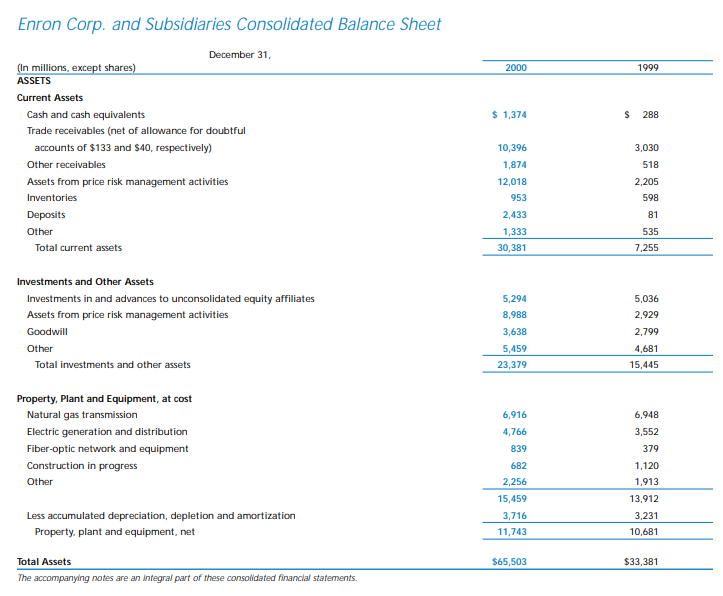
Most of the time, it is not easy to uncover because bad management has gone all out to hide stuff. I managed to find Enron's balance sheet in year 2000 online. Without hindsight, it is not easy to say things are wrong. The lines - "asset from price risk management activities" were where most of the bad was parked under, USD21bn worth of it, but management made so much effort to explain it so well that it's difficult to fault analysts for not being able to figure things out. 
Bad management will never admit that they are bad so sometimes, in the end, it really boils down to gut feel. I have written about this on various posts in the past: Billon Dollar Whale Fraud Detection Lessons and Theranos, the fraudulent startup. To jot down a few tell-tale signs:

1. Bloated balance sheet, what we have we talking about so far

2. Keep talking about importance of secrecy, trade secret and know-how, trademark protection to mask the lack of disclosure

3. Lack of governance

4. Past issues with the law, including ongoing litigation.

As a side note, companies with litigation risks should also be avoided because the cost is simply to hard to measure. We discussed BP and Bayer in the past on this infosite. Both names did not recover past their previous peaks after the litigation mess broke out. BP was the infamous Deepwater Horizon accident and Bayer was ensued in the supposedly cancer causing Roundup fertilizer class action lawsuits.

In the next and final post, we discus other lessons learnt from Security Analysis.

Huat Ah!

Friday, October 07, 2022

Lessons Learnt from 4 Biggest Losses - Part I

Most people brag about their investment wins. It is just human nature. We need to show we are better, so we get status, pride and get to lead and enjoy the benefits that get accrued to leadership in tribes. In prehistoric times, alpha males who can hunt, have muscles, can fight well tend to get the best food, the best shelter and the women and produce more offsprings and win the natural selection competition. 

As such, bragging is biological.

Alpha male primate can even get cookies!

Today, it is about money. You can be bald and fat but if you are a billionaire, then prestige and goodies and some women will come your way. So we brag about investment wins to showcase that. We buy cars, watches, houses and NFTs to display wealth. It is imperative, biologically and socially.  But what is truly and fundamentally beneficial is to learn from our losses. That is how we get better as investors. That is what this post and the next is about. 

As I look at my portfolio, there are now four big loss-making positions which I felt compelled to write about. The losses amount almost to six digits and you can imagine how it pains to write about them. But I believe there are many lessons learnt and I hope readers can really takeaway some of these so as not to repeat them. But trust me, it will be easier said than done! Here are the losers in no particular order:

1. Overseas Education, negative c.30%, I have blogged about this stock.

2. SIA Engineering, negative c.20%, pandemic victim, I have also briefly blogged about this.

3. Under Armor, negative c.70%, hit by overvaluation and the pandemic.

4. Cinema related small cap name, negative c.80%, looks like I will never recover my capital.

As I looked at the four painful names, I see similar mistakes and recurring lessons. While all four names were somewhat impacted by Covid-19, it was not just the pandemic. It was overpaying i.e. valuations, it was ignoring small cap risks and not understanding all the issues and most importantly, it was not getting the sizing right. Actually, sizing is so crucial so let's talk about that in more detail. 

What I got from Google wrt to sizing

For me, the sizing mistake relates to all four names but it had the biggest absolute damage in the first two. As such, despite the percentage loss was only 20-30%, the outsized impact on the absolute damage was big and this is the nutshell lesson about sizing:

We must size the bet such that we can still sleep if we lose 80% of the amount invested. We must also think in terms of percentage of the portfolio. In most professionally run portfolios, there are hard limits like 10% for one position but for personal accounts, we may want to size it lower depending on our own psychological construct and the amount of absolute loss we can bear.

Let's use so numbers to illustrate the above. First we must determine how much we can afford to lose in one position. I will arbitrary put that as S$40,000 which is close to half of Singapore's median household income. (Imagine when you need to tell your better half that you lost half a year's income on one stock. This should be good pyschological threshold ;) Looking at my actual losses, since a position can go down 80%, that means the maximum bet on one stock should be c.S$50,000. Of course that also depends on your portfolio. If this is more than 10% of your portfolio, then perhaps it should be smaller. 

There is also a minimum size for a position which relates to transaction costs. When I first started, round trip (buying and selling) transaction cost can cost minimally $100 which means that any position should be c.S$10,000 otherwise it doesn't make sense as it costs 1-2% every time you do some buying and selling. Well, the world has changed and transaction costs can go to zero with some brokers, but still, sometimes it's not and it pays to know what is the optimal minimal size for you.

Going back to my mistakes, if I sized the bets correctly, I could have reduce my absolute losses by half and the pain will also be halved and I would not have to endure the wrath of my better half! When you can size correctly, losses cannot hurt your portfolio and your family peace and you can sleep better at night. There is a lot more to talk about sizing which perhaps deserve its own post but let's stop here for today and we shall discuss in the next post:

1. Valuations 

2. Small cap issues

3. Unknown risks

There are two rules in investing. First rule: don't lose money. Second rule: don't forget the first rule.

Huat Ah!


Friday, September 30, 2022

2022 Australia Dividend Post - First ever!

As mentioned previously, Poems offer a good screener that is pretty sufficient for our purposes as value investors looking for good stock ideas. Today, we look at Australia, one of the most attractive and yet under-rated markets globally. Australia is the world's 18th largest economy by PPP at c.USD1.8trn which is roughly 6x larger than Singapore's. It took the record for the longest stretch of uninterrupted GDP growth in the developed world (26 years from 1991 to 2017) driven by good policies, growth of its natural resource producers and its strong financial sector. It is also a fertile hunting ground for good value and growth compounders even if we just look at large caps above USD10bn.

Criteria used for ASX's screening

I have almost always used the same criteria for screening (partly due to the limitation of the screen) and the above shows what is being used for today's Australia screen. The criteria are simply ROE at 10%, ROA at 5% and operating margins (OPM) at 10% and we generated a pretty interesting screen. I have not used traditional valuations such as PER and PBR because it will cut out interesting names such as CSL, Cochlear and Resmed etc. 

First section of 2022 ASX's screen

Valuation has evolved over the last 20 years and the way to value growth stocks might be to use Price to sales or PEG because traditional metric like PER and PBR does not work for the super growth companies we have seen like Tesla, Amazon. We also have a few of those in Australia shown on this first section. Aristocrat is one of the largest gaming machines maker and has compounded well over the last 20 years. Australia also has some of the most interesting healthcare names in the world. Cochlear is the company that invented ear implants and cure deafness. If Helen Keller was born in this era in Australia, she would be able to listen and speak. Then she may not become Helen Keller, but that's besides the point. Cochlear has the ability to ensure that no babies will be deaf since its founding, unfortunately government policies and restriction continue to inhibit this reality even though we already have the technology.

Second section of 2022 ASX's screen

The second section has James Hardie, a homebuilder that has compounded double digits for decades and Resmed, another world class healthcare company that cures sleep apnea. But what is worth highlighting today would be Woodside Petroleum. This is one of the pure LNG listed companies that has gone from strength to strength. With today's energy prices soaring, Woodside will continue to benefit. It should have been bought out by big majors but somehow it never happened. Now that is has grown to become a USD 60bn company, it might be too big to swallow, but we never know. Energy security will be ever more important. So glad I kept my global energy names all these years. 

As usual, here's the past lists:

2020 Dividend List
2019 Dividend List
2018 Dividend List - Part 4
2018 Dividend List - Part 3
2018 Dividend List - Part 2
2018 Dividend List - Part 1
2017 Oct Dividend List - Part 2
2017 Oct Dividend List - Part 1

Huat Ah!

Thursday, September 15, 2022

Charts #46: Fed's tightening

We are finally getting back to textbook's environment of risk free rate at 3% after years of QE although it remains to be seen if this can last.


Since Singapore's monetary policy imports rate from the US, do keep buying Singapore T-bills while the interest is still good!

Thursday, September 01, 2022

Singapore Treasury Bills from 1987-2022: Full Analysis

Singapore Treasury bills and bonds (T bills and bonds in short) continue to intrigue me as I studied the recent movements. Things started to get interesting around March 2022 when the US Fed started talking about hiking interest rates. The following table depicts our six month T bill movement - issue date and cut off yield, which is the yield we get when we subscribe, fortnite by fortnite (no gaming pun intended).

  • 20 Jan 0.48%
  • 3 Feb 0.69%
  • 17 Feb 0.76%
  • 3 Mar 0.78%
  • 17 Mar 0.95%
  • 31 Mar 1.22%
  • 13 Apr 1.32%
  • 27 Apr 1.56%
  • 11 May 1.69%
  • 26 May 1.8%
  • 9 Jun 2.04%
  • 23 Jun 2.36%
  • 7 Jul 2.66%
  • 21 Jul 2.93%
  • 4 Aug 2.87%
  • 18 Aug 2.98%
  • 1 Sep 2.99%
As of this writing, 6 month T bill pays 2.99%pa (1.49% over six months). This is risk free. Well, as long as Singapore stands, which I think she should for the next six months. I hope some of you subscribed as previewed in this post c.1 month ago! MAS also issues 1 year T bills but only on a quarterly basis and the latest cut off yields are as follow:
  • 13 Apr 2%
  • 21 Jul 3.1%

Singapore has one the highest home ownership in the world and as such I believe most of us reading this should have a mortgage. Given that mortgage rate is lower 2.99% (about 1.6-2.1% today), we should all draw out maximum mortgage and put into T bills, effective making free money! To illustrate this, if you can borrow at 2% and invest in this, using the 21 Jul 1 year T bill rate of 3.1%, you make 1.1% risk free with no equity. Let's use concrete no.s, say we can borrow $1m from the bank, which is not your capital since you borrowed it, then you buy the 1 year T bill and make 3.1%. After one year, you get back $1.031m, pay the bank $1.02m and voila you just made $11,000 with no capital outlay! 

Okay, you say there is duration mismatch. The mortgage can last 10, 20, 30 years, we cannot guarantee T bills will be at 3.1% for 10, 20, 30 years. The latest issue of our 10 year Gahmen bond has a cut off yield at 2.71% (see below). So technically, it is still doable. In fact, this also works if you can borrow at any kind of facility at 1-2%pa (ie lower than the cut off yield).


Now that we know this wonderful trick, the next relevant question would naturally be - so how much did our Singapore T bills yield over time? Here's the shocking conclusion. Read on. 

The MAS publishes all the data on T bills and bonds since 1987. Anyone can download all the data via the link below. The average 6 month T bill cut off yield has been 2.07% since 1987. While it has been mostly uninteresting at below 1% over the last decade or so, no thanks to QE, it did hit 3.05% in 2015 (and now 2.99%). In Jun 2000, right after the dot-com crash, it was 4.74%!  

https://eservices.mas.gov.sg/statistics/fdanet/BondTreasuryBillsCMTBsAuctions.aspx

We spent 16 years discussing on this infosite about investing, taking risk and trying to make 8%pa. We all know someone, aunties or uncles, or even our own parents rushing to banks every few months to hunt for the highest fixed deposit rate and park money there to earn 1.x%pa. But since 1987, the Singapore government provided this ultimate instrument that can make on average 2%pa and in "good times" 3-4%pa. If you can borrow at 1+%pa which most of us could, we can make free money at infinity%pa. 

So, I am shutting down this infosite, thanks for reading folks! (Young Wonder Woman saying goodbye below)

Just kidding.


Wednesday, August 17, 2022

Charts #45: Food inflation

 This chart from The Economist says it all.

Also, we are running out of raw material for our food. Malaysia's export ban of fresh chicken to Singapore was quite worrisome a few months back (see below).

Well, fortunately, we didn't reach this stage. But chicken rice no longer cost $3 and I think we are on our way to find hawker chicken rice cost as much Chatterbox's chicken rice (when it first came out).

Monday, August 01, 2022

Invest in Risk Free Singapore T Bills!

Treasury bills or T bills are short term bonds issued by the government for periods of less than 1 year. For the longest time, they only yield basis points due to global quantitative easing (QE) which has drove global interest rates to zero. But in recent weeks, yield on Singapore’s T bills has shot up with the Federal Reserve raising interest rates and our T bills now yield close to 3%! 

In financial textbooks, we always talked about the risk free rate. This usually referred to the country's ten year bond yield which was usually at 3-4% in the good old days and this was the basis of all investments because risky assets cannot yield less than the risk free rate. During the great QE over the last 12-13 years, risk free rate went to zero and hence anything yielding 1-2% becomes interesting. This was especially so when disruptive companies promised to grow to the moon, increase their revenue 100x and vowed to change the world. Speculators rushed in where value investors feared to tread.  

Now that risk free rate is back to the textbook level of 3%, there is a lot more downside for such stocks with minuscule earnings trading at 50x PER (this translates to earnings yield of 2% which is lower than the risk free rate now and hence makes no sense for value investors). So, if you want to buy Tesla's stock at current 100x PER, maybe you should buy Singapore T bills instead.

The only way it is justifiable to buy Tesla based on the risk free yield vs Tesla's earnings yield comparison is that Tesla grows its earnings more than 10x from here which means that the future PER is closer to 10x (ie earnings yield of 10%). Even so, current share price has already factored in this scenario, so Tesla has to do more than that for its market cap to go to USD2trn (another 110% upside from its current USD900bn market cap). This is not to say that it cannot be done, just very difficult. Having said that, this valuation math also didn't work when Tesla was USD100bn going to USD1trn in market cap. So speculators in Tesla did make a lot of money so far!  

T bills is a good way to park any excess cash that you have because it comes back soon, in 6 to 12 months. In Singapore, you can only buy through the three banks: DBS, OCBC and UOB and no relationship manager will recommend this because they earn nothing. The process is also deliberately cumbersome to discourage buying but you just have to push on. You will be asked to choose either competitive or non-competitive bids and a huge warning would pop up to say that if you choose non-competitive, you might lose money - which could be true with negative interest rates, but not today.

The last bid closed on 21 July and the details are in the table above. If you chose the non-competitive bid, you would have gotten 100% allocation at 2.93%, which is the cut-off yield. Non-competitive bid is 40% of each issuance and unless the amount of non-competitive bid exceeds 40% which is c.SGD2bn, most likely than not, you will get 100% allocation. As for competitive bid, you will dictate the yield you want, but risk getting nothing if your bid is higher than the cut-off yield.

Note: this is 2.93% for 12 months so you only get half the money (ie 1.465%) over 6 months.

Looking at this 6 month T bill at almost 3%pa, some of you might have figured this out - the Singapore yield curve is inverted with 6 month T bill and also the two year bond at higher yields vs the 10 year Singapore bond at 2.7% as of this writing. While the academic theory is not clear, inverted yield curve usually means that a recession is coming. This means that things can get ugly, you may not have income or you need to help someone close who needs money, so you do not know when you need cash. As such, don’t put everything into this one basket. Well, recession aside, inflation is looming and money in the bank is losing value. So if we can claw back 3%, we should seize the day! The next T bill auction closes 4 Aug. See you at the ATM!

Huat Ah!

Tuesday, July 19, 2022

Thoughts #28: Price of a Human Being

While researching for another earlier post, I found this - someone tried to calculate the price of a human being by amalgamating what each and every organ can fetch in the black market. It's USD45m according to the Medical Futurist.


We can put price tags on everything but intrinsic value is not price. The value of a human being is up to us to create and is always far greater whatever price tag whoever wants to put on.

Thursday, July 07, 2022

2022 SG Dividend List

We are at a good time to look at the annual dividend list again and as market cycle goes, we are back in the doldrums and therefore see a lot more names just in our beloved little red dot. The criteria have to be added so that we can down to a manageable list.


For the first time in a long while, I used the PE cap to limit the number of names. I put a cap at 20x meaning that any stock trading at more than 20x will be cut out. Surprisingly, I still get so many names that we need have two lists below (ranked by market cap). This year, we see a lot of property names and new names which, to be honest, I have not studied and would not be able to comment.

At the top of the market cap range, we start with Thai Beverage at close to SGD18bn market cap. I have owned this name for a while and I believe this is perhaps one of the rare compounders we can find on SGX. The numbers speak for themselves, double digits margins and double digit ROEs. I would argue that at 16x price earnings, this name is not expensive. Top Glove of Malaysia is another superb company but the numbers do look strange with ROE over 100% and dividend over 20%. That said, we know its strengths and kudos to the managers who brought the company to such global success over time. Alas, both of these strong names are not home grown Singapore companies. 


The second part of the list goes down the market cap and again, there are many unfamiliar names. But one familiar one did stand out - Bukit Sembawang. This is a well-known property play currently trading below book but with ROA at 10% and ROE at 13.5%. It also offers a decent dividend yield of 6.5%. On surface, it definitely looks like a good bargain. Perhaps someone will take them out like what happened with SPH and SPH Reit.

Next up, let's see if we can find more interesting names in the other markets!

As usual, here's the past lists:

2020 Dividend List
2019 Dividend List
2018 Dividend List - Part 4
2018 Dividend List - Part 3
2018 Dividend List - Part 2
2018 Dividend List - Part 1
2017 Oct Dividend List - Part 2
2017 Oct Dividend List - Part 1

Huat Ah!

Wednesday, June 29, 2022

SPH and SPH Reit gone!

5 July 2022 Update: Apologies for the mis-information and the anxiety that this post might have caused. While SPH is not longer around, SPH Reit is not delisted and was last traded today at $0.90. Cuscaden's chain offer would only privatize the company if it managed to buy more than 90% of outstanding shares. Since the lowball offer ($0.9372) was unattractive, it only acquired c.62%.

I have kept this post for readers who may still be interested. Will be updating on this name in the weeks ahead now that we have an actual bid at $0.9372 (which means at 15-20% discount from this price, this name will have really good margin of safety and worth taking a very close look) and there should be further developments.

Today is the last day you can trade SPH Reit. This was a stock I owned since its IPO and it is sad that I have to sell it the way I did. It was definitely not trading at my intrinsic value but I have not choice, unfortunately. In Singapore, minority shareholders continue to suffer when stocks are taken private cheaply.

For the uninitiated, the saga began around March with SPH Reit's parentco SPH embroiled in a bidding war sparked between Keppel Corp and Cuscaden Peak. Cuscaden Peak is a vehicle owned by Singapore #1 shrewd businessman Ong Beng Seng who has strong connection with Temasek. The actual shareholding is a bit complicated and I have copied the description from Shentonwire (pic below): https://shentonwire.net/2022/06/02/cuscaden-peaks-chain-offer-for-sph-reit-turns-unconditional/


To cut the story short, Cuscaden won and SPH, Singapore Press Holdings, publisher of The Straits Times, was taken private last month, ending its life as a public blue chip company on the SGX. Some shareholders took umbrage that it was taken out at SGD2.40 while most long term investors would remember this stock should be valued closer to SGD4.00, which was where it traded for donkey years.

SPH Reit was then bidded to be taken private at $0.9372 as part of a chain offer. The latest NAV of the company was $0.92 so at face value, we cannot say it was taken out at a cheap price. But, considering that rent is skyrocketing in sunny Singapore as a result of global inflation and further considering the stock's IPO price was $1 back in 2013 and the current cap rate (4.5-6%) of its five properties are pretty, which means it is not expensive (see pic below), well, I guess we have to admit Ong Beng Seng got the better bargain.

It is very difficult to have win-win transactions in life. Some people live through their lives believing it doesn't exist. Someone has to win and the other party has to lose. While that is not true, it might be so in this case. We, as minority shareholders, did not get our fair exit, with the backdrop of the current worldly state of affairs. Firstly, inflation rate is spiking and we know that properties are one of the best asset classes to own during an inflationary environment. Secondly, we all know that rents in Singapore are going through the roof, so we should see property prices soaring. 

Lastly, Paragon, the iconic Orchard property, valued at SGD2.6bn, cap rate of 4.5% seemed to be at a discount. Pre-covid, it was valued closer to SGD2.8bn. Coincidentally, the market cap of SPH Reit is also at the takeover market cap of SGD2.6bn, which means that the rest of the properties come free. Of course that is simplistic because we did not take into the account of the debt. If we do that, then we come back to the NAV of $0.92 which, gut-feel wise, also seemed cheap. 

So, are minority shareholders being short-changed?

The short answer, I would say is yes. But as a long term shareholder though, I have also benefited from collecting the c.5% dividend over the last 9 years. So this meant that I have collected 45% of my capital or c.$0.40-$0.44 which meant that I still made a decent profit selling to Ong Beng Seng at $0.9372 considering the dividend gains. It is said that more than half of long term investing gains come from dividends and in this case, that is arguably true. 

Unfortunately, for recent buyers, they might be taken out at a cheap price and there is really no good way to fight back. Perhaps Singapore needs to see its share of activist investors who can fight for minority rights and stop corporate raiders from taking listed companies out cheaply.

For interested readers, you can also read about CK Tang